The first sound I heard when I came home from war was not my wife calling my name.
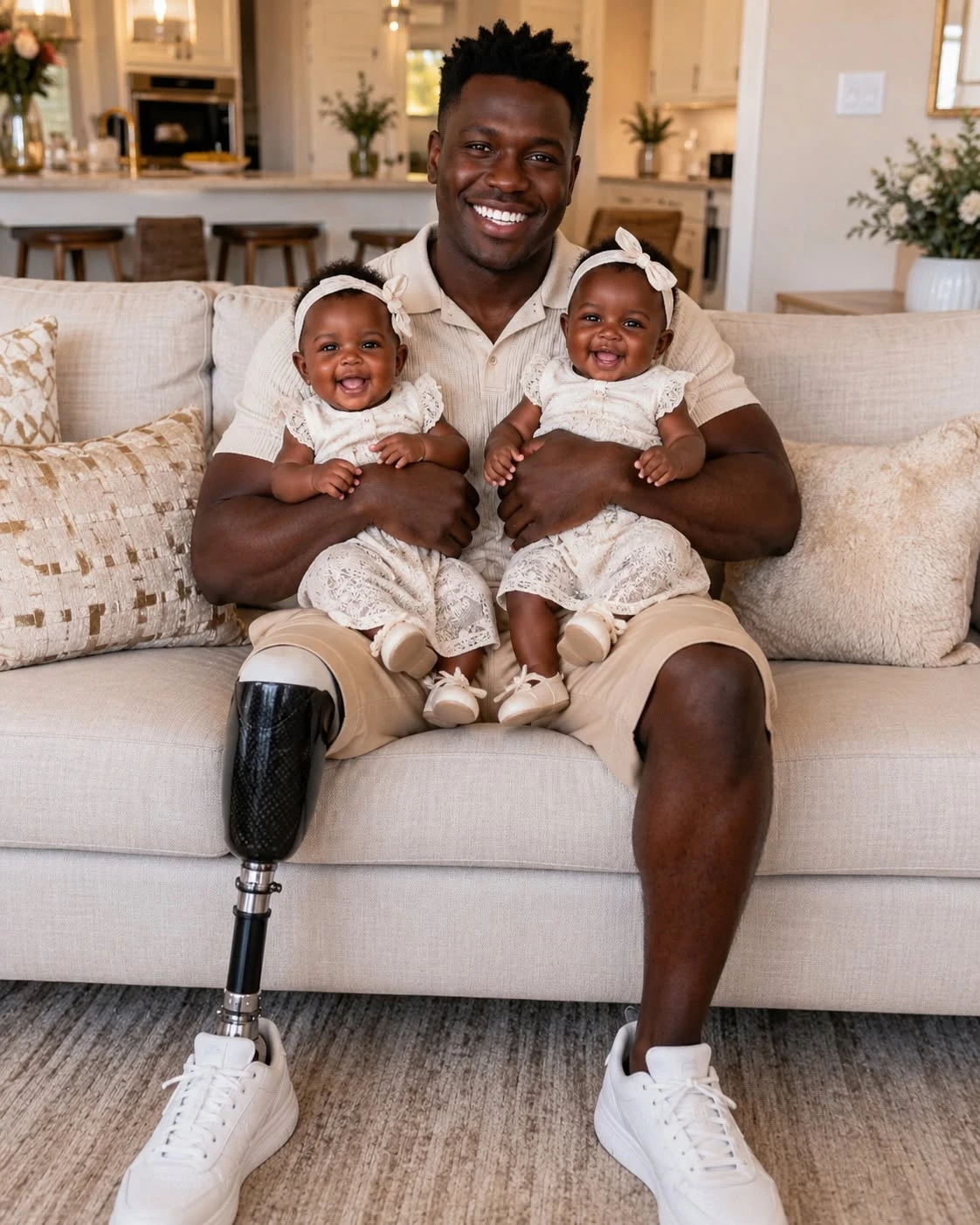
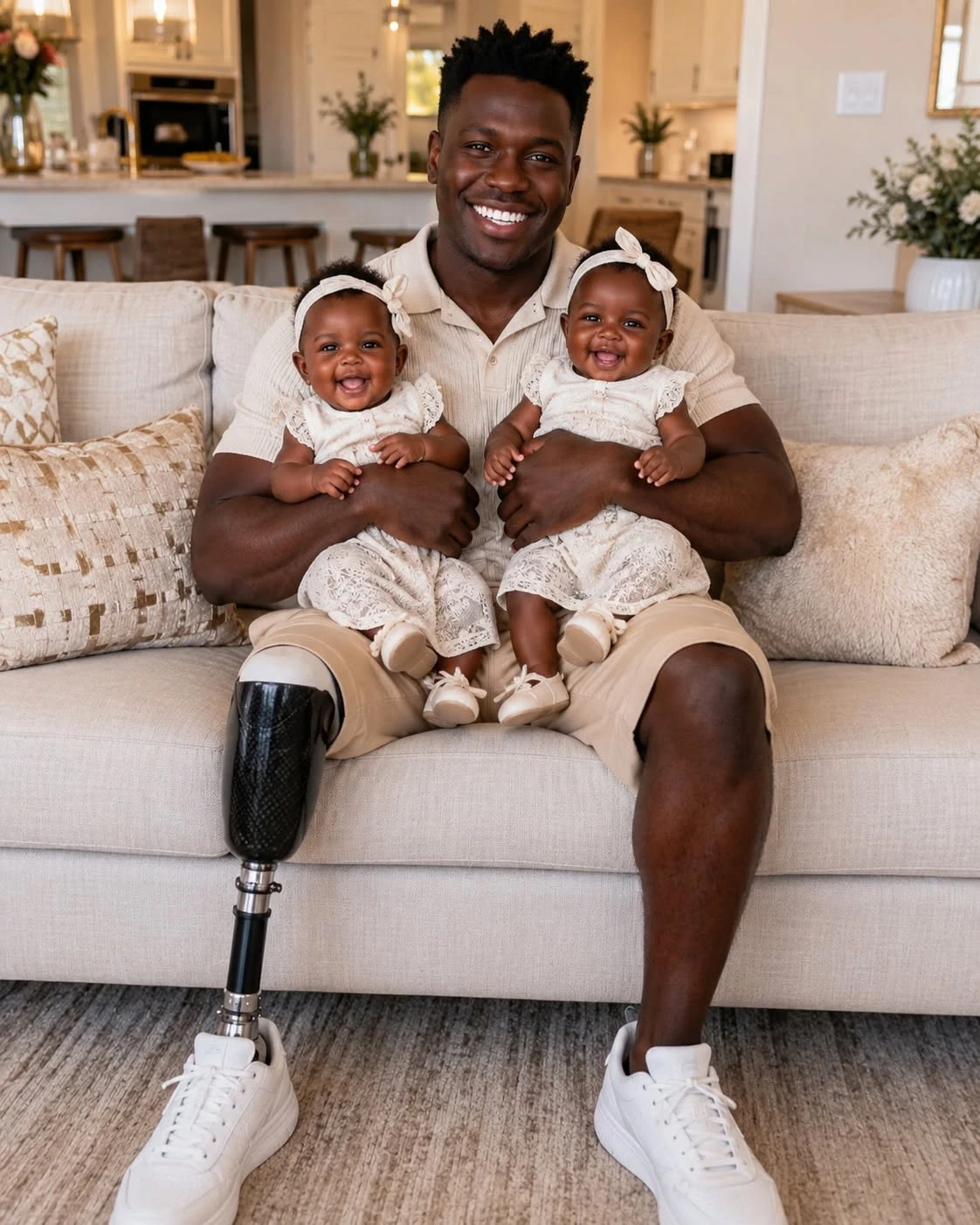
It was one of my newborn daughters screaming upstairs.
The cry tore through the empty house—thin, desperate, and hoarse from having gone unanswered too long.
I stood just inside the front door with one hand gripping my cane and the other still resting on the doorknob. My uniform felt too heavy. The prosthetic socket around what remained of my left leg burned from the flight, the drive, and the final uneven climb up our front steps.
For eleven months, I had imagined this moment.
Mara running toward me.
Her arms around my neck.
The twins sleeping against her chest.
Maybe tears. Maybe laughter. Maybe all four of us collapsing together on the living-room rug while I tried to explain why I had not warned her I was coming home early.
Instead, the living room was empty.
Not messy.
Not temporarily disorganized.
Empty.
The couch was gone. The television was gone. The framed wedding photograph that had hung above the fireplace was gone. Even the blue ceramic lamp Mara once claimed made the room feel like home had disappeared.
Pale rectangles marked the walls where pictures had been removed.
Dust outlined the places where furniture had stood.
The house did not look robbed.
It looked erased.
Then the baby screamed again.
A second cry joined the first.
My daughters.
I dropped my duffel bag.
“Mara?”
My voice sounded strange in the hollow room.
There was no answer.
I took one step toward the staircase, and the metal joint in my prosthetic leg clicked.
Then another.
The stairs seemed steeper than I remembered.
Before the explosion, I could take them two at a time. That afternoon, I dragged myself upward by the banister, trying not to fall as panic drowned out the pain in my residual limb.
“Mara!”
One of the twins shrieked until her voice cracked.
By the time I reached the landing, sweat had soaked through the back of my uniform.
The nursery door stood open.
Inside, my mother was sitting on the floor between two cribs.
She had one baby pressed against her shoulder and the other cradled awkwardly across her lap. Her silver-streaked hair had come loose from its bun. Her blouse was stained with formula. Her eyes were swollen, and her face looked twenty years older than it had during our last video call.
She looked up.
The color vanished from her face.
“Evan?”
The baby on her shoulder began wailing again.
I stared at my mother.
Then at the twins.
Then at the half-packed diaper bag near the rocking chair.
“Mom?”
She tried to stand, but her knees failed her.
I moved forward instinctively, forgetting the prosthetic, and nearly collapsed. I caught the crib rail with both hands.
May you like
They Raised a Glass to My Death on Day Ninety. I Came Downstairs Owning Their Future..105
“Where’s Mara?”
My mother looked at the floor.
“Mom.”
“I’m so sorry.”
“Where is my wife?”
She pressed her lips together as tears spilled down her cheeks.
“I’m so sorry, sweetheart.”
A coldness spread through my chest.
It was colder than the field hospital.
Colder than the moment I woke after surgery and reached beneath the blanket for a leg that was no longer there.
“Did something happen to her?”
My mother shook her head.
“Is she hurt?”
Another shake.
“Then where is she?”
My mother’s eyes moved toward the rocking chair.
A folded sheet of paper rested on the cushion.
My name was written across the front in Mara’s handwriting.
I knew every curve of those letters. I had stared at that handwriting on envelopes during deployment, tracing it with my thumb whenever I needed to remember there was still a world beyond sand, smoke, and gunfire.
I picked up the note.
My hands began shaking before I opened it.
Evan,
I can’t do this anymore.
I’m too young to waste my life taking care of babies and a broken man. I tried, but this isn’t the future I want.
Mark understands me. He can give me the kind of life I deserve.
As for the twins, you and your mother can keep them. You always wanted a family more than I did.
Don’t come looking for me.
Mara.
I read it once.
Then again.
The words rearranged themselves each time, as if there had to be another meaning hidden between them.
There wasn’t.
My wife had abandoned our three-month-old daughters.
She had left me for Mark Bennett—my oldest friend, the man who had stood beside me at our wedding and called me his brother.
And she had timed her departure so carefully that the movers had finished before I reached the door.
I lowered myself to the nursery floor.
The prosthetic leg stuck straight in front of me because I had not yet learned how to sit gracefully with it. My mother watched me with helpless terror.
“How long?”
“Two days.”
“Two days?”
“She called me from the airport,” Mom whispered. “She said she was overwhelmed and needed help. When I got here, the house was half empty. Mark’s movers were loading the last truck.”
“You saw him?”
“Yes.”
“And you let them leave?”
The accusation came out sharper than I intended.
My mother flinched.
“I begged her to stay. I begged her to take the babies. She said she didn’t want them.”
I looked toward the cribs.
One twin had a small red mark on her cheek from crying against my mother’s blouse. The other had curled her fingers around the edge of a blanket.
I had seen photographs of them.
I had watched grainy videos from a hospital bed.
But I had never held them.
I did not even know which was which.
My mother seemed to understand.
She shifted the baby from her shoulder and moved closer.
“This is Sophie,” she said. “And this is Lily.”
I took Sophie first.
My hands had carried rifles. Tourniquets. Bleeding men. Pieces of equipment heavier than she was.
Yet I was terrified I would break her.
She weighed almost nothing.
Her crying weakened as I held her against my chest. Her face was red, her mouth open in outrage and grief. Then she heard my heartbeat.
Slowly, she quieted.
Lily continued crying from my mother’s lap, so I reached for her too.
My mother hesitated.
“You need to balance—”
“Give me my daughter.”
She placed Lily in my other arm.
The twins lay against me, one on each side.
Sophie’s tiny fingers caught on a ribbon above my service medal. Lily’s cheek rested over the pocket where I had carried Mara’s letters throughout deployment.
I looked down at them.
Two daughters who had been left behind before they could understand what leaving meant.
Two babies who had lost their mother on the same day they met their father.
My vision blurred.
“I don’t know how to do this,” I whispered.
My mother knelt beside me.
“You’ll learn.”
“I can barely walk.”
“You’ll learn that too.”
“I don’t have a job lined up. I don’t know how I’m going to pay for this house. I don’t know how to feed them, bathe them, or get them to sleep.”
“You won’t learn everything tonight.”
“What if I fail them?”
My mother took my face between her hands.
“Then you fail, and you try again the next morning. That is what good parents do. They stay.”
The word settled over the nursery.
Stay.
Mara had not.
Mark had not.
Half my body felt as if it had been rebuilt from scars, screws, and anger. I could not promise my daughters wealth. I could not promise an easy life. I could not promise I would never fall.
But I could promise that.
I tightened my arms around them.
“No one will ever make you feel abandoned again.”
At the time, I thought that promise was only about Mara.
I had no idea how many other people had already abandoned my daughters before I ever carried them down those stairs.
The first year nearly destroyed me.
War had taught me how to function without sleep, but babies did not follow orders, respect schedules, or care whether their father’s leg was bleeding inside a prosthetic socket.
Sophie suffered from reflux and screamed after nearly every feeding.
Lily refused to sleep unless someone held her.
During the first month, I spent most nights on the nursery floor because getting in and out of bed with the prosthetic was too painful. I lined bottles along the wall, kept diapers within reach, and learned how to change one baby while soothing the other with my voice.
My mother stayed for six weeks.
Then her arthritis worsened, and she had to return to her apartment across town, where the building had an elevator and no stairs.
“I can move in permanently,” she offered.
“No.”
“Evan—”
“You raised me. You don’t have to raise my children.”
“You are my child.”
“And they’re mine.”
She studied my face for a long moment.
“You think accepting help means you’re weak.”
“I think you’ve already done enough.”
“No parent ever believes they’ve done enough.”
She still came every morning.
She brought groceries, folded laundry, and held the twins while I went to physical therapy. On days when the nerve pain felt like electricity burning through a foot I no longer had, she sat beside me without pretending to understand.
The military provided rehabilitation, but the disability payments barely covered the mortgage and medical expenses. Mara had emptied our joint savings before leaving. She had also taken the newer car, most of the furniture, and several pieces of jewelry that had belonged to my grandmother.
The bank did not care that I had been injured in service.
Bills still arrived.
The twins still needed formula.
The roof still leaked when it rained.
So I found work.
Before deployment, I had been trained as a mechanical systems technician. A small manufacturing company called Hartwell Agricultural Equipment hired me to inspect hydraulic assemblies.
The owner, Raymond Hartwell, was seventy-two, impatient, and allergic to pity.
During my interview, he glanced at my prosthetic leg once.
“Can you do the job?”
“Yes.”
“Can you show up on time?”
“Yes.”
“Can you tolerate stupid people?”
“Depends how many.”
He almost smiled.
“You start Monday.”
My shift began at six in the morning. I woke at four, prepared bottles, packed the twins’ bag, and drove them to my mother’s apartment. Then I worked ten hours standing on concrete until my leg felt as if it were being crushed inside a vise.
At night, I came home to crying, laundry, and silence.
There were moments I hated Mara so much I could taste it.
I hated her when Sophie developed a fever and I sat alone in the emergency room at two in the morning.
I hated her when Lily took her first steps toward me and I had no one beside me to share the joy.
I hated her when strangers asked where the twins’ mother was.
But hatred required energy.
Eventually, survival took all of mine.
I stopped searching Mara’s name online.
I stopped asking mutual friends about her.
Mark’s number had been disconnected within a week of their departure. His parents claimed they did not know where he was, but their carefully blank expressions told me they were lying.
Six months after Mara left, divorce papers arrived.
She asked for no custody and no visitation.
She also demanded half the equity in the house.
My attorney, Carla Reyes, stared at the documents in disbelief.
“She drained your accounts, abandoned two infants, and now she wants part of the house?”
“She signed the mortgage too.”
Carla leaned back in her chair.
“She’s not asking because she thinks she deserves it. She’s asking because she believes you’re too exhausted to fight.”
She was right.
I was exhausted.
But I fought.
Mara did not appear at the hearing. Her attorney represented her through video conference. She relinquished all parental rights in exchange for giving up her claim to the house and avoiding any request for child support.
The judge asked three times whether she understood what she was signing.
Each time, her answer was yes.
The final order arrived on a cold Tuesday in January.
I sat at the kitchen table with Sophie and Lily asleep in matching high chairs beside me.
The decree stated that I had sole legal and physical custody.
It also stated that Mara Cole—she had already taken Mark’s last name—had voluntarily terminated her parental rights.
I should have felt relieved.
Instead, I cried.
Not for Mara.
For the day my daughters would be old enough to read the words and understand that their mother had signed them away.
Carla sat across from me.
“You don’t have to tell them everything at once.”
“I won’t lie to them.”
“No. But truth has an age. You give children the portion they’re strong enough to carry.”
I folded the decree and placed it in a locked box.
For almost three years, that was where it stayed.
Life did not become easy.
It became ours.
I learned that Sophie hated peas but would eat anything mixed with sweet potato.
Lily loved music and danced before she could speak in full sentences.
Sophie was bold, loud, and fearless.
Lily watched people quietly before deciding whether they deserved her trust.
They both called my prosthetic leg “Daddy’s robot foot.”
On difficult mornings, Sophie decorated it with stickers.
On better mornings, Lily tried to polish it with a washcloth.
When they were two, they discovered that striking the metal ankle with a wooden spoon produced a satisfying clang. They formed what they called a “band” and followed me through the kitchen, laughing while I pretended to complain.
Their laughter filled every room Mara had emptied.
I bought secondhand furniture.
My mother sewed curtains.
Raymond Hartwell gave me overtime whenever I needed it and pretended not to notice when I fell asleep in the break room during lunch.
By the twins’ third birthday, I had been promoted to quality-control supervisor.
The raise allowed me to replace the leaking roof.
For the first time since coming home, I began to believe we were safe.
Then Raymond summoned me to his office.
His office overlooked the factory floor. Framed photographs of tractors, workers, and his late wife covered the walls. A photograph of a younger Raymond standing beside a dark-haired boy rested on the corner of his desk.
I had seen the picture before.
I had never asked about it.
“Close the door,” Raymond said.
I sat down.
He did not.
He stood by the window with both hands behind his back.
“How old are your girls now?”
“Three.”
“And you’ve never heard from their mother?”
“No.”
“Not once?”
“No.”
He nodded as though confirming something.
Then he placed a large envelope on the desk.
My name was written across it.
“What’s this?”
“Something I should have given you sooner.”
A familiar coldness entered my chest.
“Is this about Mara?”
Raymond looked at the photograph on his desk.
“It’s about Mark.”
I did not touch the envelope.
“How do you know Mark?”
“He was my son.”
The factory noise seemed to disappear.
I looked at Raymond.
Then at the photograph.
The boy beside him was younger, perhaps seventeen, but there was no mistaking the narrow face and confident smile.
Mark Bennett.
My best friend.
The man who had betrayed me.
“Your son?”
“Biologically.”
“His last name was Bennett.”
“His mother’s name. She took him away when he was nine.”
I stood too quickly. Pain shot through my residual limb.
“You knew who I was when you hired me.”
“Yes.”
“You knew he left with my wife.”
“Yes.”
“And you said nothing?”
Raymond’s face tightened.
“I did not know where they had gone. Mark had cut contact with me years earlier.”
“Why hire me?”
“Because you were qualified.”
“Don’t insult me.”
Raymond’s jaw moved.
“Because I knew what my son had done to you, and I could not undo it.”
I turned toward the door.
“Evan, open the envelope.”
“I don’t want anything from you.”
“It isn’t money.”
“I don’t care.”
“It’s about your daughters.”
I stopped.
Every muscle in my body went rigid.
“What about them?”
Raymond sat slowly.
“Two months ago, I received a letter from an attorney in Denver. Mark died last year.”
The words should have brought satisfaction.
They didn’t.
They brought nothing.
“How?”
“His car went off a mountain road during a storm.”
“Was Mara with him?”
“No.”
“Then why does this concern my children?”
Raymond pushed the envelope toward me.
“Because Mark left a will.”
I laughed once, without humor.
“And he left something to the babies he helped abandon?”
“Not exactly.”
I opened the envelope.
Inside were copies of legal filings, a death certificate, a trust document, and a letter signed by a law firm.
Halfway down the first page, I saw the twins’ names.
Sophie Grace Mercer.
Lily Rose Mercer.
Both names appeared under a heading that made my breathing stop.
BENEFICIARIES.
I read the sentence below it twice.
Upon the death of Marcus Daniel Hartwell, all controlling interest in Hartwell Agricultural Equipment and associated real-estate holdings shall transfer in equal shares to Sophie Grace Mercer and Lily Rose Mercer, subject to confirmation of biological relationship.
I looked up.
“What biological relationship?”
Raymond’s eyes filled with something that looked like shame.
“Mark claimed he was their father.”
The room tilted.
“No.”
“He stated it in the trust.”
“No.”
“He included private paternity results.”
“No.”
I shoved the papers away.
“Mara was my wife.”
Raymond did not answer.
“She told me the twins were mine.”
“I know.”
“They were conceived while I was home on leave.”
“Were they?”
I reached across the desk and seized his shirt.
The movement knocked over the framed photograph.
“You don’t get to ask me that.”
Raymond did not resist.
“Evan, I am not trying to take them from you.”
“They are my daughters.”
“Yes.”
“Say it.”
“They are your daughters.”
“Then tell me this is a lie.”
“I can’t.”
I released him and stepped backward.
My prosthetic heel caught the leg of the chair. I fell hard against the wall.
Raymond moved toward me.
“Don’t touch me.”
He stopped.
I picked up the paternity report.
The laboratory name was legitimate.
The report listed Mark as the alleged father and claimed a 99.98 percent probability of biological paternity based on samples labeled Sophie M. and Lily M.
The collection date was six weeks before Mara left.
My mouth went dry.
“How did he get samples?”
“A cheek swab would have been enough.”
“Mara.”
“Yes.”
I stared at the pages.
Memories I had protected began turning against me.
Mara becoming distant during my final deployment.
Mark visiting often “to help with the house.”
The way he joked that the twins had his eyes.
A joke I had laughed at.
A joke that had not been a joke.
I dropped into the chair.
“All this time…”
Raymond’s voice softened.
“Biology does not change who raised them.”
“It changes what she did.”
“Yes.”
“She didn’t just leave me for him. She had been with him before they were born.”
“Yes.”
“And he abandoned his own children?”
Raymond looked away.
“That is what I believed.”
“Believed?”
“There’s more.”
He removed another document from his desk drawer.
“This is not the only paternity test.”
I stared at him.
“A probate judge ordered new testing because the original samples could not be independently verified. The executor obtained DNA from Mark’s stored medical tissue and requested legal samples from the girls.”
“Nobody tested my daughters.”
“Not yet. The petition was sent to an old address and returned. The attorney contacted me because I am Mark’s surviving biological parent. I recognized their names.”
“Then the trust isn’t final.”
“No.”
“What happens now?”
“You can refuse testing, but the trust will remain in litigation. If the girls are Mark’s biological children, they inherit my company when I die, along with the assets Mark held separately.”
“And if they aren’t?”
“Everything returns to me.”
I studied his face.
“You want the test.”
“I want the truth.”
“You want heirs.”
“I want to know whether those girls are my granddaughters.”
The word struck like a blow.
“Don’t call them that.”
Raymond nodded.
“That was unfair.”
I gathered the documents.
“What’s the value?”
He hesitated.
“The company, properties, investments, and insurance total approximately $48 million.”
I almost laughed.
For three years, I had counted coupons for formula while Mark lived in luxury.
For three years, I had worked through pain while Mara traveled with the man who might have fathered my daughters.
Now a fortune had appeared inside an envelope, attached to a betrayal I had never known existed.
I looked again at the beneficiaries’ names.
Something about the documents bothered me.
Not the amount.
Not the paternity claim.
The date.
Mark had signed the trust eight months after he left with Mara.
If he believed Sophie and Lily were his daughters, why had he left them behind?
Why had he waited eight months to name them?
And why had Mara never tried to claim the money after his death?
“When did Mara learn Mark was dead?”
“Immediately. She was listed as his spouse.”
“Then why didn’t she contact the executor about the twins?”
Raymond’s expression changed.
“That is the question no one has been able to answer.”
I did not tell my mother that night.
I did not sleep either.
I sat in the twins’ room and watched them breathe.
Sophie had kicked off her blanket.
Lily slept curled around a stuffed rabbit with one ear.
I searched their faces for Mark.
I hated myself for doing it.
Sophie had dark hair like Mara.
Lily had my mother’s chin—or perhaps I had only convinced myself she did.
At three years old, they trusted me completely.
To them, fatherhood was not blood.
It was pancakes shaped like stars.
It was bedtime stories read with different voices.
It was a hand waiting when they fell.
Yet the documents had reopened every wound I believed had scarred over.
Around midnight, Lily stirred.
“Daddy?”
“I’m here.”
She sat up, hair tangled around her face.
“Bad dream.”
I lifted her from the bed and placed her on my lap.
“What happened?”
“Mommy went away.”
My throat tightened.
The twins had recently begun asking about mothers after starting preschool. They saw mothers at pickup. They saw mothers in books. They had noticed the missing shape in our family.
“Which mommy?”
“The book mommy. She went in the forest.”
I exhaled.
“In the story, she came back.”
Lily pressed her face against my chest.
“You come back.”
“Always.”
“Promise?”
I kissed the top of her head.
“I promise.”
She fell asleep in my arms.
At dawn, I called Carla Reyes.
By noon, she was reading the documents in her office.
“This original paternity report could be fabricated,” she said.
“It came from a real lab.”
“Real labs can receive fraudulent samples. The names on labels do not prove who provided the DNA.”
“So we test them again?”
“Before we do anything, we investigate.”
“What is there to investigate?”
“Everything.”
She placed Mark’s trust beside the death certificate.
“Why did a man who abandoned two infants create a trust worth millions for them eight months later? Why didn’t he seek custody? Why didn’t Mara pursue the inheritance? Why did she disappear after his death? And why did Raymond Hartwell wait until now to show you this?”
“He said the attorney only contacted him recently.”
“Maybe.”
“You don’t trust him?”
“I’m an attorney. Trust is what people ask for when evidence is inconvenient.”
She tapped the trust.
“This document does not merely make the girls beneficiaries. It gives them controlling interest in a private company. That could destroy Raymond’s ability to sell, merge, or restructure the business.”
“He’s seventy-two.”
“Which means succession matters.”
“He could challenge it.”
“He is challenging it through paternity.”
I leaned forward.
“You think he hired me because he knew this was coming?”
“I think we should avoid assuming that a wealthy man kept you close for three years out of guilt.”
The thought made my stomach turn.
“What do we do?”
“We obtain the probate file. Mark’s medical records. The police report from his death. His marriage records. Financial statements. Communications with Mara. And the original laboratory chain of custody.”
“That could take months.”
“Truth usually does.”
“I know where Mara lives.”
Carla looked up.
“How?”
“Her address is listed in one of the probate notices.”
“Do not go there.”
“She lives less than two hours away.”
“Evan.”
“She abandoned my daughters and lied about who their father was.”
“Which is exactly why confronting her without preparation is dangerous.”
“I’m not afraid of her.”
“I’m not worried she’ll hurt you physically. I’m worried she’ll manipulate the situation, destroy evidence, or claim harassment.”
I stood.
“I need to see her face.”
“No. You need to protect the girls.”
Those words stopped me.
Carla gathered the documents.
“Give me one week.”
I gave her five days.
On the sixth morning, a process server arrived at my house.
The envelope contained an emergency petition filed by Mara.
She was seeking immediate custody of Sophie and Lily.
For three years, she had not sent a birthday card.
She had not asked whether they were healthy.
She had not requested a photograph.
But within days of learning that the twins might inherit $48 million, Mara suddenly remembered she was their mother.
Her petition painted a different history.
She claimed she had suffered severe postpartum depression.
She claimed I had been emotionally volatile after returning from service.
She claimed my mother had pressured her into surrendering parental rights while she was medically vulnerable.
She claimed she now regretted leaving and had spent years undergoing therapy.
She also claimed the twins were Mark’s biological children and that, as their surviving parent, she should manage their inheritance.
I read the filing at the kitchen table.
Each lie was polished enough to sound plausible.
Carla paced near the window.
“She moved quickly.”
“How did she know we found the trust?”
“The probate court may have notified her that Raymond located the beneficiaries.”
“She wants the money.”
“Probably.”
“Probably?”
“We prove motive with evidence, not anger.”
“She called me a broken man.”
“The note helps us.”
“She signed away her rights.”
“She’ll argue incapacity.”
“The judge questioned her three times.”
“And we have the transcript.”
I looked toward the living room, where the twins were building a tower with wooden blocks.
“What happens to them?”
“Nothing immediately. Her rights were terminated by final order. She faces an enormous burden to reopen that judgment.”
“But she can try.”
“Yes.”
The doorbell rang.
My mother answered before I could stand.
A woman waited on the porch.
She wore a cream coat, dark sunglasses, and heels too narrow for the cracked walkway. Her hair was longer than I remembered, swept over one shoulder in glossy waves.
For one second, I did not recognize her.
Then she removed the sunglasses.
Mara.
My mother went completely still.
“You have no right to be here,” Mom said.
“I came to see my children.”
“They aren’t your children.”
Mara’s gaze moved past her and found me.
“Hello, Evan.”
The sound of my name in her voice pulled me backward three years.
Back to the empty house.
Back to the note.
Back to my daughters screaming in their cribs.
I moved between Mara and the living room.
“Leave.”
She looked down at my prosthetic leg.
Her expression flickered.
Not disgust.
Not pity.
Calculation.
“You look well.”
“Leave.”
“I know you’re angry.”
“You abandoned two infants.”
“I was sick.”
“You emptied our bank account.”
“Mark handled the finances.”
“You took the furniture.”
“I wasn’t thinking clearly.”
“You wrote that you were too young to waste your life on a broken man.”
Tears gathered in her eyes with impressive speed.
“I don’t remember writing that.”
My mother made a sound of disbelief.
Mara looked toward the living room.
“Are they here?”
I blocked her view.
“You will not go near them.”
“I am their mother.”
“You signed that away.”
“I was manipulated.”
“By whom?”
“Mark.”
The name altered the air.
Mara lowered her voice.
“He controlled me.”
“You left me for him.”
“He lied to me.”
“You betrayed me before the twins were born.”
Her face went pale.
“So Raymond told you.”
“Are they Mark’s?”
She looked past me toward Carla, who had stepped into the hallway.
“Who is she?”
“My attorney,” I said.
Mara’s tears disappeared.
“I came to speak privately.”
“You filed for custody.”
“I had no choice.”
“You had three years.”
“I was trying to survive.”
“In a mansion?”
Her mouth tightened.
“The house belongs to Mark’s estate.”
“And the twins are worth $48 million.”
She slapped me.
The strike was so sudden that my mother gasped.
I did not move.
Mara stared at the red mark forming on my cheek as though she had surprised herself.
Then Sophie appeared in the hallway.
“Daddy?”
Mara froze.
Sophie wore purple pajamas covered in stars. She held one wooden block in her hand.
Lily stood behind her.
For the first time in three years, Mara saw the daughters she had abandoned.
Her lips parted.
The twins studied her with solemn curiosity.
Mara took one step forward.
“Sophie?”
Sophie moved behind my leg.
Mara looked at Lily.
“My babies.”
Lily gripped her sister’s hand.
“Who are you?”
Mara’s face crumpled.
Whether the pain was real or performed, I could not tell.
“I’m your mommy.”
Sophie frowned.
“We don’t have one.”
The words were not cruel.
They were simply true.
Mara covered her mouth.
I opened the front door.
“Get out.”
“Evan, please.”
“Any communication goes through Carla.”
“I can explain.”
“Then explain under oath.”
She looked once more at the girls.
“I never stopped loving you.”
Sophie whispered to Lily, “That lady is crying.”
I stepped aside.
Mara walked out.
Before reaching her car, she turned.
“There are things you don’t know about Mark.”
“I know enough.”
“No,” she said. “You don’t even know why he chose your daughters.”
Then she drove away.
The custody hearing was scheduled for six weeks later.
During those six weeks, every part of my life became evidence.
A court-appointed evaluator inspected our home.
Teachers were interviewed.
Medical records were requested.
My combat-related trauma became a topic for strangers to examine.
Mara’s attorneys argued that my prosthetic limitations made caring for twins difficult.
They questioned whether my mother’s age created instability.
They requested psychological testing based on my military service.
Carla warned me not to react.
“They want anger,” she said. “They need you to become the dangerous veteran in their story.”
“I’m not dangerous.”
“I know. But people believe patterns they recognize. Their pattern is injured soldier, trauma, rage. Do not give them a single frame that fits.”
So I answered every question.
I allowed inspectors into the home.
I submitted to evaluations.
I described nightmares I had not discussed with anyone.
I explained how I carried two sleeping children upstairs when phantom pain made me nauseated.
I provided records of every pediatric appointment, every preschool payment, every therapy session, every bottle of antibiotics.
Mara submitted photographs of herself in therapy offices.
She produced a psychiatrist who diagnosed her retrospectively with severe postpartum depression.
She showed the court a nursery prepared in her mansion: twin beds, matching lamps, expensive toys, and framed photographs enlarged from images she had taken from my social media.
She had built a perfect room for children who did not know her.
Then Carla received the probate records.
We met after the twins were asleep.
She spread the documents across my dining-room table.
“Mark amended the trust three times,” she said.
“The twins were always beneficiaries?”
“No. That’s where this becomes interesting.”
She showed me the first version.
It left everything to Mara.
The second version, signed four months later, divided the estate between Mara and a charitable foundation.
The third and final version removed Mara entirely and named Sophie and Lily as sole beneficiaries.
“Why?”
“The amendment was signed six days before Mark filed for divorce.”
I stared at her.
“He was leaving Mara?”
“Yes.”
“Did the divorce happen?”
“No. He died eleven days after filing.”
The timeline settled into place.
Mark intended to divorce Mara.
He removed her from his estate.
Then he died.
“Was his death really an accident?”
“The police ruled it accidental.”
“But?”
“But the vehicle’s brake line had been serviced three days earlier at a garage owned by a company connected to Mara’s current attorney.”
I looked up.
“That can’t be coincidence.”
“It may be. We do not make accusations without proof.”
“What else?”
Carla slid a photograph across the table.
It showed Mark’s wrecked sports car below a mountain road. The front end had been crushed against trees.
“Investigators found a second phone in the vehicle. It was damaged but recently recovered during probate discovery.”
“What was on it?”
“Messages between Mark and someone saved under the name Sparrow.”
“Who is Sparrow?”
“We don’t know. But the messages discuss the twins.”
She handed me printed transcripts.
Mark: She still believes the original story.
Sparrow: Does Evan know?
Mark: No. He can never know unless something happens to me.
Sparrow: You should tell him.
Mark: If I do, Mara will run.
Sparrow: The girls deserve the truth.
Mark: The girls deserve Evan. He’s the only one who ever loved them without wanting something.
I read the final line again.
“What original story?”
“We don’t know.”
“Did Mark know I was raising them?”
“Yes.”
“He could have contacted me.”
“Maybe he was afraid of Mara.”
“He stole my wife and left me with two babies.”
“Or that may not be the whole story.”
I pushed away from the table.
“Don’t defend him.”
“I’m not.”
“You didn’t know him.”
“Neither did you, apparently.”
The words hurt because they were true.
Carla softened her voice.
“The last message was sent the night before his death.”
She pointed to the page.
Mark: I made the amendment. If she does what I think she’ll do, the trust will bring everything into court.
Sparrow: That could take years.
Mark: It only has to bring Evan to the document.
Sparrow: And then?
Mark: He’ll ask the right question.
I looked at the trust.
“What question?”
Carla leaned forward.
“Why would Mark need a fraudulent paternity claim to give your daughters his company?”
I went still.
“He could simply name them beneficiaries.”
“Exactly.”
“So why include the paternity report?”
“To force verification.”
“But the verification would prove they weren’t his.”
“Unless that was the point.”
The room seemed to contract around us.
“You think Mark knew the report was false.”
“I think Mark wanted someone to conduct a legally supervised DNA test after his death.”
“Why?”
Carla looked directly at me.
“Because the test might reveal something else.”
The court approved genetic testing.
Samples were collected from Sophie and Lily under supervision.
Mark’s DNA profile came from preserved hospital tissue.
Raymond provided his own sample to verify the family line.
At Carla’s suggestion, I provided mine too.
The laboratory estimated ten business days.
They were the longest ten days of my life.
Mara’s attorneys objected to my inclusion, arguing that my paternity was irrelevant to the trust.
The judge allowed it because my legal relationship to the children was central to the custody case.
During the wait, Mara called from an unknown number.
I nearly declined.
Then I answered.
“What?”
“You submitted your DNA.”
It was not a question.
“Yes.”
“You shouldn’t have.”
My grip tightened around the phone.
“Why?”
“You’re going to misunderstand the results.”
“That sounds like something said by a person who already knows what they are.”
“I wanted to tell you in person.”
“You came to my house and told the girls you were their mother.”
“I am their mother.”
“Biologically?”
Silence.
“Mara.”
“I gave birth to them.”
“That wasn’t my question.”
Her breathing changed.
“Mark ruined everything.”
“Mark is dead.”
“He wanted to punish me.”
“For what?”
“For leaving.”
“You left him?”
“He was divorcing me.”
“Why?”
“Because he became obsessed with the past.”
“What past?”
“You and him. Your childhood. His father. All of it.”
I struggled to follow.
“What does Raymond have to do with this?”
Mara began crying.
“Evan, I was twenty-nine. I was terrified. You were overseas, and then they said you might not survive. Mark told me I would be alone with two babies and a disabled husband. He said he could protect me.”
“So you slept with him.”
“Yes.”
The admission landed differently now.
Less like a blade.
More like confirmation of an old scar.
“Were the twins conceived during the affair?”
“I thought so.”
“You thought?”
“Mark arranged the test.”
“The fraudulent test.”
“I didn’t know it was fraudulent then.”
“Why fake it?”
“Because he wanted me to leave with him.”
“And abandon the girls?”
“No.”
Her answer came too fast.
“No?”
“He told me we would come back for them after you were settled.”
I laughed in disbelief.
“You left a note saying I could keep them.”
“Mark wrote most of it.”
“But you signed it.”
“I was afraid.”
“You keep saying that as though fear erases decisions.”
“You don’t know what he was capable of.”
“Then tell me.”
She was silent for so long I thought the call had dropped.
Finally, she whispered, “Mark knew those babies were never mine to keep.”
My skin prickled.
“You gave birth to them.”
“Yes.”
“What are you talking about?”
“I can’t explain on the phone.”
“You will explain now.”
“I made a mistake before you deployed.”
“The affair?”
“No.”
Her voice broke.
“The clinic.”
“What clinic?”
“The fertility clinic.”
I stopped breathing.
Mara and I had struggled to conceive for two years before my final deployment. We had undergone testing, hormone treatments, and one failed round of in vitro fertilization. Insurance had refused to cover another cycle.
Three months before deployment, Mara told me she had become pregnant naturally.
Twins.
A miracle, we called it.
“What did you do?”
“I wanted a baby.”
“We both did.”
“But you were leaving. The doctor said your sperm count had worsened. The clinic still had frozen embryos from our cycle, but they were rated low-quality. The transfer would cost money we didn’t have.”
My heartbeat pounded in my ears.
“Go on.”
“Mark offered to pay.”
“Why would Mark pay for our fertility treatment?”
“He said it was a loan.”
“Go on.”
“I signed the forms.”
“What forms?”
“I don’t know. Consent forms. Storage forms. Transfer authorization.”
“You signed without reading them?”
“I was desperate.”
“What did the clinic transfer?”
“I thought they were our embryos.”
My knees weakened.
I sat down.
“You thought?”
“After the girls were born, Mark told me there had been a mix-up.”
“What kind of mix-up?”
“He said our embryos had failed.”
The room became very quiet.
“What was transferred into you, Mara?”
She began sobbing.
“I don’t know.”
“What was transferred?”
“Embryos belonging to someone else.”
The genetic results arrived the next morning.
Carla insisted we open them in her office.
The report confirmed that Mark was not Sophie or Lily’s biological father.
Raymond was not their grandfather.
Mara was not their biological mother.
And I was not their biological father.
I stared at the page until the letters blurred.
No biological relationship detected.
Four words.
Four words that seemed to erase the entire foundation of my life.
Carla reached across the desk.
“Evan.”
I pulled my hand away.
“They’re not mine.”
“They are yours.”
“You know what I mean.”
“Yes.”
“Then say it.”
“You are not their biological father.”
The sentence cut deeper when spoken aloud.
I bent forward, pressing both palms against my eyes.
“They don’t have any of me.”
“They have three years of you.”
“That isn’t the same.”
“No,” Carla said. “It’s more.”
I looked up angrily.
“Don’t give me a speech.”
“I’m giving you the law. You are their legal father. Mara’s rights were terminated. Biology does not undo the custody order.”
“But whoever created those embryos—”
“May have claims, depending on the circumstances.”
The horror of it widened.
Somewhere, two people might have spent three years believing their embryos were lost.
Somewhere, a family might be searching for children I had promised never to lose.
“What happens now?”
“We identify the clinic records.”
“Mara knows.”
“She knows part of it.”
“Then we make her tell us everything.”
The probate trust had achieved what Mark intended.
It had brought us to the document.
It had forced the test.
And the test had exposed the real secret.
But it still did not explain why Mark had structured everything around Sophie and Lily.
Carla turned to the second page.
“There’s another finding.”
I looked at her.
“The twins are not full siblings.”
For a moment, I did not understand.
“They’re twins.”
“Gestational twins. They were carried during the same pregnancy, but the DNA indicates they came from embryos created by different biological parents.”
“That can happen?”
“If two separate embryos were transferred.”
“So Sophie belongs to one family and Lily to another?”
“Possibly.”
My stomach twisted.
Even their bond, the one thing I had believed no document could divide, now faced a threat.
“They can’t separate them.”
“No one has asked to.”
“Yet.”
Carla closed the file.
“We find the records before Mara’s attorneys do.”
But Mara already had them.
That afternoon, she submitted an amended custody petition.
Attached were fertility-clinic documents and a sworn declaration.
She claimed she had recently discovered that the twins resulted from embryos mistakenly transferred at the Caledon Center for Reproductive Medicine.
She argued that because neither I nor she was biologically related to the children, the original custody order had been based on mutual mistake.
She asked the court to appoint her temporary guardian while biological parents were located.
She also asked to administer the Hartwell trust on the twins’ behalf.
Even after learning that the paternity claim was false, she still wanted control of the money.
Her strategy was clear.
If she could not reclaim the twins as their mother, she would position herself as the woman who carried them.
The custody case became national news when a court clerk leaked part of the filing.
Headlines appeared online.
VETERAN FATHER RAISING EMBRYO-MIX-UP TWINS.
$48 MILLION INHERITANCE AT CENTER OF CUSTODY WAR.
TWO FAMILIES MAY HAVE LOST BIOLOGICAL CHILDREN.
Reporters parked outside my house.
Strangers debated whether I was a “real father.”
Some called me a hero.
Others said the children belonged with their biological families.
The twins were three years old.
They did not understand why cameras waited at the end of the driveway.
They only understood that preschool had been canceled and Daddy looked tired.
One night, Sophie climbed onto the couch beside me.
“Are we in trouble?”
“No.”
“Why are people outside?”
“They’re curious.”
“About us?”
“Yes.”
“Why?”
I looked at Lily, who sat on the carpet lining up toy animals.
Because you may belong to someone else.
Because your mother carried you but did not create you.
Because your father raised you but did not create you either.
Because adults made decisions before you were born, and now everyone thinks blood gives them the right to rearrange your lives.
Instead, I said, “Because our family is unusual.”
Sophie considered this.
“Because of your robot foot?”
I laughed despite everything.
“Maybe a little.”
She rested her head against my shoulder.
“I like our family.”
“So do I.”
“Lily stays here?”
I looked at her sharply.
“Why would you ask that?”
She pointed toward the muted television, where a photograph of the twins appeared beside the headline EMBRYO ERROR MAY SEPARATE SISTERS.
My chest tightened.
“Lily stays with us.”
“Promise?”
I looked at both girls.
The promise felt larger than any promise I had made before.
“No one is separating this family.”
Carla traced the fertility records to a private clinic that had closed eighteen months earlier after its medical director, Dr. Adrian Vale, disappeared.
Not retired.
Disappeared.
The clinic’s archived records had been sold to a medical-storage company, but several years of files were missing—including the year of Mara’s transfer.
Mark’s recovered phone provided the next clue.
“Sparrow” was not a lover, employee, or attorney.
Sparrow was a nurse named Elena Price.
She had worked at Caledon.
Carla found her living in a small town in Oregon under her married name.
Elena refused to speak over the phone.
So I flew to Oregon.
It was the first time I had left the twins overnight since coming home.
My mother stayed with them. Sophie demanded I video call before bed. Lily made me promise three times that I was coming back.
Elena lived in a modest house overlooking the ocean.
She was in her late forties, with tired eyes and hands that never stopped moving. She twisted a napkin between her fingers as we sat in her kitchen.
“You look like him,” she said.
“Mark?”
“No. Your father.”
I stared at her.
“My father died when I was twelve.”
“I know.”
“How did you know him?”
She glanced at Carla, who sat beside me.
“Because your father helped establish Caledon.”
I almost stood.
“My father was an electrician.”
“That was what he told your family.”
Elena opened a metal box and removed a photograph.
It showed my father, Thomas Mercer, standing beside Dr. Adrian Vale and Raymond Hartwell.
The picture had been taken outside the newly opened clinic.
My father looked younger than I remembered.
Raymond’s presence made my blood run cold.
“What is this?”
“Caledon was not originally a fertility clinic,” Elena said. “It began as a private genetic-research center.”
“What kind of research?”
“Embryo selection. Hereditary-disease prevention. Experimental mitochondrial replacement. Some of it was legal. Some of it operated in areas where the law had not caught up.”
“And my father?”
“He designed secure systems and data infrastructure. Later, he became responsible for protecting patient identities.”
“My father fixed electrical lines.”
“He did that too.”
I pushed the photograph away.
“What does this have to do with Sophie and Lily?”
Elena folded her hands.
“Everything.”
She explained that Caledon maintained two operations.
The public clinic treated ordinary fertility patients.
The private program served wealthy families willing to pay for experimental procedures unavailable elsewhere.
Raymond Hartwell had funded much of the research.
Dr. Vale controlled the medical program.
My father discovered that Vale had begun switching embryos, falsifying consent forms, and using patients as unwitting carriers.
“Why?”
“At first, research,” Elena said. “Later, leverage.”
“Leverage?”
“Wealthy clients paid to hide genetic heirs, bypass surrogacy laws, or produce children without public records connecting them. Vale kept copies of everything. Births became insurance policies.”
“Blackmail.”
“Yes.”
“What did my father do?”
“He copied the records and threatened to expose the program.”
“My father died in a car accident.”
Elena looked at me.
“No. Your father was killed.”
The kitchen seemed to tilt.
“The police said a drunk driver crossed the center line.”
“The other driver worked for a security company owned by Raymond Hartwell.”
I turned to Carla.
She had gone very still.
“You knew?”
“No.”
I looked back at Elena.
“Raymond killed my father?”
“I cannot prove he ordered it. But Thomas was dead two days after confronting Raymond and Vale.”
My hands curled into fists.
“And Mark knew?”
“Not until recently. He found files among Raymond’s private papers.”
“That’s why he created the trust.”
“Yes.”
“Why my daughters?”
Elena’s face tightened.
“Because the embryos transferred to Mara came from Caledon’s private program.”
“Whose embryos?”
“One belonged to a couple who had been told their daughter’s embryo was genetically abnormal and destroyed.”
“And the other?”
She looked toward the ocean.
“Elena,” Carla said quietly.
“The other was created using an egg from Mara.”
I stopped.
“The DNA says Mara isn’t Lily or Sophie’s mother.”
“The egg was altered through mitochondrial replacement. Depending on the testing method, the primary nuclear DNA would not match Mara if her egg’s nucleus had been removed.”
I struggled to understand.
“Then whose DNA would it carry?”
“The nuclear DNA came from the intended mother. Mara’s egg provided healthy mitochondrial material.”
“So Mara contributed something.”
“Yes, but not in the conventional way.”
“Which twin?”
“I don’t know.”
“And the father?”
Elena looked directly at me.
“The father was you.”
I laughed once because the alternative was screaming.
“The test says I’m not related to either girl.”
“Because the report you received compared standard autosomal markers.”
“That is how paternity testing works.”
“Unless the embryo was modified using donor genetic material at the nuclear level.”
Carla leaned forward.
“Are you claiming one child was produced through germline editing?”
“I’m saying Vale attempted it.”
The room went silent.
“This is impossible,” I said.
“It was experimental, unethical, and illegal. But not impossible.”
“Where would they get my genetic material?”
“Your father stored cord blood and tissue samples from you as a child. You had a hereditary muscular disorder marker.”
I remembered years of childhood tests. Doctors. Needles. My father telling me it was routine.
“The marker never caused symptoms,” Elena continued. “Vale later used your stored cells in an experimental process designed to correct it before embryo development.”
“You’re saying one of my daughters was created from my cells without my knowledge?”
“Yes.”
“Which one?”
“I don’t know.”
“Why transfer her to Mara?”
“Because Vale recognized her name when she came to the clinic. He knew she was married to Thomas Mercer’s son. To him, it was the perfect hidden trial.”
I stood so abruptly the chair crashed backward.
“My daughters were experiments.”
Elena flinched.
“No. They are children. What was done before their birth does not define them.”
“Did Mark know all of this?”
“He learned part of it. Enough to know the paternity report was false and a legal DNA investigation might expose the clinic.”
“Why not tell me directly?”
“He believed Mara was helping Raymond suppress the records.”
“Mara?”
“She discovered the embryo switch shortly after the birth. Mark convinced her that your daughters could be used to obtain control of Hartwell’s company. He fabricated the paternity test to persuade her they were his biological heirs.”
“So he manipulated her.”
“Yes.”
“And when she left the babies?”
“Mark was horrified.”
“He went with her.”
“He believed staying close was the only way to find the full archive.”
I wanted to reject it.
Mark was the villain I had carried for three years. The betrayer. The thief. The man who took my wife and abandoned my daughters.
But the messages on his phone echoed in my mind.
The girls deserve Evan.
“He left them with me deliberately,” I said.
Elena nodded.
“He knew you would protect them.”
“He could have warned me.”
“He was afraid Raymond would take them if he knew you had discovered the truth.”
“Raymond hired me.”
“Which allowed him to watch you.”
The room became cold.
Every promotion.
Every act of kindness.
Every overtime shift.
Raymond had not been helping me.
He had been keeping me within reach.
I picked up the photograph.
“Why are you telling me this now?”
“Because Mark is dead. Vale is missing. And Raymond knows the genetic test exposed the switch.”
“What will he do?”
Elena’s eyes filled with fear.
“He will try to make sure those girls never reach the age when the trust becomes theirs.”
We returned home that night.
My mother met me at the door.
Her face told me something was wrong.
“Where are the girls?”
“Asleep.”
“What happened?”
“Raymond came by.”
I froze.
“When?”
“This afternoon. He brought birthday gifts.”
“You let him inside?”
“He’s your employer.”
“Not anymore.”
I climbed the stairs as quickly as the prosthetic allowed.
The twins were asleep in their room.
Sophie clutched a new stuffed bear.
Lily had an identical one.
I tore the toys from their beds.
“Evan!” my mother whispered.
I carried them downstairs and cut open the seams with a kitchen knife.
Inside Sophie’s bear was a small electronic device.
A tracker.
Inside Lily’s was a second device.
My mother covered her mouth.
“Oh, God.”
I called Carla.
Then I called the police.
By midnight, patrol cars surrounded the house.
Raymond claimed the devices were anti-loss tags installed by the manufacturer. The packaging had been discarded, and the toys had been purchased through an assistant.
The police said the trackers were suspicious but not illegal by themselves.
Raymond called me personally.
“You’ve become paranoid,” he said.
“You tracked my children.”
“I gave them toys.”
“You knew the paternity test was false.”
Silence.
“You knew about Caledon.”
“Be careful, Evan.”
“My father wasn’t an electrician.”
Another silence.
Then Raymond sighed.
“I always liked you.”
“You watched me struggle for three years.”
“I gave you work.”
“You watched your granddaughters—”
“They are not my granddaughters.”
The sharpness of his response revealed more than he intended.
“You already knew.”
“I suspected.”
“That is why you wanted the test.”
“Yes.”
“You knew it would lead back to the clinic.”
“I hoped it would settle the trust.”
“By proving they weren’t Mark’s.”
“Correct.”
“And then the company stays yours.”
“It is my company.”
“Mark left it to them.”
“Mark was unstable.”
“Mark discovered what you did.”
Raymond’s breathing changed.
“You spoke to Elena.”
“Did you kill my father?”
“Your father made dangerous choices.”
The words emptied every doubt from my mind.
“Did you kill Mark?”
“I did not touch my son.”
“That wasn’t my question.”
“Mark drove too fast in bad weather.”
“After someone serviced his brakes.”
“You have daughters to protect, Evan. Do not waste your attention on dead men.”
The threat was calm.
Almost paternal.
That made it worse.
“You will never go near my children again.”
“They are not yours.”
I looked toward the stairs.
“They became mine the moment everyone else decided they were disposable.”
Raymond laughed softly.
“Courts may see it differently.”
The call ended.
The next morning, Hartwell Agricultural Equipment terminated my employment for alleged misconduct and misuse of confidential company information.
By afternoon, Mara’s attorneys submitted a motion requesting emergency removal of the twins from my care, citing threats connected to the Hartwell estate.
The judge denied removal but ordered private security and sealed the children’s location.
We moved into a temporary rental under another name.
For the second time in three years, my daughters left their home because of Mara and Mark.
Only this time, I understood that Mark might have died trying to protect them.
The custody hearing began on a Monday morning.
Mara entered wearing navy blue, the color of seriousness and restraint. Her attorneys surrounded her.
Raymond sat behind them.
He had aligned himself with Mara.
Their argument was simple: neither of us was a biological parent, but Mara had carried and delivered the twins. She claimed a gestational bond. Raymond claimed an interest as trustee and potential guardian of the Hartwell estate.
Together, they painted me as a well-meaning but unrelated caretaker.
My attorney called it what it was.
“A coordinated attempt to seize two children because those children are connected to money and evidence.”
The judge allowed testimony about the embryo switch but excluded unverified allegations of murder.
Elena testified remotely.
Mara denied knowing the full extent of Caledon’s activities.
Raymond denied involvement in illegal research.
Then Mara took the stand.
She described the pregnancy.
The nausea.
The fear.
The birth.
For the first time, I heard details she had never shared with me.
Sophie had been born first, silent for seven terrifying seconds before crying.
Lily had arrived two minutes later with one fist raised beside her face.
Mara’s voice broke as she described holding them.
For a moment, I saw not the woman who abandoned them but the woman she might once have been.
Then Carla stood for cross-examination.
“Mrs. Cole, did you leave your daughters when they were three months old?”
“I was suffering from severe depression.”
“Did you remove furniture and money from the marital home?”
“Mark arranged the move.”
“Did you leave a handwritten note?”
“Yes.”
“Did that note call your husband a broken man?”
“I don’t remember.”
Carla displayed the original note.
Mara stared at it.
“Is that your signature?”
“Yes.”
“Did you voluntarily terminate your parental rights?”
“I was not mentally well.”
“Did you receive independent legal counsel?”
“Yes.”
“Did the judge ask whether you understood your decision?”
“Yes.”
“Did you answer yes?”
“Yes.”
“Did you contact the twins during the following three years?”
“No.”
“Did you send support?”
“No.”
“Did you request photographs?”
“No.”
“Did you ask about their health?”
Mara hesitated.
“No.”
“When did you first file to regain custody?”
“After Mark died.”
“Not immediately after his death. Correct?”
“Correct.”
“You filed after learning the twins might inherit the Hartwell estate.”
“I filed after learning the truth.”
“Which truth?”
“That they were not Evan’s biological children.”
The courtroom went silent.
Carla walked closer.
“So you believed Mr. Mercer was good enough to raise them when you thought they were his, but no longer entitled to raise them once you believed they were worth $48 million?”
“That’s not what I said.”
“It is what you did.”
Mara’s composure cracked.
“He was never supposed to keep them forever.”
I felt the room change.
Carla stopped.
“What did you say?”
Mara realized her mistake.
“I meant—I believed I would recover.”
“No. You said he was never supposed to keep them forever. Who was supposed to take them?”
Mara looked at Raymond.
Raymond’s attorney stood.
“Objection.”
“Overruled,” the judge said. “Answer.”
Mara’s hands began trembling.
“Mark said the twins would be safe with Evan temporarily.”
“Until when?”
“Until the trust was ready.”
“What trust?”
“The Hartwell trust.”
Carla lifted the final document.
“This trust was not created until eight months after you left.”
Mara swallowed.
“There was another arrangement.”
“What arrangement?”
Raymond rose.
“Mara, do not answer that.”
The judge struck the bench with his gavel.
“Mr. Hartwell, sit down.”
Mara looked from Raymond to the judge.
Then to me.
Her face collapsed.
“He told us Evan would raise them until the girls were old enough for the genetic patents to mature.”
No one moved.
Carla’s voice became very quiet.
“What genetic patents?”
Mara began crying.
“The treatments. The modifications. Vale said the girls’ DNA contained processes worth billions.”
The courtroom erupted.
The judge ordered silence.
Raymond’s attorney demanded a recess.
The judge refused.
Carla turned toward Raymond.
“Mr. Hartwell, did your company finance genetic research connected to these children?”
Raymond said nothing.
The judge ordered him to answer.
Raymond looked at me.
For the first time since I had known him, the old man appeared afraid.
“They were never supposed to become public,” he said.
The admission landed like an explosion.
Mara covered her face.
Raymond continued, as if once the first truth escaped, the rest could no longer be contained.
“Vale claimed he had corrected multiple hereditary defects at the embryonic stage. He needed live births to prove long-term viability.”
“Children,” I said. “The word is children.”
Raymond ignored me.
“Mark discovered the research had succeeded. He believed the girls should control the intellectual property derived from their own genetic material.”
That was why he left them the company.
Not because they were his children.
Because Hartwell Agricultural Equipment secretly owned medical patents, laboratory investments, and genetic technologies developed through Caledon.
The $48 million estimate had been a fraction of the truth.
If the research was valid, the patents could be worth billions.
The twins were not merely heirs.
Their bodies were evidence of the most valuable illegal human experiment ever concealed.
The judge immediately sealed the courtroom and notified federal authorities.
Raymond was taken into custody before the hearing ended.
Mara tried to leave through a side door.
Federal agents stopped her.
I stood beside Carla as chaos consumed the room.
Reporters shouted beyond the courthouse.
Attorneys argued.
Officials collected documents.
But one question remained.
Who were the biological families behind the two embryos?
Federal investigators raided Hartwell properties, laboratories, and storage facilities across three states.
Dr. Adrian Vale was arrested at a private clinic in Argentina two weeks later.
Raymond was charged with conspiracy, fraud, unlawful human-subject research, obstruction, and financial crimes.
Evidence connected his security contractor to my father’s death, though proving he had ordered the collision would take longer.
The investigation into Mark’s crash reopened.
A mechanic admitted he had been paid to weaken the brake line. Payment records led to a shell company controlled by Mara.
She claimed Raymond had ordered her to arrange the sabotage.
Raymond claimed Mara acted alone to prevent Mark from divorcing her.
Both stories contained pieces of the truth.
Mara eventually accepted a plea agreement.
She admitted that after learning Mark had removed her from his will, she arranged to frighten him by tampering with his car.
She insisted she never intended for him to die.
No one believed her.
Yet the most shocking discovery came from a vault beneath an abandoned Caledon facility.
Investigators recovered the missing embryo records.
Sophie’s embryo had been created for Daniel and Rebecca Hayes, a couple from Chicago who had been told their only viable embryo carried a fatal disorder and had been destroyed.
Lily’s genetic origins were more complicated.
Her nuclear DNA came from a woman named Dr. Naomi Mercer.
My father’s younger sister.
An aunt I had never known existed.
Naomi had worked at Caledon and died shortly before I was born. Official records claimed she died from leukemia.
In reality, she had volunteered for early genetic research after learning she carried the same hereditary marker found in my family.
Her frozen egg had been combined with genetic material produced from my stored cells through an experimental process that did not fit any ordinary definition of conception.
Lily was biologically connected to me.
Not as a conventional daughter.
Not entirely as a niece.
The science was unprecedented, and experts disagreed on the terminology.
But none of it changed what she called me.
Daddy.
Sophie’s biological parents were still alive.
When federal authorities located Daniel and Rebecca Hayes, they had two teenage sons and no daughters.
They had spent years grieving the embryo they believed had been lost.
The court arranged our first meeting privately.
I expected them to arrive demanding Sophie.
Instead, Rebecca stood in the doorway and began to cry.
She looked at Sophie’s face as if seeing a ghost.
Sophie hid behind my leg.
Daniel knelt several feet away.
“We’re not here to take you,” he said softly.
Sophie looked up at me.
“Who are they?”
My throat tightened.
“They’re people who helped make you.”
Rebecca covered her mouth.
Sophie considered the explanation, then held out the stuffed rabbit she had brought.
“This is Bun.”
Rebecca laughed through tears.
“Hello, Bun.”
The Hayes family did not seek custody.
They asked for a relationship.
Slowly.
Carefully.
Under the guidance of child psychologists, Sophie learned that families could grow without being broken apart.
Daniel and Rebecca became part of our lives.
Their sons adored both twins.
They attended birthdays, school plays, and Sunday dinners.
They never treated Lily as less important because she was not biologically connected to them.
Blood had brought them to our door.
Choice kept them there.
The Hartwell trust became the subject of years of litigation.
Because Mark had intentionally named Sophie and Lily, their inheritance survived the invalid paternity claim.
The court also ruled that patents derived from their genetic material could not be exploited without independent guardianship and future consent.
A settlement placed the company and research assets into a protected foundation.
The twins would gain limited control at twenty-five.
A significant portion funded victims of fertility fraud, genetic-research oversight, and support for injured veterans raising children alone.
I did not become a billionaire overnight.
I did not want to.
But the twins’ futures were secure.
The mortgage disappeared.
Medical bills disappeared.
My mother received the best arthritis treatment available.
And I opened a rehabilitation workshop that trained wounded veterans in advanced manufacturing.
I named it the Thomas and Mark Center.
People questioned why I included Mark.
Because Mark had betrayed me.
He had slept with my wife.
He had helped her leave.
But he had also discovered the truth.
He had sacrificed his inheritance, his marriage, and eventually his life to place the evidence where I would find it.
He had trusted me to ask the right question.
Forgiveness did not erase what he had done.
It simply allowed the full truth to exist beside the pain.
Three years after I first returned home, I stood at Mara’s front door holding the document that had started everything.
The trust.
At the time, I believed I was there to confront her about the twins’ inheritance.
I believed karma had brought me to her mansion so she could see that the “broken man” she abandoned had survived.
But when Mara opened the door, the expression on her face told me the document meant something far more dangerous to her.
She looked at the envelope.
Then at me.
“You found it.”
“I found the names.”
Her eyes filled with fear.
“You shouldn’t have come here.”
“They’re listed as Mark’s biological children.”
“They aren’t.”
“You knew.”
She glanced over her shoulder.
The mansion behind her was silent.
“Where is Raymond?” she asked.
“At the factory.”
“No. He’s not.”
“What are you talking about?”
“He called me ten minutes ago. He said you had the trust.”
Cold moved through me.
“How would he know?”
“Because the document was never meant for you to keep.”
She stepped onto the porch and closed the door behind her.
“Mark created it as a trap.”
“For whom?”
“For Raymond. For Vale. For all of them.”
“Why use my daughters?”
Her face twisted.
“Because they were the only proof that survived.”
At that moment, I understood that Mara was not afraid I would take her money.
She was afraid someone had followed me.
A black vehicle turned slowly onto the street.
Mara saw it.
Her face went white.
“Get inside,” she whispered.
I did not move.
“Evan, listen to me. Whatever you think of me, get inside.”
The vehicle stopped at the curb.
Raymond stepped out.
He smiled as if we had arranged to meet.
“Evan,” he called. “You should have brought the girls.”
Mara grabbed my arm.
“Run.”
That moment would later return to me in dreams.
The luxury house.
The document in my hand.
The woman who had abandoned us trembling beside me.
The old man who had watched my family from the shadows.
For three years, I believed karma had given me a chance to confront Mara.
The truth was that Mark had used the trust to bring all of us to the same door.
Mara opened the house and pulled me inside.
She locked it.
Raymond approached calmly.
“What is happening?” I demanded.
“There’s a safe in Mark’s study,” Mara said. “The complete Caledon archive is inside.”
“Then why haven’t you taken it to the police?”
“Because I don’t know the code.”
“Mark expected me to know it?”
“He said you would.”
Raymond knocked.
Three slow knocks.
Mara flinched.
“What code?”
“I don’t know. Mark said it was something only you would understand.”
I unfolded the trust.
At the bottom of the final page was a handwritten sentence I had overlooked.
Planes rise because every hidden part does its job.
My father’s saying.
The same words he had taught me.
The same words Raymond could not have known unless he had known my father.
I looked around Mark’s study.
Model airplanes lined one wall.
On the desk sat a photograph of Mark and me at age ten, holding a wooden plane my father had helped us build.
I turned the photograph over.
Four numbers were written on the back.
The date of my father’s death.
I entered them into the safe.
The lock released.
Inside were drives, laboratory files, recorded confessions, and a letter addressed to me.
Mara stood behind me.
Raymond began pounding on the front door.
I opened Mark’s letter.
Evan,
If you are reading this, I failed to stop them myself.
I know you hate me. You should.
I betrayed you long before I understood the size of the betrayal surrounding us.
But the girls are not mine, and they were never Mara’s to bargain with.
They are yours because you stayed.
The trust is not a gift. It is a shield.
Raymond believes the children are assets. Vale believes they are proof. Mara believes they are her last path to security.
You are the only person who ever saw them as daughters.
Take the archive.
Protect them.
And forgive me only if doing so helps you sleep.
—Mark
The pounding stopped.
Through the front window, I saw police vehicles flooding the street.
Mara stared at me.
“I called them before you arrived,” she said.
“You knew Raymond was coming?”
“I knew he would follow the trust.”
“Why help me?”
She looked toward the letter.
“Because Mark died before I understood he had been trying to save them.”
“You left them.”
“I know.”
“You tried to take them back for the money.”
“I know.”
“You helped kill him.”
Her eyes closed.
“I know.”
There was no apology large enough for what she had done.
No diagnosis.
No excuse.
No final speech capable of transforming her into a good person.
She had helped expose Raymond that day, but she had done so only after every selfish choice had trapped her.
Karma had not brought me to her door so I could watch her suffer.
It had brought me there so I could choose what kind of man I would remain after learning the truth.
I took the archive.
I walked past her.
At the doorway, she whispered, “Tell them I loved them.”
I stopped.
“No.”
She looked at me in shock.
“I won’t lie to them,” I said. “I’ll tell them you had chances to love them, and you chose yourself every time.”
Then I stepped outside.
Federal agents moved past me and placed Mara in handcuffs.
Raymond stood beside the black vehicle, surrounded by officers.
His gaze dropped to my prosthetic leg.
“You think you won?” he asked.
I looked down the street, where the first morning light was beginning to reach the roofs.
“No.”
I thought of Sophie and Lily sleeping safely at my mother’s house.
“I think they did.”
Years later, the twins asked to read Mara’s note.
They were thirteen.
Old enough to know the truth had layers.
Strong enough to carry more than the softened version I had given them as children.
We sat together at the same kitchen table where I had once opened the divorce decree.
Sophie read the note first.
Her face hardened at the phrase broken man.
Lily read it more slowly.
When she finished, she folded the paper along its original creases.
“Did this hurt more than losing your leg?” Sophie asked.
I considered lying.
“Yes.”
“Why?”
“Because I knew the leg was gone. For a long time, I kept hoping the person I loved was still somewhere inside your mother.”
Lily looked toward my prosthetic.
“Do you hate her?”
“No.”
“Why not?”
“Hate keeps someone inside your life even after they’ve left.”
Sophie pushed the note away.
“Did you ever wish we weren’t there when you came home?”
The question broke something open inside me.
I moved my chair closer.
“Never.”
“Not even when we cried all night?”
“Especially then.”
“Why?”
I looked at both of them.
At Sophie, who had inherited Rebecca’s eyes and my stubbornness through no mechanism science could measure.
At Lily, whose DNA contained fragments of a family history altered before she had a name.
“You gave me a reason to become more than what happened to me.”
Sophie smiled faintly.
“So we saved you?”
“You did.”
Lily touched the old note.
“And you saved us.”
“No,” I said. “I raised you. That is different.”
“How?”
“Saving happens once. Raising someone happens every day.”
Lily took my hand.
“Then we raised each other.”
I laughed.
“That sounds about right.”
Outside, the rehabilitation workshop’s evening whistle sounded in the distance.
My mother was arriving for dinner.
The Hayes family would be there soon.
Our home would fill with people connected by biology, history, grief, forgiveness, and choices no laboratory could chart.
For years, experts had argued over what Sophie and Lily were.
Genetic heirs.
Victims.
Scientific evidence.
Legal anomalies.
But the answer had always been simpler.
They were sisters.
They were my daughters.
And I was their father.
Not because of what a test said.
Not because a judge signed an order.
Not because Mark wrote their names into a trust.
I was their father because on the worst day of my life, two babies cried for someone to stay—and I did.
That was the one fact no fortune, betrayal, experiment, or bloodline could ever change.
And in the end, the document I carried to Mara’s door did not prove who had created my daughters.
It proved who had earned the right to call them family.
- A Boy Kept Saying He Was My Son’s Brother — Then I Saw His Face Hoặc drama hơn:
- After Four Years Working Overseas, I Came Home Without Warning and Found My Wife Sleeping Beside the Garage, Weighing Barely a Hundred Pounds—My Mother Told Me,
- I Became A Surrogate For My Brother — But When He Saw His Newborn Daughter, He Said, “I Can’t Take This Baby,” And The Reason Made My Knees Buckle.
- Five years after the divorce, I returned to the country with my fiancée and found my ex-wife cleaning the floor at the airport. I was about to approach her to say hello when my fiancée went pale and whispered, “What is she doing here?” I said nothing, but hours later I opened an old family folder and discovered that our encounter had not been a simple coincidence.
- My husband forgot to end the video call, and 30 employees watched his assistant sitting on his lap, wearing the $110,000 necklace he had refused to buy me.
