“When I had those embryos frozen,” she began, “Daniel and I were still married.”
Evelyn went still.
“He was the biological father,” Lauren said.
“You know that.
What you don’t know — what I only found out four months ago — is that Daniel signed a legal document two years after our divorce.
A consent withdrawal.
He revoked his parental rights to those embryos.”
“He can do that?”
“Apparently the clinic said yes.
And because I never updated my emergency contact or checked the storage account after the divorce, I didn’t know.” Lauren looked at her hands.
“I also didn’t know he had remarried.
Or that his new wife had been trying to conceive for three years.”
Evelyn’s expression shifted.
Something moved behind her eyes.
“Lauren—”
“She contacted the clinic,” Lauren said.
“Daniel’s new wife.
She told them she and Daniel wanted to discuss the stored embryos.
The clinic called the number on file.” She paused.
“That number was yours, Mom.
You were still listed as my secondary contact.”
The room felt smaller.
“They called you,” Evelyn said slowly.
“They called you,” Lauren repeated.
“And you didn’t tell me.”
Evelyn pressed her lips together.
“What did they say to you?” Lauren asked.
“When they called?”
“They said Daniel’s wife was requesting a consultation.
That she wanted to discuss the future of the stored embryos.
That if no decision was made within sixty days, the embryos would be transferred to a new storage agreement under Daniel’s name.” Evelyn’s voice was very quiet now.
“They said you had sixty days.”
“And you didn’t tell me.”
“I tried to reach you.
You weren’t answering.
You’d just ended things with Marcus, you were barely getting out of bed — Lauren, you told me yourself you were done.
You said those words to me.
You said, ‘Mom, I’m done.
I’m never doing this again.
I can’t go through another loss.'”
“That wasn’t permission.”
“I know.”
“That wasn’t you saying destroy them or give them away or let Daniel’s new wife have them.”
“I know that.”
“Then why—” Lauren’s voice broke completely.
She stopped.
She pressed her hands flat on her knees and breathed.
“Why didn’t you just call me back?
Why didn’t you try harder?
Why did you think the answer was to fly to another country and put one inside yourself?”
Evelyn looked at her daughter for a long moment.
“Because he was yours,” she said.
“And I couldn’t watch him disappear.
I couldn’t watch Daniel’s wife raise your child while you sat alone in that apartment not knowing he existed.
I couldn’t do it, Lauren.
I’m your mother.
I could not do it.”
Lauren put her face in her hands.
Neither of them spoke.
Then Lauren said, very quietly, from behind her palms: “His name was going to be Thomas.”
Evelyn made a sound like something tearing.
“After Dad,” Lauren said.
“I know,” Evelyn whispered.
“That’s why I bought the blue cap.”
—
Dr.
Thorne came back in two minutes later, as promised.
He found them the same way he’d left them — Lauren seated, Evelyn standing — but something between them had shifted.
The air in the room was different.
“Evelyn,” he said gently.
“We need to move now.”
She nodded.
She didn’t reach for the diaper bag.
Lauren stood and took her mother’s arm.
“I’m coming with her,” she said.
“Of course.” He held the door.
Evelyn stopped in the doorway.
She looked back once at the bag on the floor — the diapers, the bottles, the soft blue cap folded on top.
She didn’t pick it up.
Lauren saw her looking.
“I’ll get it,” Lauren said.
She picked up the bag and held it against her chest the same way her mother had held it when she first walked in.
They walked out together.
—
The surgery took four hours.
Lauren sat in the waiting room alone for the first two.
She had her phone in her hand but didn’t use it.
She watched the door.
She watched the clock.
She watched a nurse cross the hallway three times without looking up.
At the ninety-minute mark, a woman sat down two seats away.
Lauren didn’t look at her at first.
Then the woman said, “Is it your mother?”
Lauren turned.
The woman was perhaps seventy.
Gray hair pinned back.
A paper coffee cup in both hands.
“Yes,” Lauren said.
“Mine too,” the woman said.
“Hip replacement.
Third time.” She smiled slightly.
“She keeps falling off the same porch step.
We’ve asked her to use the ramp.
She says the ramp is for old people.”
Lauren almost laughed.
It came out wrong — too close to a sob — but the woman didn’t flinch.
“She’ll be all right,” the woman said.
Not as a promise.
Just as something to say that wasn’t nothing.
“I don’t know if I handled it right,” Lauren said.
She hadn’t meant to say it out loud.
“Handled what?”
“What I said to her.
In there.” She gestured vaguely toward the hallway.
“Before they took her in.”
The woman looked at her coffee cup.
“Did you say what was true?”
“Yes.”
“Did you say it because you love her?”
Lauren thought about that.
“Yes.
Even the parts that were angry.”
“Then you handled it right.” The woman took a sip of her coffee.
“The ones who don’t love you don’t bother getting angry.
They just go quiet and leave.”
Lauren looked back at the door.
She thought about her mother buying a blue knit cap.
Flying alone to another country.
Coming home with medications and a secret and a stomach that grew slowly under loose dresses while neighbors asked questions and she just smiled and said second chance, second chance, second chance.
It was the most reckless thing Evelyn Vance had ever done.
It was also, Lauren understood now, the most her mother thing she had ever done.
—
Dr.
Thorne came out at the four-hour mark.
Lauren stood before he reached her.
“She’s stable,” he said.
“The surgery went well.
We were able to address the internal bleeding without further complication.
She’s in recovery now.”
Lauren sat back down.
She didn’t cry.
She just sat very still with her hands in her lap and breathed.
“She’s going to need several days here,” Dr.
Thorne continued.
“And she’ll need someone with her when she goes home.
Her recovery will take time.”
“I’ll be there,” Lauren said.
“Good.” He paused.
“She was asking for you before the anesthesia took effect.”
“What did she say?”
He almost smiled.
“She said to tell you the blue cap was on sale.
She wanted you to know she got a good deal.”
Lauren pressed her hand over her mouth.
She laughed this time.
A real one.
It hurt in her chest and she didn’t mind at all.
—
Evelyn was moved to a private room by evening.
She was pale and smaller-looking against the white pillows, with an IV line in her left arm and a monitor clipped to her finger.
But her eyes were open when Lauren came in, and they tracked to her daughter immediately.
Lauren pulled a chair close and sat down.
They looked at each other.
“I’m angry with you,” Lauren said.
“I know,” Evelyn said.
“I’m going to be angry with you for a while.”
“That’s fair.”
“And I’m going to need you to talk to someone.
A counselor.
Not me — someone professional.
Because what you did came from love and it also came from somewhere else, and I think you know that.”
Evelyn was quiet for a moment.
“Yes,” she said.
“I think I do.”
“Okay.” Lauren reached out and took her mother’s hand — the one without the IV.
“Okay.”
Evelyn turned her hand over and held on.
“I’m sorry,” she said.
“For not calling you back harder.
For deciding for you.
For all of it.”
“I know you are.”
“He would have been beautiful.”
Lauren’s throat tightened.
“Yeah,” she said.
“He would have.”
They sat like that for a while.
The monitor beeped softly.
The hallway outside was quiet.
Through the window, the Ohio sky had gone the deep blue of early evening, the kind that looks almost purple at the edges.
“I need to call the clinic,” Lauren said eventually.
“The storage facility.
I need to find out what’s left.
What Daniel’s attorney has already done.
Whether there’s anything I can still—” She stopped.
“I need to know what’s left.”
“I’ll help you,” Evelyn said.
“Whatever you need.
Whatever I can do.”
“You can start by getting better.”
“That I can manage.”
Lauren looked at her mother — really looked at her.
At the lines around her eyes and the gray at her temples and the hands that had packed a diaper bag with such complete and total certainty that love could make something impossible into something real.
“You are the most stubborn woman I have ever known,” Lauren said.
Evelyn’s mouth curved.
“Your father used to say the same thing.”
“He was right.”
“He usually was.” A pause.
“Don’t tell him I said that.”
Lauren laughed again.
The second real one in one day.
She hadn’t laughed twice in a single day in a long time.
—
Three days later, Lauren made two phone calls.
The first was to the fertility storage facility.
She spoke to a patient advocate for forty minutes.
She learned that two embryos remained in storage under her name.
She learned that Daniel’s consent withdrawal had been filed but not yet legally finalized — a procedural delay that the clinic’s own attorney had flagged.
She learned that she had options.
Not all of them easy.
Not all of them certain.
But options.
She wrote everything down in a notebook with a blue pen.
The second call was to Daniel.
He picked up on the third ring.
“Lauren.”
“Daniel.” She kept her voice level.
“I know about the consent withdrawal.
I know about your wife’s inquiry to the clinic.
And I know that my mother intercepted a call that should have come to me.”
Silence.
“I’m not calling to fight,” she said.
“I’m calling to tell you that I have spoken to a patient advocate and I will be speaking to a reproductive attorney next week.
Whatever you and your wife are planning — whatever you think is going to happen with those embryos — I need you to understand that I am now fully informed and fully involved.”
“Lauren, we just wanted to—”
“I know what you wanted,” she said.
“And I understand that you and your wife are going through something painful.
I do understand that.
But those embryos are mine.
And whatever I decide to do with them, that decision belongs to me.”
Another silence.
Longer.
“Okay,” Daniel said finally.
Just that.
Okay.
“Good,” Lauren said.
“I’ll have my attorney contact yours.”
She ended the call.
She sat at her kitchen table for a moment.
The notebook was open in front of her.
Two embryos.
Her options written in blue ink.
A name she’d chosen years ago still sitting quietly in the back of her mind.
She closed the notebook.
She got up and put the kettle on.
—
Evelyn came home on a Thursday.
Lauren had driven up the day before to prepare the house — fresh sheets, groceries, the porch ramp that Evelyn had always refused to use but would now need for the next several weeks.
Lauren had also, without saying anything about it, moved the diaper bag from where the hospital had stored it with Evelyn’s belongings to the top shelf of the hallway closet.
Not thrown away.
Just put somewhere quiet.
Evelyn noticed.
She noticed everything.
“You kept it,” she said, when she saw the closet door slightly open.
“It’s yours,” Lauren said.
Evelyn nodded once and didn’t say anything else.
They had dinner together that evening — soup, because it was easy, because Evelyn was still tired, because Lauren had made it from scratch and needed something to do with her hands.
They sat at the kitchen table where Lauren had done homework as a child, where her father had read the newspaper every Sunday morning, where Evelyn had sat alone for six years eating meals for one.
“I’ve been thinking,” Evelyn said, near the end of the meal.
“About what?”
“About what you said.
About talking to someone.”
“And?”
“I called the hospital social worker this afternoon.
While you were at the grocery store.” Evelyn looked at her soup.
“She gave me a name.
A counselor who works with — she said grief.
Complicated grief.
I thought that was an odd way to put it, but then I thought about it more and I think she’s right.”
Lauren set down her spoon.
“That’s good, Mom.”
“It’s not nothing,” Evelyn agreed.
“It’s not nothing.”
Lauren reached across the table.
Evelyn took her hand.
Outside, the street was quiet.
A neighbor’s porch light came on.
Somewhere down the block, a dog barked once and went still.
Evelyn looked at her daughter across the table — this woman she had raised, who had grown into someone careful and strong and capable of being furious and present at the same time — and she thought about a blue knit cap on a shelf in a closet, and a name that still existed, and two small possibilities still waiting in a facility three states away.
She didn’t say any of that out loud.
She just held her daughter’s hand and finished her soup.
And for the first time in months, the house didn’t feel empty.
—
*Some acts of love cross lines they were never meant to cross — and yet the love itself is real.
Evelyn did something she had no right to do.
But she did it because she could not bear to watch her daughter lose one more thing.*
*Have you ever watched someone you love make a choice you couldn’t agree with — but understood completely?
At 66, Evelyn Vance Walked Into Her Gynecologist’s Office With Newborn Diapers—Then One Look at the Ultrasound Forced the Doctor to Call Emergency Surgery
At sixty-six years old, Evelyn Vance entered Dr. Julian Thorne’s clinic carrying a canvas tote bag stuffed with newborn supplies.
Inside were six neatly folded diapers, two small feeding bottles still sealed in plastic, and a soft blue knitted cap no larger than the palm of her hand.
The cap had taken her three weeks to make.
She had unraveled it twice because the stitches near the crown were uneven. The third time, she worked slowly beneath the amber lamp in her living room, counting each loop aloud while rain ticked against the windows of the small Ohio house where she had lived alone since her husband died.
One, two, three.
Pull through.
Start again.
She had imagined placing the cap on a sleeping baby’s head. She had imagined the delicate warmth of new skin beneath her fingers. She had imagined a second heartbeat in the house after six years of silence.
Now, as she stood beneath the clinic’s fluorescent lights, she held the tote close to her body and smiled at the receptionist.
“Good morning,” she said.
The receptionist, a young woman named Lila, glanced at the bag.
“Shopping for a grandbaby?”
Evelyn’s smile deepened.
She rested both hands on the pronounced curve beneath her loose green dress.
“No,” she said softly. “I’m seven months pregnant.”
The waiting room went still.
A man scrolling through his phone stopped moving his thumb.
A pregnant woman near the window looked up sharply, one hand suspended over her own abdomen.
Somewhere behind the reception desk, a printer continued spitting out paper with a dry mechanical rasp.
Lila blinked.
“I’m sorry?”
“Seven months,” Evelyn repeated. “Twenty-nine weeks, according to the clinic.”
There was no embarrassment in her voice. No uncertainty.
Only pride.
The kind of pride that made her appear, for one impossible moment, younger than sixty-six.
Lila looked at the appointment schedule on her screen and then back at Evelyn.
“You’re here to see Dr. Thorne?”
“Yes.”
“For abdominal swelling?”
Evelyn’s fingers tightened around the tote handles.
“For prenatal care.”
The silence became heavier.
Evelyn felt every pair of eyes in the room, but she did not lower her head. She had endured those looks before.
At the pharmacy when she collected hormone injections.
At the supermarket when a cashier noticed the prenatal vitamins in her cart.
At church when her loose dresses stopped concealing the growth of her stomach and three women who once brought casseroles after her husband’s funeral began whispering near the hymnals.
People believed they were subtle.
They never were.
There was always a glance at her face, then her abdomen, then back to her face.
A calculation.
An accusation.
A silent question about whether a woman her age had lost not only her youth, but her mind.
Evelyn had learned to smile through it.
Let them stare.
Let them decide what dreams were respectable and which ones were grotesque.
For most of her life, she had done what respectable women were supposed to do.
She married at twenty-four.
She kept a clean home.
She raised one daughter.
She worked thirty-seven years as a librarian, remembering the names of children who returned books late, helping unemployed fathers fill out job applications, and reading stories aloud on Saturday mornings until her voice became associated with dragons, moonlit forests, and safe endings.
She cared for her husband, Daniel, through eighteen months of pancreatic cancer.
She washed him when he could no longer stand.
She fed him crushed ice when water made him vomit.
She slept in a chair beside the hospital bed installed in their dining room and woke at every change in his breathing.
When he died, people praised her strength.
Strength, Evelyn discovered, was what people called your loneliness when they wanted to stop looking at it.
For six years, she had woken each morning to a silent kitchen.
No cough from the hallway.
No newspaper folding at the table.
No one asking if she had remembered to lock the back door.
Her daughter, Mara, called every Sunday from Chicago, but the conversations had become careful and strained over time.
Work.
Weather.
Bills.
Anything except the past.
Anything except the child Mara had lost.
Anything except the way grief had hollowed both of them differently.
Evelyn had survived her husband’s death.
Mara had survived something worse.
And somehow, instead of holding each other through it, they had drifted apart.
Then, eleven months earlier, Evelyn had received an email from a private fertility clinic overseas.
At first she thought it was spam.
The clinic claimed to specialize in late-age embryo transfer for women rejected by conventional programs. Its message was warm, discreet, almost tender.
Motherhood does not belong only to the young.
Evelyn read that sentence twelve times.
Then she closed the laptop.
The next day, she opened the email again.
Within three weeks, she had sold Daniel’s antique watch, withdrawn a portion of her retirement savings, and booked a flight without telling Mara.
Now she stood in a medical office with swollen ankles, pain beneath her ribs, and a blue knitted cap in her bag.
She believed she had won.
She did not yet understand that the thing growing inside her had never been what she had been promised.
A nurse opened the waiting-room door.
“Evelyn Vance?”
Evelyn lifted her chin and followed her down the corridor.
Dr. Julian Thorne was forty-eight years old, careful in manner and slow to alarm. He had delivered more than two thousand babies, held the hands of women through miscarriages, and learned long ago that certainty could become cruelty if spoken too quickly.
When he entered the examination room, Evelyn sat upright on the edge of the table with her tote bag resting beside her.
He shook her hand.
“Mrs. Vance?”
“Evelyn, please.”
“I’m Julian.”
She smiled.
“That seems very modern.”
“It saves time.”
His humor usually relaxed patients.
It did not relax Evelyn.
Her gaze traveled to the ultrasound machine in the corner.
“I’d like to see him,” she said.
“Who?”
“My baby.”
Dr. Thorne sat on the rolling stool.
“We’ll get there. First, I need to understand your history.”
He opened her chart.
There was almost nothing in it.
No prenatal records.
No recent laboratory work.
No documented fertility treatment.
Only an online appointment request submitted two days earlier: abdominal pain, swelling, possible pregnancy.
“You’ve had no local prenatal care?”
Evelyn looked down at her hands.
“I monitored my blood pressure at home.”
“What were the readings?”
“They varied.”
“How high?”
“Sometimes one-sixty over one hundred.”
Dr. Thorne stopped writing.
“Sometimes?”
“It came down when I rested.”
“Did the clinic overseas know?”
“They said swelling was common.”
“Which clinic?”
“The New Dawn Reproductive Institute.”
“Where?”
“Bucharest.”
He typed the name into the chart.
“Did you undergo in vitro fertilization there?”
“A donor embryo transfer.”
“Whose egg?”
“I don’t know.”
“Whose sperm?”
“I don’t know that either.”
“They didn’t provide donor information?”
“They said the donors were healthy and screened.”
Dr. Thorne studied her face.
“Were you given a gestational age?”
“Twenty-nine weeks and three days.”
“Based on an ultrasound?”
“Based on the transfer date.”
“When was your last scan?”
Evelyn hesitated.
“At the clinic.”
His fingers stilled over the keyboard.
“You haven’t had an ultrasound since the embryo was transferred?”
“They gave me medication and instructions.”
“That was seven months ago.”
“I know.”
“Why didn’t you see a doctor after you came home?”
Her jaw tightened.
“Because I knew what they would say.”
“What did you think we would say?”
“That I was selfish.”
Dr. Thorne leaned back slightly.
“I’m asking medically, not morally.”
“Doctors rejected me before.”
“You applied to fertility programs in the United States?”
“Three.”
“And they declined?”
“They said the risks were too high.”
“Those risks are real, Evelyn.”
“So is loneliness.”
The answer came quickly.
Too quickly.
It was not the response of someone surprised by judgment. It was a line she had practiced against imagined critics while lying awake at night.
Dr. Thorne softened his voice.
“Did you travel alone?”
“Yes.”
“Does your family know?”
“My daughter knows I’m pregnant.”
“That wasn’t my question.”
Evelyn looked toward the window.
Outside, winter sunlight reflected harshly off parked cars.
“My daughter knows enough.”
Dr. Thorne studied the swelling in her legs.
The skin around her ankles looked stretched and shiny. When he pressed a thumb above the bone, the indentation remained.
“How long have your feet been like this?”
“A few weeks.”
“And the pain under your ribs?”
“Four days.”
“Headaches?”
“Sometimes.”
“Flashing lights in your vision?”
Her eyes shifted.
“Yesterday.”
He rose immediately.
“I want your blood pressure checked again, and I want urine and blood tests.”
“Can we do the ultrasound first?”
“We’ll do everything quickly.”
She touched his sleeve.
“Doctor.”
He looked down at her hand.
“I brought his cap.”
The hope in her voice was so naked that, for a moment, he could not answer.
Then he said, “Let’s take care of you both.”
The nurse returned with a blood-pressure cuff.
The reading was 188 over 116.
Dr. Thorne repeated it manually.
It remained dangerously high.
He asked Evelyn to change into a gown while he ordered emergency laboratory tests and contacted maternal-fetal medicine.
When he returned, she was seated on the examination table with her dress folded neatly over the chair.
The tote bag sat open.
The blue cap rested on top.
“You made that?” he asked.
“Yes.”
“It’s beautiful.”
“My husband taught me to knit.”
“He knitted?”
“He was terrible at it.” A faint laugh escaped her. “But he was very patient with knots.”
Dr. Thorne wheeled the ultrasound machine closer.
“I’m going to start with an abdominal scan.”
Evelyn lay back.
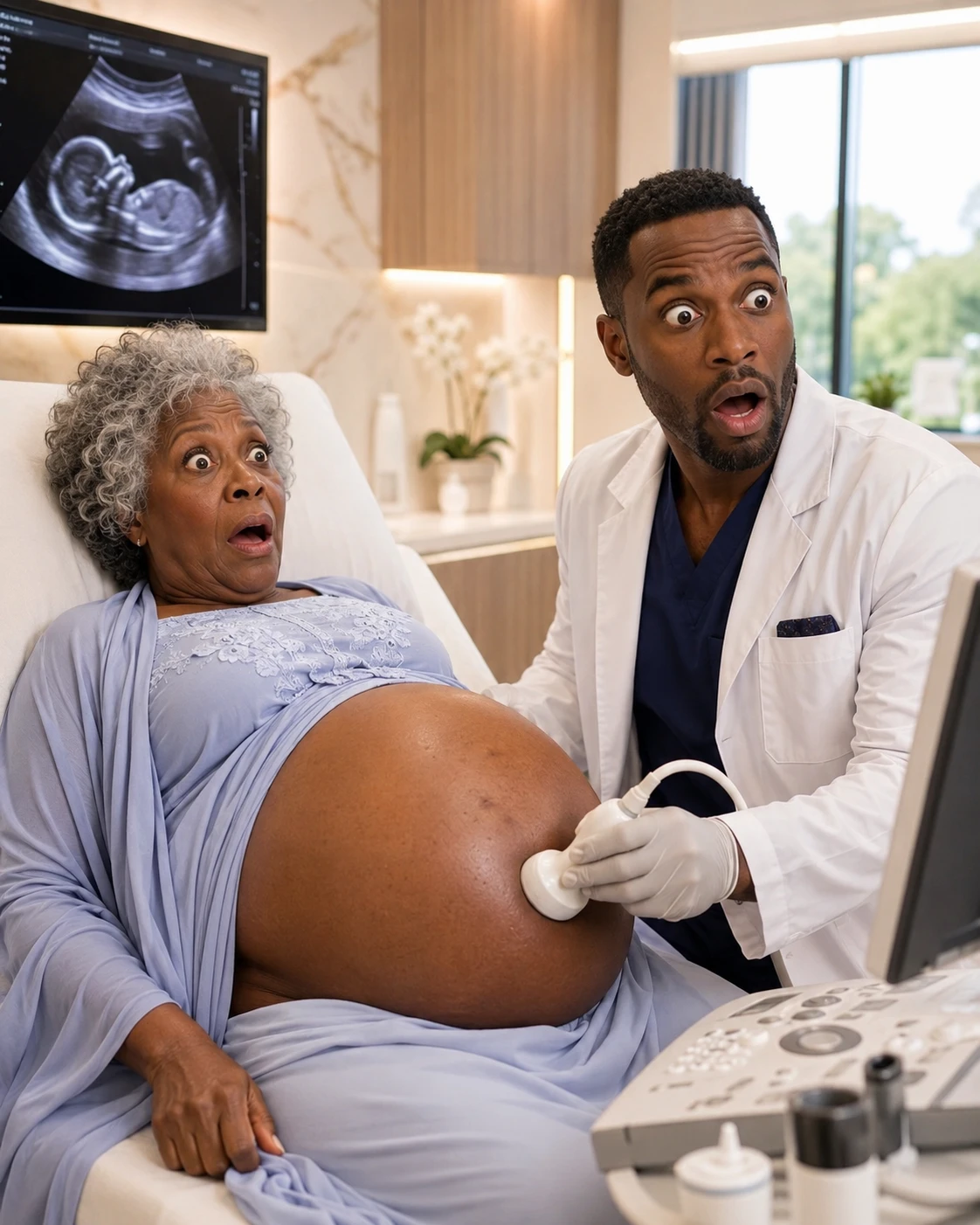
Her stomach rose beneath the gown in a smooth, firm curve.
At first glance, it resembled pregnancy.
But when Dr. Thorne placed his hand against it, something felt wrong.
The abdomen was tense.
Not simply stretched.
Guarded.
He applied warm gel and pressed the transducer against her skin.
Static shadows moved across the monitor.
Evelyn turned her head eagerly.
“Is that him?”
Dr. Thorne did not answer.
He adjusted the angle.
There should have been a clear uterine outline. A fetal head. A spine. Cardiac motion.
Instead he saw a distorted mass high in the abdomen, loops of bowel displaced around it, and pockets of dark fluid where no fluid should be.
He moved the probe lower.
The uterus appeared small.
Empty.
His pulse sharpened.
“Evelyn, did the clinic ever confirm that the embryo implanted inside the uterus?”
“They said the transfer went perfectly.”
“Did they show you a scan?”
“They showed me an image.”
“Was your name on it?”
She turned away from the screen.
“I assumed it was mine.”
Dr. Thorne pressed a button to save the image.
He changed probes.
Changed settings.
Tried again.
Evelyn searched his expression.
“Why can’t I see the baby?”
“I’m still looking.”
“Is that the head?”
“No.”
“Then what is it?”
“I need another specialist.”
Her breathing changed.
“Why?”
“I want a second set of eyes.”
“Is something wrong?”
He did not lie.
“I’m concerned.”
The words stripped the warmth from the room.
Evelyn stared at the monitor as if concentration alone might summon a heartbeat.
Dr. Thorne stepped into the corridor and called Dr. Priya Shah, the maternal-fetal medicine specialist working two floors above.
She arrived within six minutes.
Priya was small, direct, and known among residents for reading ultrasounds with unnerving precision.
She greeted Evelyn, reviewed the images, and began another scan.
The room became very quiet.
Only the machine hummed.
Priya’s face remained controlled, but Dr. Thorne saw the moment she understood.
She moved the probe toward Evelyn’s right upper abdomen.
There.
A fetal skull.
Partially obscured.
Collapsed.
No cardiac movement.
No measurable circulation through the umbilical vessels.
The fetus was not within the uterus.
It was lying in the abdominal cavity.
The placenta, however, was worse.
It appeared attached across the back of the abdomen near the great vessels, drawing blood from branches that should never have supported placental tissue.
A dark collection widened beneath it.
Internal bleeding.
Priya looked at Dr. Thorne.
He saw the message in her eyes before she spoke.
Now.
Not later.
Now.
She ordered a third scan with Doppler imaging.
The result did not change.
The pregnancy had developed outside the uterus, deep within Evelyn’s abdominal cavity.
It was an exceptionally rare condition.
And it had become catastrophic.
There was no fetal heartbeat.
The placenta had begun separating from the vessels that fed it.
Blood was collecting inside Evelyn’s abdomen.
Every minute they waited increased the possibility that one of those vessels would rupture completely.
Evelyn watched the doctors speaking in low voices.
“No,” she said.
Neither doctor had told her yet.
But she knew.
A mother could recognize the silence that came before loss.
Dr. Thorne sat beside her.
He turned off the monitor.
The black screen reflected the three of them: Evelyn lying beneath a thin gown, Priya standing with one hand on the machine, and Julian leaning forward as if proximity could soften what he was about to say.
“Evelyn,” he began.
She shook her head.
“Turn it back on.”
“I’m so sorry.”
“Turn it back on.”
“The pregnancy is not inside your uterus.”
“That doesn’t mean he’s dead.”
“There is no heartbeat.”
Her face emptied.
Priya spoke gently.
“We checked three times.”
“You’re wrong.”
“I wish we were.”
“You’re wrong.”
Evelyn pushed herself upright, smearing ultrasound gel across the gown.
Dr. Thorne reached toward her.
She slapped his hand away.
“No. Don’t touch me. Check again.”
“We have confirmed the finding.”
“I felt him move last night.”
The doctors exchanged a glance.
“What did the movement feel like?” Priya asked.
“A rolling. Here.” Evelyn pressed her right side. “He does it when I drink tea.”
Priya’s expression tightened with sorrow.
“That may have been intestinal movement against the gestational sac.”
“No.”
“Evelyn—”
“No.”
She grabbed the tote bag and pulled it against her chest.
The bottles knocked together inside.
A small, hollow sound.
Dr. Thorne forced himself to continue.
“The placenta is attached to major blood vessels in your abdomen. It has started to separate. You are bleeding internally.”
“I don’t feel bleeding.”
“It doesn’t always come with external bleeding.”
“My baby needs more time.”
“Your baby has died.”
The sentence landed with finality.
Evelyn’s mouth opened.
No sound came out.
The tote slipped slightly in her arms, and she caught it before it fell.
Priya moved closer.
“We need to operate immediately.”
“To take him?”
“To save your life.”
Evelyn’s face twisted.
“You want me to wake up empty.”
“We want you to wake up.”
“No.”
“Without surgery, you may die today.”
“Then let me.”
The words were quiet.
Almost calm.
Dr. Thorne had heard patients say similar things in shock. Usually they were cries of pain, not decisions.
Evelyn’s voice sounded different.
It sounded rehearsed.
Priya looked at him.
He understood the concern.
He pressed the call button for a nurse.
“Evelyn, we’re going to bring in the surgical team and talk through consent.”
“I’m not signing anything.”
“We may need to act under emergency authority if you lose consciousness.”
“Then I’ll leave.”
She swung her legs from the table.
The moment her feet touched the floor, her face went gray.
She folded forward with a gasp.
Dr. Thorne caught her beneath the arms.
Pain tore through her abdomen, sharp enough to steal the breath from her lungs.
The blood-pressure monitor sounded an alarm.
Priya shouted for a stretcher.
Evelyn gripped Dr. Thorne’s coat.
“My daughter,” she whispered.
“We’ll call her.”
“She’s arriving tonight.”
“We’ll call her now.”
“I promised she’d finally get to meet her little brother.”
Dr. Thorne paused.
“Your daughter knows about the pregnancy?”
Evelyn’s grip weakened.
Before she could answer, the examination-room door flew open.
A woman in her thirties rushed inside.
She wore a charcoal coat over wrinkled clothes, and her dark hair had been pulled into a knot so hastily that strands clung to her damp cheeks.
Her face was pale with panic.
“Mom.”
Evelyn stared at her.
“Mara?”
“I drove as soon as I got your message.”
“I didn’t message you.”
“You sent me a blank voicemail. I heard people talking about surgery.”
Mara looked from her mother to the dark ultrasound screen.
Then she saw the open tote.
The blue cap.
Something inside her seemed to collapse.
“Oh God.”
Dr. Thorne stepped forward.
“Are you Evelyn’s daughter?”
“Yes.”
“We need to take her to surgery immediately. She has an abdominal ectopic pregnancy with internal bleeding.”
Mara’s eyes closed.
Not in surprise.
In recognition.
Dr. Thorne saw it.
“You knew this might happen?”
Mara looked at Evelyn.
Her voice trembled.
“Mom, tell him.”
Evelyn turned her face away.
“Tell me what?” Dr. Thorne asked.
Mara stepped closer to the examination table.
“Tell him where that embryo really came from.”
A nurse entered with a stretcher, followed by two members of the emergency response team.
For several seconds, no one moved.
Evelyn clutched the tote bag tighter.
“Mara,” she whispered, “not here.”
“Where, then?” Mara’s voice broke. “Where were you planning to tell the truth? After you died?”
Dr. Thorne looked between them.
“What truth?”
Mara’s eyes filled.
“That embryo wasn’t from an anonymous donor.”
Evelyn closed her eyes.
“Mara.”
“It was mine.”
The room seemed to contract.
Dr. Thorne stared at her.
“Yours?”
“My egg. My husband’s sperm.”
Evelyn’s breath became shallow.
Mara pressed a hand to her mouth, trying to hold herself together.
“We created embryos four years ago. Before the accident.”
Dr. Thorne’s eyes shifted to Evelyn.
“You used your daughter’s embryo?”
Evelyn said nothing.
Mara answered for her.
“She stole it.”
The nurse froze beside the stretcher.
Priya took one step forward.
“Mara, we need to understand exactly what happened, but your mother is actively bleeding.”
“I know.”
“Then we need consent.”
Mara turned toward Evelyn.
“Sign it.”
“No.”
“Sign it, Mom.”
“They’ll take him.”
“He’s already gone.”
Evelyn flinched as though struck.
Mara’s voice softened.
“I’m sorry. I’m so sorry, but he’s gone.”
“No.”
“I saw Dr. Thorne’s face.”
“You don’t understand.”
“I understand more than anyone in this room.”
Evelyn looked at her daughter.
For the first time since entering the clinic, her confidence vanished completely.
Beneath it was something raw and frightened.
Something almost childlike.
“I was bringing him back to you,” she said.
Mara stared at her.
“Who?”
“Caleb.”
The name silenced them both.
Dr. Thorne did not know who Caleb was, but he watched Mara’s body react.
Her knees seemed to weaken.
She grabbed the edge of the examination table.
“Don’t,” she whispered.
“I thought if I could give you another baby—”
“Don’t say his name like that.”
“I was trying to make it right.”
“You cannot make Caleb again.”
“I know that.”
“No, you don’t.”
“I know he was unique.”
“Then why did you call this baby Caleb?”
Evelyn’s lips trembled.
“I didn’t.”
“The clinic paperwork you mailed me had the name written in the margin.”
“That was private.”
“You wrote ‘Caleb comes home in March.’”
Mara turned to the doctor.
“My son died when he was five months old.”
Evelyn began to cry without sound.
Mara’s words came faster now, torn from years of restraint.
“He had a heart defect no one caught during pregnancy. He died after his third surgery. My husband and I had created embryos before that because doctors warned us we might struggle to conceive again. After Caleb died, I couldn’t even look at the storage bills.”
She swallowed.
“My husband, Simon, died eight months later.”
Dr. Thorne’s expression changed.
“How?”
“Car accident.”
Evelyn whispered, “He was drunk.”
Mara looked at her sharply.
“He was grieving.”
“He was drunk.”
“He was trying to survive.”
“He drove into a concrete barrier.”
“Stop.”
“And you were the one who asked me to destroy the embryos.”
Mara’s eyes burned.
“I asked you to mail the consent form.”
“I couldn’t.”
“You told me it was done.”
“I couldn’t destroy the last pieces of them.”
“They were not pieces of Caleb.”
“They were his siblings.”
“They were embryos.”
“They were your family.”
“They were mine.”
The last word cracked through the room.
Mara stepped so close that only inches remained between them.
“They were mine to keep. Mine to use. Mine to destroy. Mine to leave frozen until the end of time if that was the only choice I could survive. You did not get to decide.”
Evelyn’s face crumpled.
“I thought you would thank me.”
Mara stared at her mother as if she had become a stranger.
“For using my body’s genetic child to make yourself pregnant?”
“For giving you someone to love.”
“I had someone to love.”
“I know.”
“No, you don’t.”
Mara’s tears spilled over.
“I had Caleb. I loved him through three surgeries. I loved him while machines breathed for him. I loved him when his hands swelled from the medicine. I loved him when he died against my chest, and I kept loving him when everyone else started speaking about him in the past tense.”
Evelyn covered her mouth.
“I was there.”
“You were there, and you still think another baby could replace him.”
“I never said replace.”
“You called him Caleb.”
The monitor alarm sharpened.
Evelyn’s blood pressure began to fall.
Priya moved immediately.
“We’re out of time.”
She placed the consent form on the table.
“Mara, is your mother’s medical power of attorney documented?”
“Yes.”
“Do you have it?”
“In my phone.”
“Send it to the hospital administrator. Now.”
Evelyn shook her head.
“No surgery.”
Dr. Thorne leaned over her.
“You are losing blood.”
“I need to hold him.”
“We will treat him with dignity.”
“I need to see him.”
“If it is medically safe, we can discuss that afterward.”
“No. Promise.”
Dr. Thorne held her gaze.
“I promise we will do everything we safely can.”
Evelyn searched his face for deception.
Then she looked at Mara.
“I was trying to return what you lost.”
Mara took her mother’s hand despite everything.
“You were what I had left.”
The words broke something in Evelyn.
Her fingers went slack around the tote.
The blue cap slid onto the floor.
Then the monitor screamed.
Evelyn’s eyes rolled back.
Blood pressure collapsing.
Internal hemorrhage accelerating.
The team moved at once.
They lifted her onto the stretcher.
A nurse pushed the tote aside.
Mara bent, grabbed the blue cap from the floor, and ran after them.
The corridor blurred beneath harsh ceiling lights.
Dr. Thorne called out instructions as they moved.
“Two large-bore IVs. Activate massive transfusion. Notify vascular surgery, general surgery, anesthesia, and interventional radiology.”
Evelyn drifted in and out of consciousness.
Her lips moved.
Mara leaned close.
“What?”
“The bottle.”
“What bottle?”
“In the bag.”
“Mom, stay with me.”
“Bottom pocket.”
The elevator doors opened.
Dr. Thorne stepped inside with the stretcher.
Mara followed until a nurse blocked her.
“You can’t come beyond pre-op.”
“That’s my mother.”
“We’ll update you.”
Evelyn’s hand reached weakly from beneath the blanket.
Mara caught it.
“Don’t leave,” Evelyn whispered.
“I’m here.”
“I’m sorry.”
“Stay alive and tell me later.”
The doors closed between them.
Mara stood in the corridor holding the tiny blue cap in one fist.
For a long moment, she could not breathe.
Then she remembered the bottle.
The tote bag had been placed on a chair outside the examination room.
She returned for it with legs that did not feel connected to her body.
At the bottom of the bag, beneath diapers and unopened bottles, she found a small amber prescription container.
Inside was no medication.
There was a folded note.
Mara recognized her mother’s handwriting immediately.
For Mara, if I am not brave enough to tell you.
Her fingers shook as she unfolded it.
The first line blurred.
She wiped her eyes and tried again.
Mara,
You believe I took the embryo because I could not bear to let go of Caleb and Simon. That is true, but it is not the entire truth.
The clinic in Bucharest contacted me after I requested the old storage records. They said there had been a discrepancy.
Mara stopped reading.
A cold pressure spread through her chest.
She continued.
The embryo they transferred was labeled with your name and Simon’s donor number, but before the procedure, one of the doctors told me the sample had been moved years ago during a storage failure. He said records were incomplete.
I should have walked away.
I did not.
Because I had already decided that any child connected to you was worth the risk.
Mara lowered the letter.
The hallway seemed to tilt.
She read the final paragraph.
I paid for a DNA test at ten weeks using blood they drew from me. The clinic sent the result to a private account. The fetus was not biologically related to you or Simon.
I was going to tell you tonight.
I was afraid that if you knew before meeting him, you would refuse to love him.
Mara stared at the page.
The words would not settle into meaning.
The embryo was not hers.
Her mother had not been carrying Caleb’s sibling.
She had risked her life for a stranger’s child.
A stranger’s dead child.
Mara pressed the paper against her mouth.
For months, rage had lived inside her like an animal.
When she first learned that the embryos had not been destroyed, she traced the storage records, found the international transfer authorization, and realized her mother had forged her signature.
She had called Evelyn forty-two times.
Evelyn never answered.
Then, two weeks earlier, a package arrived at Mara’s apartment.
Inside was a sonogram copied onto glossy paper, a blue ribbon, and a card.
He will need his sister.
Mara drove through the night to Ohio, but Evelyn was gone.
The neighbor said she had traveled to a retreat.
The house was locked.
Mara searched clinic records and credit-card statements, desperate to find her before the birth.
Then came the blank voicemail.
Now the truth was worse than theft.
Worse than obsession.
Evelyn had known the baby was unrelated to them and continued anyway.
Mara folded the letter with trembling precision.
A doctor in surgical scrubs approached.
“Ms. Vance?”
Mara stood.
“I’m Dr. Rourke, the vascular surgeon.”
“Is she alive?”
“She’s in the operating room. The placenta is attached across several major vessels. We’re attempting to control the bleeding without removing it all at once.”
“What does that mean?”
“It means this is extremely dangerous.”
“Tell me the truth.”
He held her gaze.
“She may not survive.”
Mara nodded once.
A sound came from her throat, small and wounded.
Dr. Rourke continued.
“We need to know whether she has religious objections to transfusion.”
“No.”
“Any known bleeding disorder?”
“No.”
“Any advance directive?”
“She wants to live.”
The words surprised her.
Only minutes earlier, Evelyn had refused surgery.
But Mara knew the refusal had not come from a desire to die.
It had come from terror of waking without the fantasy she had built.
“She wants to live,” Mara repeated.
The surgeon nodded and returned through the secured doors.
The operation lasted nine hours.
For nine hours, Mara sat beneath a television mounted in the waiting area while silent news footage rolled across the screen.
She did not watch it.
She held the blue cap.
She read the note until she knew every word.
She imagined her mother alone in Bucharest, lying beneath surgical lights while doctors placed an embryo into her body.
Had Evelyn been afraid?
Had anyone held her hand?
Had the clinic known the pregnancy was outside the uterus?
Had they cared?
At some point, a police officer arrived with a hospital administrator.
They asked about the forged consent form, the clinic, the transportation of embryos, the possibility of trafficking or falsified records.
Mara answered what she could.
Each answer made the story more monstrous.
The New Dawn Reproductive Institute had closed three months earlier.
Its website was gone.
Its listed telephone numbers had been disconnected.
The physician who signed Evelyn’s transfer documents did not appear in the Romanian medical registry.
The embryo’s true origin was unknown.
It could have belonged to another patient.
It could have been mislabeled.
It could have been transferred without consent.
There might be another family somewhere believing their last embryo had simply failed to thaw.
Mara thought of a woman she had never met opening a letter from a clinic.
We regret to inform you.
She thought of that woman crying in a kitchen, perhaps never knowing that the embryo had lived for months inside Evelyn.
The idea was unbearable.
At two in the morning, Dr. Thorne entered the waiting room.
Blood marked the edge of one shoe.
Mara stood before he spoke.
“She’s alive,” he said.
Her knees gave way.
He caught her elbow and guided her into the chair.
“She lost a tremendous amount of blood. The surgeons removed the fetus, controlled the largest bleeding sites, and left a portion of the placenta in place because separating it completely would have caused fatal hemorrhage.”
“Will it stay inside her?”
“For now. We’ll monitor it closely as the blood supply diminishes.”
“Is she awake?”
“No. She’s in intensive care on a ventilator.”
“Can I see her?”
“In a little while.”
Mara looked down at the cap.
“And the baby?”
Dr. Thorne sat opposite her.
“We were able to recover the remains intact.”
Her throat closed.
“Was it a boy?”
“Yes.”
Evelyn had been right about that.
For some reason, the detail hurt more than everything else.
“Can she see him?”
“If she wakes and still wants to.”
“When she wakes.”
Dr. Thorne did not correct her.
Mara looked at the folded letter in her lap.
“She knew the embryo wasn’t mine.”
“I’m sorry.”
“She still called him Caleb.”
“Grief can distort hope.”
“That doesn’t excuse what she did.”
“No.”
“I want you to say that.”
“What?”
“That grief doesn’t excuse it.”
He leaned forward.
“Grief does not excuse what she did.”
Mara nodded.
The confirmation seemed to steady her.
Then she asked, “Does grief explain it?”
“Sometimes explanation is the closest thing we get to mercy.”
“That sounds like something people say when they don’t have to live with the damage.”
“You’re right.”
His answer surprised her.
He looked toward the intensive-care doors.
“My wife and I lost a daughter at birth,” he said. “Seventeen years ago.”
Mara looked up.
“She had a chromosomal condition. We knew she would not live long, but we hoped for hours. We got eleven minutes.”
“I’m sorry.”
“For a year, my wife kept the nursery untouched. I wanted to dismantle it because opening the door felt like being killed repeatedly. She wanted to preserve it because changing anything felt like killing our daughter a second time.”
“What did you do?”
“We nearly destroyed each other trying to grieve correctly.”
Mara’s eyes filled again.
“How did you stop?”
“We stopped asking whose grief made more sense.”
She turned the cap over in her hands.
“My mother forged my signature.”
“Yes.”
“She used an embryo she believed was mine.”
“Yes.”
“She lied for months.”
“Yes.”
“And I’m still terrified she’ll die.”
“That is also true.”
Mara stared at the tiny stitches.
“I hate that.”
“Love is rarely disciplined enough to disappear when someone deserves our anger.”
Just before dawn, Mara was allowed into the intensive-care unit.
Evelyn lay beneath white blankets, almost unrecognizable beneath tubes and swelling.
Machines breathed for her.
Blood moved through clear lines.
Her hands, the hands that had shelved books and knitted caps and signed Mara’s school forms, rested motionless at her sides.
Mara stood beside the bed.
For several minutes, she said nothing.
Then she placed the blue cap on the table.
“You always did this,” she whispered.
The ventilator answered with a soft mechanical sigh.
“You decided what love was supposed to look like, and then you forced everyone else inside it.”
She wiped her face.
“When Dad got sick, you wouldn’t let me help because you said I had Caleb to care for. When Caleb died, you packed away his clothes before I was ready because you said looking at them was destroying me. When Simon died, you told people he had fallen asleep at the wheel because you thought the truth would shame me.”
She leaned closer.
“You kept trying to protect me by taking my choices away.”
Evelyn did not move.
Mara touched her hand.
“I don’t forgive you.”
Her voice trembled.
“Not yet.”
She sat beside the bed.
“But you don’t get to die before I understand why.”
Evelyn remained unconscious for three days.
On the fourth morning, she opened her eyes.
Mara was asleep in the chair with her head against the mattress.
Evelyn’s fingers moved.
Barely.
They brushed Mara’s hair.
Mara woke instantly.
For one wild second, relief erased everything.
“Mom?”
Evelyn tried to speak around the breathing tube.
“Don’t.”
Mara pressed the call button.
“They’re going to remove the tube when you’re ready. Just breathe.”
Evelyn’s eyes filled with panic.
Her hand moved toward her abdomen.
The blankets lay flat.
Understanding came slowly.
Then all at once.
Her eyes closed.
Tears slid into her hair.
Mara held her hand while the medical team evaluated her.
Several hours later, the tube was removed.
Evelyn’s first breath on her own sounded painful.
Her first word was not Mara’s name.
“Baby?”
Mara looked toward the nurse.
The nurse quietly left the room.
Evelyn’s voice was hoarse.
“Did they keep him?”
“Yes.”
“Can I see him?”
Mara’s stomach tightened.
“You almost died.”
“I know.”
“You knew he wasn’t mine.”
Evelyn stared at the ceiling.
“You found the note.”
“Yes.”
“I was going to tell you.”
“After what? After putting him in my arms?”
“I wanted you to see him first.”
“So I would be too attached to reject him?”
“So you would see that biology wasn’t the point.”
Mara laughed once, without humor.
“Biology was the entire reason you did this.”
“At first.”
“You stole what you believed was my embryo.”
“I saved it.”
“You stole it.”
Evelyn turned toward her.
“I couldn’t sign the destruction consent.”
“It wasn’t yours to sign.”
“You were drowning.”
“So you decided to create a baby?”
“I decided not to let grief make an irreversible choice for you.”
Mara stepped back from the bed.
“You have no idea what you’re saying.”
“I know exactly what I’m saying.”
“No, you don’t. You think because I was devastated, I wasn’t competent. You think pain erased my right to decide what happened to my own embryos.”
Evelyn flinched.
“You said you wanted every trace of that life gone.”
“And maybe I did.”
“You would have regretted it.”
“You don’t know that.”
“I know you.”
“No. You know the version of me you can manage.”
The sentence struck harder than shouting.
Evelyn turned away.
For a while, only the oxygen hissed.
Then Evelyn whispered, “When the clinic told me the embryo was not yours, I wanted to leave.”
“But you didn’t.”
“I was already pregnant.”
“You could have come home and told me.”
“I thought you would demand I end it.”
“I might have.”
“He had a heartbeat.”
“So did you.”
Evelyn’s face crumpled.
Mara sat again, exhausted by the force of her own anger.
“Why did you call him Caleb?”
“I didn’t mean this baby was Caleb.”
“You wrote his name.”
“I wrote it because the first time I felt movement, I remembered holding Caleb when he kicked beneath his blanket.”
“That isn’t the same.”
“I know.”
“Do you?”
Evelyn looked at her daughter.
“I missed him too.”
Mara’s eyes hardened.
“You were his grandmother.”
“Yes.”
“I was his mother.”
“I know.”
“Then stop placing your grief beside mine as though they weighed the same.”
Evelyn’s lips parted.
Then closed.
When she spoke again, her voice was quieter.
“I don’t think they weighed the same.”
“Then what?”
“I think your grief was so large that mine had nowhere to exist.”
Mara looked away.
Evelyn continued.
“Everyone called me after Caleb died, but only to ask how you were. They said, ‘Be strong for Mara.’ After Simon died, they said it again. ‘Be strong for Mara.’ Then Daniel got sick, and he told me the same thing from his hospital bed.”
Her voice trembled.
“Be strong for Mara.”
Mara stared at her.
“I would have listened.”
“You couldn’t breathe.”
“You never gave me the chance.”
“No.”
The admission was small.
Complete.
“No,” Evelyn repeated. “I didn’t.”
Mara looked down at their joined hands.
For the first time, she noticed how cold her mother’s fingers were.
Evelyn asked again to see the baby.
The hospital’s bereavement nurse prepared him carefully.
He was wrapped in a cream-colored blanket, his face partially covered by a small cap supplied by the hospital.
When the nurse entered, Evelyn began shaking.
“Not that one,” she said.
Mara understood.
She retrieved the blue knitted cap from the table.
Her hands trembled as she removed the hospital cap and replaced it with Evelyn’s.
The blue wool was slightly too large.
It covered the baby’s forehead and one tiny ear.
Evelyn held out her arms.
Mara hesitated.
Then she lifted the bundle and placed him against her mother’s chest.
Evelyn made a sound so broken that the nurse turned away.
“Oh,” she whispered.
She touched one finger to his cheek.
He weighed less than expected.
He was perfectly still.
“I’m sorry,” Evelyn told him. “I’m so sorry.”
Mara stood at the foot of the bed.
She had expected jealousy.
Rage.
Perhaps even revulsion.
Instead, looking at the small face, she felt a grief with no rightful owner.
The baby was not Caleb.
Not Caleb’s brother.
Not hers.
Not Evelyn’s in any legal or genetic sense.
And yet he had lived inside her mother for seven months.
He had moved when she drank tea.
He had occupied her hopes.
He had nearly killed her.
He had existed.
That fact alone demanded witness.
“Did you name him?” Mara asked.
Evelyn looked up.
“No.”
“You called him ‘him’ for seven months and never chose a name?”
“I was waiting for you.”
Mara’s jaw tightened.
“You planned for me to name him.”
“I hoped.”
“Why?”
Evelyn looked down at the baby.
“Because I knew he could never be mine alone.”
Mara moved closer.
The baby’s hand rested near his chin, fingers curled.
She thought of Caleb’s hands.
Not the same.
Caleb’s fingernails had been almost transparent. One thumb always tucked beneath the others.
This baby’s fingers were longer.
Different.
Entirely his own.
“He needs a name,” Evelyn whispered.
Mara stared at the tiny face.
“Daniel,” she said.
Evelyn’s eyes lifted.
“After Dad?”
“No.”
“Then why?”
“Because Daniel means God is my judge.”
Evelyn almost smiled through her tears.
“That sounds like something your father would have appreciated.”
“He loved dramatic meanings.”
“He did.”
Mara placed her hand over the baby’s blanket.
“Daniel,” she repeated.
The name settled into the room.
For one brief, impossible moment, happiness appeared.
Not joy.
Not peace.
Something smaller.
A fragile certainty that this child would not leave the world unnamed.
Evelyn closed her eyes and held Daniel closer.
Mara stood beside her.
Mother, daughter, and the child who belonged to neither of them in the way they had once believed.
A photographer from the bereavement team took one picture.
Then another.
In the final photograph, Evelyn was looking down at Daniel while Mara’s hand rested on her shoulder.
They looked like a family.
That was the cruelest part.
They looked like a family precisely when there was no future left for them to become one.
Two weeks later, Evelyn was transferred to a rehabilitation unit.
The retained placental tissue slowly began to shrink.
She required repeated scans, blood tests, and medication.
Some days she spoke constantly.
Other days she stared at the wall.
Mara stayed in Ohio.
She worked remotely from Evelyn’s house, sleeping in her childhood bedroom beneath faded glow-in-the-dark stars.
While searching for insurance documents, she found boxes in the attic.
One contained Daniel’s hospice supplies.
One contained Caleb’s baby clothes.
Evelyn had told Mara she donated them years ago.
She had lied about that too.
At the bottom of the box was a yellow sleeper Caleb wore the night before his first surgery.
Mara pressed it to her face.
It no longer smelled like him.
That hurt in a way she could not explain.
She sat on the attic floor until darkness filled the rafters.
Then she carried the box downstairs.
When Evelyn returned home six weeks later, she saw it beside the fireplace.
“I thought you threw those away,” Mara said.
“I couldn’t.”
“You told me you did.”
“I thought knowing they were gone would help you move forward.”
“You keep deciding what will help me.”
“Yes.”
The word came without defense this time.
Evelyn lowered herself carefully into a chair.
“Yes, I do.”
Mara looked at her mother’s changed body.
She had lost weight.
Her hair had thinned.
A surgical scar ran from beneath her breastbone to below her navel.
She moved like every step required negotiation.
“Why?” Mara asked.
Evelyn looked at the box.
“Because when you were six, you ran into the road chasing a red balloon.”
Mara frowned.
“What?”
“A delivery truck was coming. I grabbed your dress and pulled you backward. You cried because the collar scratched your throat.”
“I don’t remember.”
“I do.”
Evelyn folded her hands.
“After that, some part of me believed loving you meant seeing the truck before you did. Catching your dress. Pulling you back. Even when you were grown.”
“You cannot protect me from every truck.”
“I know.”
“You became one.”
Evelyn’s eyes closed.
“I know that too.”
Months passed.
The criminal investigation into the overseas clinic expanded.
Authorities identified eleven former patients whose embryos had been transferred or destroyed under questionable circumstances.
Records had been falsified.
Consent forms forged.
Embryos mislabeled.
One former employee agreed to cooperate.
Through genetic testing, investigators finally identified Daniel’s biological parents.
Their names were Rachel and Thomas Hale.
They lived in Michigan.
They had undergone fertility treatment five years earlier.
After multiple failed transfers, the clinic informed them that their final two embryos had been damaged during storage and could not be used.
They had grieved.
They had eventually adopted a daughter.
They had no idea one embryo had been transferred into Evelyn.
Mara read the report twice before telling her mother.
Evelyn sat at the kitchen table wearing one of Daniel’s old cardigans.
“What are their names?” she asked.
“Rachel and Thomas.”
“Do they know?”
“Investigators contacted them.”
Evelyn looked toward the window.
“What did they say?”
“They want to meet us.”
Fear crossed her face.
“Why?”
“To understand what happened.”
“They’ll hate me.”
“They may.”
“I didn’t know.”
“You knew the records were wrong.”
“I didn’t know whose embryo it was.”
“You knew enough to stop trusting the clinic.”
Evelyn looked down.
“Yes.”
The meeting took place in a private room at the hospital.
Rachel Hale arrived carrying a folder.
Thomas carried nothing.
He was tall, gray-haired, and so visibly angry that he did not remove his coat.
Rachel was forty-one, with tired eyes and a steady voice.
She looked at Evelyn for a long time before sitting.
“You carried our son,” she said.
Evelyn’s hands began to shake.
“I believe so.”
“The DNA confirms it.”
“I’m sorry.”
Thomas turned away sharply.
Rachel opened the folder.
Inside were photographs of a little girl with dark curls.
“This is our daughter, Lily.”
Evelyn touched the edge of one picture.
“She’s beautiful.”
“She’s adopted.”
Rachel’s voice remained controlled.
“We love her completely. I need you to understand that before I say anything else.”
“I do.”
“When the clinic told us our embryos were gone, I thought my body had failed again.”
Thomas placed a hand on his wife’s shoulder.
Rachel continued.
“I blamed myself for years.”
Evelyn began to cry.
“I’m so sorry.”
“I don’t know what to do with your apology.”
“I understand.”
“No, you don’t.”
Rachel’s composure cracked.
“You got to feel him move.”
Evelyn covered her mouth.
“You got to carry him. You got to hear people call him your baby. You got to hold him after he died.”
“I didn’t know he was yours.”
“But you knew he might be someone’s.”
The sentence struck with terrible precision.
Evelyn lowered her head.
“Yes.”
Thomas finally faced her.
“Why didn’t you report the clinic when you learned the DNA didn’t match?”
“Because I was afraid they would take him.”
“He was not yours.”
“I know.”
“You say that now.”
“I knew it then too.”
Thomas stared at her.
“Then why?”
Evelyn looked at Rachel.
“Because he was alive.”
The room went still.
“I had already felt him move,” she continued. “I told myself that whoever his parents were, they had either abandoned the embryo or would never know. I told myself I could love him enough to make what happened acceptable.”
Rachel’s eyes filled.
“And did you?”
“Did I what?”
“Love him enough?”
Evelyn’s face collapsed.
“No.”
Thomas looked away.
Evelyn whispered, “No one could.”
For the first time, Rachel’s anger softened.
Not into forgiveness.
Into recognition.
Mara placed the blue knitted cap on the table between them.
“We buried him with this,” she said.
Rachel reached toward it, then stopped.
“Buried?”
Mara nodded.
“There’s a grave in a memorial garden outside Columbus. The marker says Daniel Hale-Vance.”
Thomas’s head snapped up.
“Hale?”
“We changed it after the DNA results.”
Rachel pressed both hands over her mouth.
Thomas sat down slowly.
Mara slid a photograph across the table.
It was the final hospital image.
Evelyn holding Daniel.
Mara’s hand on her shoulder.
Rachel stared at it.
Her first reaction was pain.
Then something stranger.
She touched the image of the baby’s face.
“He has Thomas’s mouth,” she whispered.
Thomas leaned closer.
The anger left him for one devastating second.
“Yes,” he said.
Rachel began to sob.
Not politely.
Not quietly.
She folded over the table, and Thomas held her.
Evelyn sat across from them, watching two parents grieve a child they had never known existed.
Mara watched her mother understand that the secret she had carried was larger than their family.
It had roots in strangers’ lives.
It had stolen mourning from people who had already mourned once.
The meeting lasted three hours.
No one forgave anyone.
But before leaving, Rachel asked for a copy of the photograph.
Thomas asked for directions to the grave.
Six months later, all four of them stood in the memorial garden.
Lily played near a row of white stones, collecting fallen leaves.
Rachel placed a small wooden train on Daniel’s grave.
Thomas placed a letter beneath it.
Evelyn remained several steps away until Rachel motioned her forward.
“You can come closer,” she said.
Evelyn approached slowly.
The blue cap was not there.
It lay beneath the earth with Daniel.
Mara stood beside her mother.
Their shoulders touched.
“Are we ever going to be all right?” Evelyn asked.
Mara looked at the stone.
Daniel Hale-Vance.
Beloved son.
Briefly held.
Forever known.
“I don’t know,” she said.
Evelyn nodded.
For once, she did not try to turn uncertainty into hope.
She simply accepted it.
That evening, Mara returned to Evelyn’s house.
She made tea.
Evelyn sat near the window, thinner now, older in a way she had not been before the pregnancy.
On the table between them lay a letter from the district attorney.
The clinic’s director had been arrested in France.
Charges were pending.
There would be trials.
Testimony.
More families.
More secrets.
Evelyn folded the letter.
“Will Rachel ever forgive me?”
“I don’t know.”
“Will you?”
Mara looked into her tea.
Steam moved between them.
“I’m trying to understand you without excusing you.”
“Is that forgiveness?”
“No.”
“Is it the beginning?”
“Maybe.”
Evelyn nodded.
A small sound came from the hallway.
Mara stood.
“What was that?”
“The heating vent.”
It came again.
A soft electronic chime.
Evelyn looked toward the mantel.
Mara followed her gaze.
There, beside Daniel’s photograph, sat the old amber prescription bottle.
Inside it was a USB drive recovered from the Bucharest clinic’s files.
Investigators had mailed it that afternoon.
The label read: EMBRYO TRANSFER RECORD—VANCE, EVELYN.
Mara inserted it into her laptop.
A single video file appeared.
The footage showed a clinical room.
A much thinner Evelyn lay on a table while a masked physician prepared the transfer catheter.
The timestamp matched the date in her records.
A technician held up a dish to the camera.
The image was blurry.
Then a woman’s voice spoke offscreen in Romanian.
Subtitles had been added by investigators.
“Confirm patient embryo allocation.”
The physician answered.
“Patient Vance. Donor code H-17.”
Another voice interrupted.
“No. H-17 belongs to Hale.”
The physician looked toward the door.
“Vance paid for a viable embryo.”
“There is another sample assigned to her.”
“That one did not survive thawing.”
A pause.
Then the technician said, “She believes this belongs to her daughter.”
The physician replied, “Then let her believe it.”
Evelyn made a sound beside Mara.
A small, strangled gasp.
The video continued.
The physician approached the table.
Evelyn looked toward him.
In clear English, she asked, “Is this my daughter’s embryo?”
The physician hesitated.
Then smiled.
“Yes.”
Mara turned toward her mother.
Evelyn was staring at the screen with horror.
“I didn’t know,” she whispered.
Mara looked back at the video.
The transfer proceeded.
But in the final seconds, as the doctor left the room, the technician leaned close to Evelyn.
Her English was broken but understandable.
“This embryo is not your family.”
Evelyn’s recorded face changed.
She had heard.
She had understood.
The technician continued.
“You stop now?”
On the screen, Evelyn looked toward the door.
Then toward the catheter.
Then she closed her eyes.
“No,” she said.
“Continue.”
The video ended.
The room fell silent.
Mara slowly closed the laptop.
Evelyn’s face had gone white.
“I forgot that,” she whispered.
Mara stared at her.
“No.”
“I was sedated.”
“No.”
“I didn’t remember.”
“You remembered enough to order the DNA test.”
“I thought she meant the records were uncertain.”
“She told you.”
“I wanted to believe the doctor.”
“You chose to believe him.”
Evelyn began to cry.
“I was alone.”
“So was Rachel.”
“I had already traveled so far.”
“So you kept going.”
“I wanted someone to need me.”
The truth entered the room without drama.
No excuses remained around it.
No dead husband.
No grieving daughter.
No lost grandson.
Only a woman who had become so terrified of being unnecessary that she allowed a stranger’s child to become the answer.
Evelyn looked toward Daniel’s photograph.
“I loved him,” she whispered.
Mara’s eyes filled.
“I know.”
“Does that matter?”
“Yes.”
“Does it make any of this less terrible?”
“No.”
Evelyn nodded as tears moved silently down her face.
Mara sat beside her.
She did not embrace her.
Not yet.
But she did not leave.
Outside, snow began to fall over the dark Ohio street, softening the rooftops, covering every path, making the whole world appear untouched.
On the mantel, beneath the photograph of a baby in a blue knitted cap, four words had been written in Evelyn’s trembling hand:
May you like
- A Boy Kept Saying He Was My Son’s Brother — Then I Saw His Face Hoặc drama hơn:
- After Four Years Working Overseas, I Came Home Without Warning and Found My Wife Sleeping Beside the Garage, Weighing Barely a Hundred Pounds—My Mother Told Me,
- I Became A Surrogate For My Brother — But When He Saw His Newborn Daughter, He Said, “I Can’t Take This Baby,” And The Reason Made My Knees Buckle.
- Five years after the divorce, I returned to the country with my fiancée and found my ex-wife cleaning the floor at the airport. I was about to approach her to say hello when my fiancée went pale and whispered, “What is she doing here?” I said nothing, but hours later I opened an old family folder and discovered that our encounter had not been a simple coincidence.
- My husband forgot to end the video call, and 30 employees watched his assistant sitting on his lap, wearing the $110,000 necklace he had refused to buy me.
