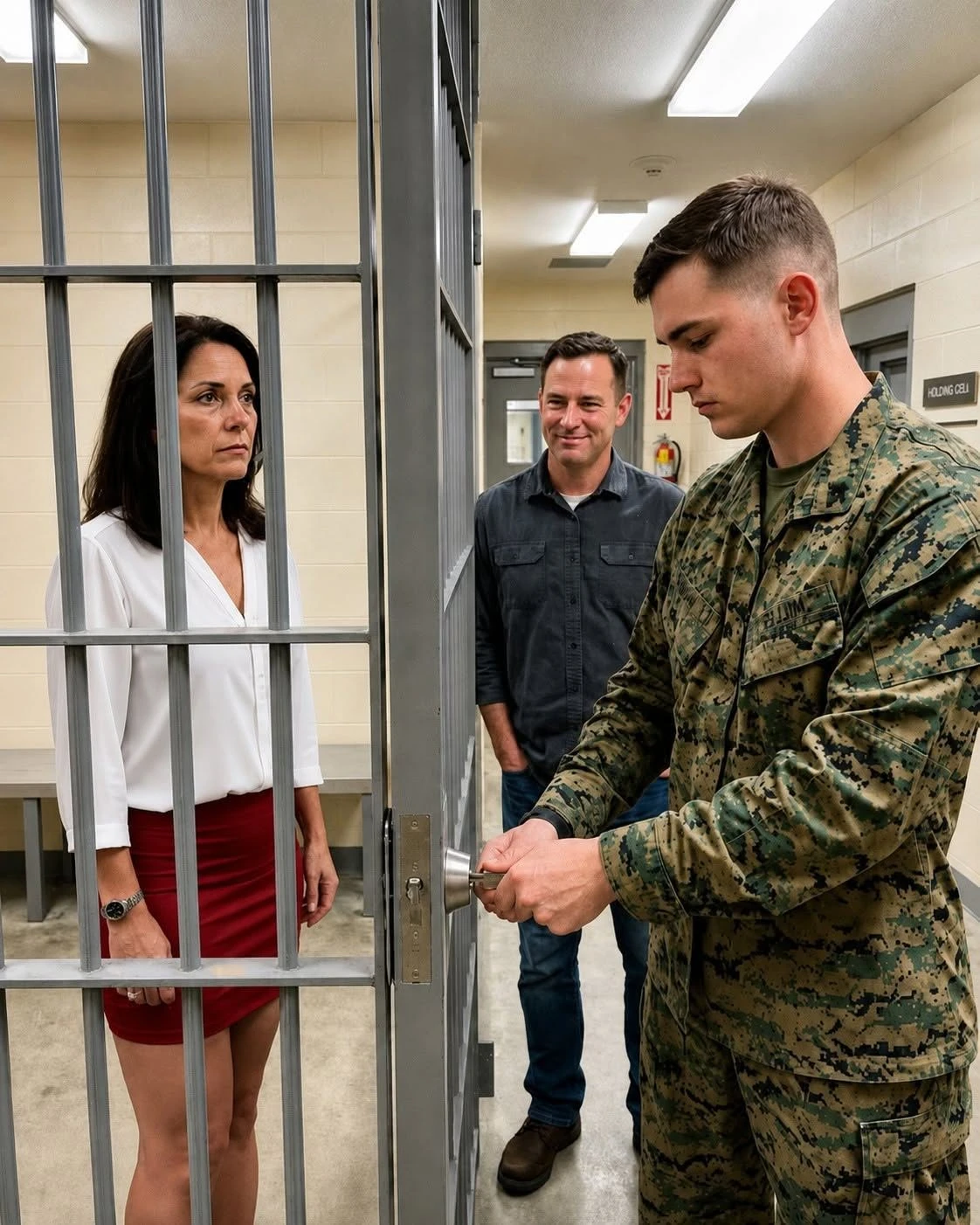
A corporal locked me inside a holding cell on the Marine base I was about to command, and my brother smiled at me through the bars. “I told you they’d figure you out,” he said.
I said nothing. Then the officer of the day walked in… and went still.
I arrived at the gate in civilian clothes because I wanted to see the installation before anyone had time to prepare a perfect ceremony around me.
No escort. No convoy. No dress blues.
Just my old sedan, my orders, and my brother Glenn beside me wearing the same half-smile he’d used for thirty years whenever he talked about my career.
At eighteen, when I told my family I wanted to earn a commission in the Marine Corps, my father laughed. Glenn said I was playing dress-up for the government.
Everyone laughed, so Glenn kept saying it.
Every promotion became another version of the same insult. Captain meant I pushed paperwork while real Marines worked. Lieutenant colonel meant I’d simply gotten better at wearing the costume.
Even after I was selected for a star, some small part of me still wanted my little brother to finally see what I had built and have nothing left to say.
That was why I brought him.
Then the gate scanner rejected my credential.
It had been reissued during the promotion process, and the system hadn’t updated yet. To me, it was an administrative problem that one phone call could fix.
To Corporal Jared Brandt, twenty-two years old and only two weeks into standing watch alone, I was a woman in a blouse holding a bad card and telling an unbelievable story.
“Ma’am, this card is invalid,” he said.
I showed him my orders. I asked him to call the command group. I asked him to contact the protocol office.
One call would have settled it.
But Corporal Brandt had already decided what he was looking at.
“You are not entering my base with a fake story,” he said. “Until someone tells me different, you’re going to wait.”
Glenn stood behind me smiling.
That smile hurt more than what happened next.
They put me in the holding cell.
The room was cold and painfully bright, fluorescent lights buzzing over a steel bench. The metal felt exactly the way it looked—temporary, impersonal, built for people nobody expected to stay long.
I had faced harder moments in thirty years of service. But none had felt this personal.
Because sitting behind those bars felt strangely familiar.
I had spent most of my life explaining myself to Glenn. Every achievement required proof. Every sacrifice needed evidence. Every promotion somehow became another invitation for him to tell me it wasn’t real.
He stepped closer to the bars.
“Thirty years of dress-up,” he whispered. “And this is where it ends.”
Years earlier, I would have defended myself.
I would have listed the deployments, the commands, the nights away from home, the responsibilities, the people who had depended on me when getting something wrong carried consequences far beyond my own pride.
This time, I didn’t give him the list.
Something in me had gone quiet.
Not anger. Not revenge.
Acceptance.
If someone is determined not to see you, another explanation rarely fixes it. They just move the line and ask you to prove yourself again.
So I sat on the steel bench, folded my hands, and stopped trying to carry the truth across the room to my brother.
Then footsteps sounded in the hallway.
Glenn glanced toward the door.
The footsteps came closer and stopped directly outside the cell.
For the first time since we had arrived, my brother’s smile wasn’t the thing I was watching.
The lock moved.
The heavy steel door swung inward, scraping against the sealed concrete floor with a screech that shattered the stillness of the room.
Lieutenant Colonel Marcus Vance, the base’s chief of staff, stepped into the holding area with the brisk, rhythmic stride of a career officer who had spent twenty-five years on active duty.
He carried a heavy leather binder under his left arm, his chest decorated with six rows of ribbon bars, and his face carved from the kind of weathered granite that only decades of salt water, dust, and command decisions could shape.
Beside him stood Corporal Jared Brandt, puffing his chest out in a display of triumphant, young-officer zeal, eager to demonstrate how his sharp eyes had intercepted a civilian fraud trying to breach the main perimeter.
“Sir, we’ve got a trespassing situation using an unauthorized barcode,” Corporal Brandt announced proudly, stepping ahead to point a gloved finger at the cell.
“She claims she’s the incoming commanding general, but the gate scanner threw an instant administrative flag, and she arrived without an official escort or command vehicle. I initiated standard detention procedures to secure the gate.”
Lieutenant Colonel Vance didn’t look at Corporal Brandt.
He didn’t look at the buzzing fluorescent lights overhead, nor did he acknowledge my brother Glenn, who was still leaning comfortably against the iron bars with his hands shoved into his denim jacket pockets, wearing that familiar, condescending smirk.
May you like
- A Boy Kept Saying He Was My Son’s Brother — Then I Saw His Face Hoặc drama hơn:
- After Four Years Working Overseas, I Came Home Without Warning and Found My Wife Sleeping Beside the Garage, Weighing Barely a Hundred Pounds—My Mother Told Me,
- I Became A Surrogate For My Brother — But When He Saw His Newborn Daughter, He Said, “I Can’t Take This Baby,” And The Reason Made My Knees Buckle.
- Five years after the divorce, I returned to the country with my fiancée and found my ex-wife cleaning the floor at the airport. I was about to approach her to say hello when my fiancée went pale and whispered, “What is she doing here?” I said nothing, but hours later I opened an old family folder and discovered that our encounter had not been a simple coincidence.
- My husband forgot to end the video call, and 30 employees watched his assistant sitting on his lap, wearing the $110,000 necklace he had refused to buy me.
Vance’s eyes drifted toward the cell bench, locked onto my face, and instantly went wide. Every muscle in the chief of staff’s body snapped taut as if struck by a high-voltage current. The color drained from his face so fast he looked as though he had seen a phantom rise from the concrete floor.
For three agonized, silent seconds, no one in the hallway moved.
The only sound was the low, electric hum of the security monitors mounted in the corner of the room.
Vance’s binder slipped half an inch under his arm before he caught it, his posture snapping into an involuntary, rigid stance of fundamental military deference.
His right hand shot up to the brim of his cover in a crisp, blindingly fast salute that cut through the stagnant air of the guard station like a whip crack.
“General,” Vance’s voice echoed off the concrete walls, raspy and strained, vibrating with a mixture of absolute shock and sheer, unadulterated panic.
“Ma’am… I… we were notified that your flight was delayed at Headquarters Marine Corps.
Your protocol detail was scheduled to meet your transport at the airfield at fourteen hundred hours.”
Corporal Brandt’s mouth dropped open. The triumphant, self-righteous expression on the twenty-two-year-old Marine’s face dissolved into horror.
He looked from Vance’s raised salute to my civilian blouse, then to the metal bars, his mind frantically attempting to calculate the astronomical scale of the mistake he had just executed.
“Sir?” Brandt stammered, his voice pitching up into an embarrassing squeak. “She… her credential failed the gate audit, sir.
She didn’t present a flag officer ID—”
“Shut your mouth, Corporal,” Vance growled without breaking his posture, his voice dropping into a low, terrifying register that made the young Marine flinch as if struck.
“You locked the incoming Commanding General of Marine Corps Installations East in a processing cell.”
Beside the bars, Glenn’s smug half-smile didn’t just vanish; it completely shattered.
His jaw went slack, his shoulders slumped inward, and his eyes darted frantically between Lieutenant Colonel Vance’s chest of ribbons and my calm, unmoving posture on the bench.
The man who had spent thirty years reducing my service to a childhood game of dress-up suddenly looked like he was suffocating on the very air in the room.
He reached out to grip one of the iron bars for balance, his knuckles turning white as the reality of three decades of denial crashed down upon his shoulders.
I stood up slowly from the cold steel bench, smoothing the front of my civilian trousers with unhurried grace.
I didn’t rush. I picked up my leather purse, where a set of brass stars rested inside the zipped side pocket alongside my official orders, and stepped out of the cell as Vance swung the iron gate wide open.
“At ease, Colonel,” I said, my voice quiet, flat, and entirely under control. I returned his salute with the effortless precision built over thirty years of uniform service.
“Your gate sentry executed the letter of the security directive when presented with an unverified credential.
Though his initiative regarding command verification leaves a significant administrative gap.”
“Ma’am, there is no excuse,” Vance stammered, his forehead glistening with a fine sheen of cold sweat despite the air-conditioned chill of the guardhouse.
“I take full personal responsibility for the failure of our protocol integration. I will order an immediate command inquiry into the sentry detail—”
“That won’t be necessary, Colonel,” I interrupted, walking past Corporal Brandt, who was standing at rigid attention, staring straight ahead at the cinderblock wall with eyes wide in absolute terror.
“Corporal Brandt followed security procedure when the scanner threw an error code.
However, he forgot the first rule of sentry duty: verify before you isolate. Arrange for his platoon sergeant to conduct a thorough review of command group contact procedures tomorrow morning.”
“Aye, aye, Ma’am,” Vance replied, stepping back to give me clear passage down the corridor.
I stopped at the threshold of the guardhouse exit and turned back to look at Glenn.
My brother was standing in the middle of the holding area, looking smaller and more frail than I had ever seen him.
The condescension that had defined his relationship with me since I was eighteen years old had been completely wiped away, replaced by an embarrassing, naked embarrassment.
He opened his mouth as if to say something—to offer an excuse, a laugh, or one of his usual dismissive jokes—but no sound came out.
“Glenn,” I said softly, my tone completely devoid of anger, malice, or triumph. “You wanted to see what thirty years of dress-up looked like.
This is the base. These are the Marines. And this is my command.”
Glenn swallowed hard, his eyes dropping to the concrete floor, unable to hold my gaze for even a single second.
“Evelyn… I didn’t know… I thought you were just…”
“I know what you thought,” I said quietly, turning my back on him and stepping out into the bright Carolina sunlight.
“Colonel Vance, please ensure my brother is provided a commercial transport back to the airport. He won’t be attending the change of command ceremony tomorrow.”
“Understood, General,” Vance said, motioning for two armed military policemen standing near the entrance to step inside the building. “We will handle his departure immediately.”
As I walked toward the staff car that had just pulled up to the curb—a shiny black sedan flying a red two-star general’s flag on its front fender—the driver, a sharp young sergeant, snapped a crisp salute and held the rear door open for me.
I took one final breath of the humid base air, listening to the distant cadence of recruits marching across the parade deck in the distance. For thirty years, I had carried the burden of trying to prove my worth to a family that chose to be blind.
But as the heavy door of the staff car clicked shut and we pulled onto the main boulevard of the installation I was born to lead, I realized I had never needed their eyes to see my truth.
I had built an empire of service, and no quiet insult from a bitter brother could ever tear down a single stone of it.
—
The morning sun broke over the parade deck at Camp Lejeune in a brilliant burst of gold and sapphire, burning away the ground fog that clung to the pine trees surrounding the grandstands.
Five thousand Marines stood in flawless, sharp formations across the asphalt field, their bayonets catching the sunlight, their dress uniforms crisp and immaculate.
The deep, rhythmic thrum of the Marine Corps Band echoed through the stands, where hundreds of visiting dignitaries, local officials, and senior military officers sat in silent anticipation.
I stood behind the temporary wooden stage erected at the edge of the field, adjusting the gold-braided belt of my Dress Blue Alpha uniform.
The two silver stars pinned to my epaulets felt heavy, not with the weight of metal, but with the quiet history of every deployment, every late-night operational brief, and every sacrifice that had brought me to this podium.
Lieutenant Colonel Vance walked up the wooden steps behind me, holding a black leather folder containing the master script for the ceremony.
“General, the reviewing officer has taken his seat. All units are formed and ready to report. We are on schedule for zero-nine-hundred execution.”
“Thank you, Marcus,” I said, turning to face him.
The chief of staff looked far more composed today than he had twenty-four hours earlier in the holding cell, though a subtle flicker of hyper-vigilance remained in his posture whenever he addressed me. “Is the perimeter secure?”
“Completely, Ma’am,” Vance replied smoothly. “And… if I may speak freely for a moment, General?”
“Granted.”
Vance hesitated, his eyes dipping slightly before meeting mine with genuine sincerity.
“I processed your brother’s civilian departure clearance yesterday afternoon, as ordered. Before he boarded his transport, he left a small envelope at the visitor control center.
He asked that it be delivered to your office after the ceremony.”
I looked at the blue sky above the parade deck, feeling a faint, familiar knot tighten in my stomach, only to unravel just as quickly.
“Set it on my desk, Marcus. I’ll review it when the official reception concludes.”
“Aye, aye, Ma’am,” Vance said, taking a step back and snapping a sharp salute. “Permission to march on the colors?”
“Execute,” I commanded softly.
As the brass fanfares roared to life and the color guard marched onto the deck with the American flag and the battle-scarred Marine Corps standard fluttering in the autumn breeze, I stepped up to the podium.
The vast sea of Marines snapped to attention in a single, synchronized motion, the sound echoing across the field like a clap of thunder.
I looked out over the sea of faces—young men and women who had sworn an oath to defend their nation, leaders who had given everything in distant sands, and veterans who watched from the stands with tears in their eyes.
In that moment, the memory of my father laughing at the kitchen table when I was eighteen felt a million miles away.
The memory of Glenn’s smug half-smile through the iron bars of a holding cell felt insignificant, like a speck of dust swallowed by the vastness of the ocean.
They had spent three decades insisting that my life was a costume party, unable to comprehend that true strength isn’t given by approval—it is forged through relentless, unyielding purpose.
I raised my right hand, took the microphone, and delivered my first official order to the command: “Pass in review.”
The band struck up *The Marines’ Hymn*, its triumphant brass notes filling the air as five thousand Marines turned as one and began their march past the reviewing stand. Boots struck the pavement in perfect, hypnotic unison, a living wall of discipline, honor, and raw military power.
I held my salute as unit after unit passed before me, their guidons dipping in respect to their new commanding general.
Hours later, after the handshakes, the photo opportunities with visiting congressmen, and the formal luncheon had finally concluded, the high-ranking guests dispersed into the afternoon.
The bustling base quieted down as the units returned to their barracks and operational duties.
I walked alone down the quiet, oak-paneled corridor of the building headquarters, the heavy wooden doors bearing brass nameplates of the legendary commanders who had come before me.
I unlocked the double doors to the Commanding General’s suite, stepping inside the vast office.
The room was dominated by a massive mahogany desk, floor-to-ceiling windows overlooking the river, and framed maps of historic battles spanning a century of Marine Corps history.
Sitting in the exact center of the pristine blotter was a small, plain white envelope.
I walked over to the desk, set my officer’s cap down beside a brass desk lamp, and sat in the heavy leather chair.
For a long moment, I simply stared at the envelope. There was no return address, just my name written across the front in my brother’s jagged, familiar handwriting: *Evelyn.*
Not *General Vance.* Not *Commanding General.* Just the name he had taunted across dinner tables for thirty years.
I picked up an ivory letter opener, sliced the top of the paper, and pulled out a single sheet of hotel stationary.
*Evelyn,*
*I sat in the airport terminal for four hours yesterday waiting for my flight home. I watched the news monitors in the lounge.
They ran a short segment on the local affiliate about the change of command ceremony scheduled for today. They showed a photo of you in your dress uniform, listing your deployments, your decorations, and the thousands of Marines who would be under your direct authority starting this morning.*
*I realized something while sitting there, surrounded by strangers who were looking at the screen with respect.*
*When we were kids, and Dad laughed at you for joining the delayed entry program, I didn’t laugh because I thought you would fail. I laughed because I was terrified you would succeed.
I spent my whole life staying in the same town, working the same comfortable job, and taking the easy path. Every time you earned a promotion, every time you shipped out to a war zone, it reminded me of everything I was too afraid to try.*
*Calling your career ‘dress-up’ was the only way I could make my own small life feel big enough. If your achievements weren’t real, then my cowardice didn’t matter.*
*When that sentry locked you in that cell yesterday, for five terrible minutes, I thought I had finally been proven right. I thought the fantasy was over. But when that lieutenant colonel walked in and saluted you… when I saw the sheer, undeniable reality of who you had become…
I realized that the only person who had been playing dress-up for thirty years was me.*
*I don’t expect you to forgive me for the years of cheap insults, or for letting you sit on that steel bench while I smiled. I don’t know if I’ll ever be the brother you deserved. But for the first time in my life, I am looking at you for who you really are.*
*Congratulations, General.*
*Glenn.*
I sat in the quiet office for a long time, holding the paper in my hands as the golden light of the setting sun spilled through the window, casting long shadows across the mahogany floor.
A soft, cold breeze rattled the heavy glass panes, bringing with it the faint, distant sound of bugles playing *Taps* across the installation as the sun dipped below the horizon.
I didn’t cry. I didn’t feel a sudden surge of vindication or bitter joy. Instead, a profound, unbroken peace settled deep within my chest.
I folded the letter carefully, slipped it into the bottom drawer of my desk alongside my old service records, and pushed the drawer shut with a firm, quiet click.
I picked up my pen, opened the first operational briefing folder resting on my desk, and began to work. The past was settled, the truth was known, and I had a command to lead.
# THE SHADOW OF COMMAND
## CHAPTER 1: THE PAPERS IN THE MAAHOGANY DRAWER
The quiet click of the mahogany drawer closing echoed through the vast, oak-paneled suite of the Commanding General like the sealing of a vault.
I leaned back in the heavy leather chair, staring at the polished surface of the desk. The fading gold of the evening sun stretched across the battle maps framed on the walls, casting long, geometric shadows across the room. Outside, the final notes of *Taps* faded into the cool coastal air of North Carolina, leaving behind an absolute, majestic stillness.
Glenn’s letter lay buried deep beneath thirty years of service records, operational summaries, and combat evaluations. He had finally seen the truth. The illusion he had spent a lifetime constructing—the comfortable lie that my life was a meaningless parade of costumes and paperwork—had shattered against the cold iron of a holding cell and the crisp salute of a Lieutenant Colonel.
It was the ending any storybook would have demanded. A quiet confession. A long-overdue surrender from a bitter brother who had finally been forced to confront his own smallness.
I reached for the first operational folder on my desk—a top-secret intelligence dossier marked **EXCHANGE MATRIX: REGIONAL INFRASTRUCTURE**.
As Commanding General of Marine Corps Installations East, my authority stretched over seven major bases, tens of thousands of active-duty personnel, and critical logistical arteries that fed global deployments. It was a massive machine, built on precision, trust, and absolute accountability.
I flipped open the heavy blue cover of the dossier.
Inside was a series of encrypted network logs, supply requisitions, and access audits that had been prepared by the outgoing commander’s internal review team. As I skimmed the first three pages, my hand froze.
The document was an audit of the base’s automated security and credentialing database—the very system that had rejected my administrative card at the gate thirty-six hours earlier.
According to the official report prepared by Lieutenant Colonel Marcus Vance, my card had failed because of a routine “synchronization delay” during the promotion processing at Headquarters Marine Corps in Quantico.
Except the raw server logs attached to the back of the report didn’t show a synchronization delay.
They showed a manual override.
Four minutes before my old sedan had pulled up to the main gate, someone using a high-level administrative terminal inside the headquarters building had personally flagged my encrypted credential as *REVOKED / POTENTIAL FRAUD*.
The flag hadn’t been an automated administrative error.
It had been a deliberate, surgical strike designed to ensure that when I reached that sentry box, Corporal Jared Brandt’s scanner would throw an un-bypassable red alarm, forcing the young sentry to execute immediate detention protocols.
My pulse didn’t spike. Decades of command under fire had trained my nervous system to drop into a state of icy, analytical stillness whenever a tactical threat emerged.
I pulled the server log closer to the brass desk lamp.
The terminal ID used to execute the manual revocation was **TERM-01-ALPHA**.
That terminal wasn’t located at Headquarters Marine Corps in Quantico.
It was located twenty yards down the hallway from my current office—inside the private suite belonging to the Chief of Staff.
Lieutenant Colonel Marcus Vance.
—
## CHAPTER 2: THE ANOMALY OF LIEUTENANT COLONEL VANCE
I didn’t call for Vance. I didn’t press the intercom button on my desk.
Instead, I sat in the gathering darkness, tracing the digital signatures on the printout with my index finger.
Why would a twenty-five-year career officer—a man decorated with six rows of ribbons, a battle-tested Marine holding the vital position of base Chief of Staff—deliberately stage an embarrassing gate incident for his incoming Commanding General?
Was it a test? A crude attempt by an old-school officer to humiliate a female general before she could set foot on the parade deck?
Or was it something far more dangerous?
A distraction.
If I was locked in a holding cell at the main gate, surrounded by a drama involving a terrified sentry and a condescending brother, my attention—and the attention of the entire base security apparatus—would be completely focused on the administrative failure at the gate.
During those forty-five minutes I had spent sitting on that steel bench while Glenn taunted me through the bars, what had been happening on the rest of the installation?
I stood up, pulled my officer’s cap from the desk, and walked over to the secure terminal built into the wall beside the floor-to-ceiling windows. I swiped my master command key—the physical, hard-coded silver key that superseded all network overrides—and entered my thirty-two-digit security clearance code.
The high-definition monitor flickered to life, displaying the installation’s real-time operational grid.
I brought up the automated perimeter logs for yesterday’s shift—specifically the exact forty-five-minute window when I was detained in the guardhouse holding cell.
The main gate logs showed complete gridlock caused by my halted sedan and Corporal Brandt’s detention protocols.
But the commercial logistics gate—Gate 4, located three miles north along the New River, where heavy freight and civilian contractors entered the base—showed an anomaly.
At 14:12 hours—exactly seven minutes after Corporal Brandt locked my cell door—a heavy, un-flagged commercial tractor-trailer had entered Gate 4.
The automated manifest listed the cargo as *Standard Facilities Maintenance Equipment*.
The sentry on duty at Gate 4 during that window had bypassed the secondary radiological and weight-plate inspection.
The authorization code attached to the bypass was signed under the direct emergency authority of the Chief of Staff.
Lieutenant Colonel Marcus Vance.
I leaned against the cool metal frame of the monitor housing, my mind piecing together the terrifying architecture of what had actually occurred.
My brother Glenn hadn’t been the only person taking advantage of my arrival.
In fact, Glenn had been a useful idiot—a loud, civilian distraction who made the scene at the main gate look like nothing more than an embarrassing family drama and an administrative blunder.
Vance hadn’t paled in the hallway because he was horrified at locking his general in a cell.
He had paled because he realized I wasn’t an administrative error that could be brushed aside—and because I had arrived early enough to catch the ripples of a dark, covert operation running directly beneath his command.
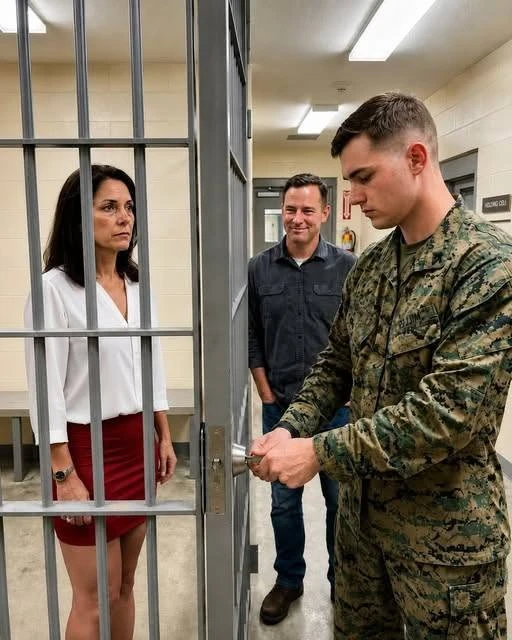
I tapped the screen, pulling up the internal audio-visual recording from the holding cell where I had sat with Glenn.
Because the holding cell was a secure military processing facility, every second of audio and video was automatically recorded to a hardened, off-site server managed by the Provost Marshal’s Office. Vance had authority over local base security, but he couldn’t alter the raw, off-site feeds without leaving a permanent digital footprint.
I rewound the video file to the exact moment Vance had stepped into the holding area.
On the screen, my brother Glenn was leaning against the iron bars, smiling his condescending smile.
*”Thirty years of dress-up,”* Glenn’s recorded voice whispered through the monitor’s small speakers. *”And this is where it ends.”*
Then, the heavy steel door had swung open. Vance had stepped into the room, followed by Corporal Brandt.
I paused the video. I zoomed in on Vance’s face.
Yesterday, in the heat of the moment, I had interpreted his sudden pallor and wide eyes as pure panic over a catastrophic career mistake.
Now, looking at the high-definition freeze-frame with dispassionate clarity, I saw what was actually written in the lines around his eyes.
It wasn’t panic.
It was recognition. But not recognition of *me*.
Vance’s eyes hadn’t locked onto my face first.
In the first micro-second after the door opened, Vance’s eyes had locked onto **Glenn**.
I unpaused the video, slowing the playback speed down to twenty-five percent.
Before Vance spoke a single word to me, before he executed that crisp, theatrical salute that had shattered my brother’s ego, Vance’s lips had moved.
There was no audio recorded from the hallway outside the cell door, only inside the room. But reading his lips was a basic skill every reconnaissance officer possessed.
As Vance looked at my brother standing behind the bars, his lips had distinctly formed two words:
*”Why now?”*
And behind the iron bars, my brother Glenn—the small-town man who had spent thirty years selling auto parts in a quiet Ohio suburb, the brother who claimed he was just along for the ride to watch his sister play “dress-up”—had done something subtle.
Glenn had dropped his left hand into his jacket pocket.
He had extended his middle and index fingers down against his thigh—a covert, non-verbal tactical signal meaning: *ABORT / DO NOT ENGAGE.*
My breath caught in my throat.
The room seemed to tilt beneath my feet.
The condescending smirk. The thirty years of insults. The endless jokes about my career being a fake costume party.
It hadn’t been a brother’s bitter insecurity.
It had been a cover.
I sat back down at the mahogany desk, the silence of the suite pressing in on me like a physical force.
Glenn.
My little brother, who had stayed in our hometown. Who lived in a modest three-bedroom house two streets away from our childhood home. Who complained about his property taxes, watched football on Sunday afternoons, and laughed at his sister for joining the Marines.
It was an exquisite, perfect camouflage.
If you want to operate without attracting the attention of federal counterintelligence, counter-surveillance, or foreign intelligence services, you don’t build a mysterious persona with fake passports and secret apartments.
You build a completely boring, utterly unremarkable, forty-year-old civilian life in a middle-American suburb. You pick a career that requires no background checks. You cultivate a reputation as a slightly cynical, lazy, predictable man who never leaves his zip code.
Unless his sister happens to be selected for a star.
Unless his sister is named the Commanding General of one of the most strategically sensitive Marine Corps installations on the East Coast.
I pulled out my secure personal phone—an encrypted satellite unit issued directly by the Defense Intelligence Agency—and dialed a private number I had used only three times in my career.
The line rang twice before a dry, neutral voice answered.
“Director Vance.”
“General Vance,” I said, my voice cold and smooth as slate. “I need an immediate, un-redacted dossier check on a civilian target.”
A brief pause on the line. “State the target.”
“Glenn Arthur Vance. Age forty-eight. Resident of Canton, Ohio.”
The line fell silent for eight agonizing seconds. I could hear the faint, rhythmic click of a high-level quantum decryption network processing the query at DIA headquarters in Arlington.
When the voice returned, it had lost its neutral, bureaucratic cadence. It was tight, strained, and filled with sharp, academic interest.
“Evelyn… where is your brother right now?”
“He was escorted off base yesterday afternoon,” I said, staring at the white envelope resting on my desk. “He left a letter. He was supposed to be on a commercial flight back to Cleveland.”
“Check his flight manifest, General,” the DIA Director said quietly. “Glenn Vance didn’t board that plane. And he hasn’t lived in Canton, Ohio, for fifteen years. The man who sat in your car, the man who stood beside you at the gate, is an operational asset designated under Project BLACKTHORN.”
I felt a cold drop of sweat trace a slow line down the center of my spine.
“What is BLACKTHORN?” I demanded.
“A deep-cover domestic counter-proliferation program initiated during the late nineties,” the Director revealed softly. “Your brother wasn’t laughing at your commission thirty years ago, Evelyn. He was recruited by the Department of the Army during his second year at Ohio State. He was placed inside a private civilian infrastructure network to track illegal hardware diversions targeting defense installations.”
“He was tracking Vance,” I whispered, the pieces slamming together in my mind with the terrifying violence of a collapsing building.
“Lieutenant Colonel Marcus Vance isn’t just an administrative Chief of Staff, Evelyn,” the DIA Director said. “He is the primary logistics node for a rogue private military syndicate attempting to move specialized electronic warfare components out of the Lejeune storage depots before your incoming command audit took place tomorrow morning.”
“The tractor-trailer,” I said, my teeth clenched tight. “The commercial truck that entered Gate 4 while I was locked in the holding cell.”
“Correct,” the Director confirmed. “Vance used your arrival—and the sudden administrative lockdown at the main gate—to clear the security corridor for that truck. But your brother wasn’t there to mock you, General.”
The Director paused, taking a slow breath.
“Glenn allowed himself to be detained with you in that cell to ensure you stayed inside the hardened guardhouse. He knew if you drove onto the main base seven minutes early, Vance’s security detail had orders to stage an armed ‘accidental confrontation’ near the depot to divert your convoy.”
“He put himself in a cell to keep me out of the crossfire,” I rasped, my hand gripping the edge of the mahogany desk so hard my fingernails turned white.
“He saved your life, Evelyn,” the Director said. “And right now, he is currently inside Depot 12 on your base, trying to stop that truck from leaving the installation.”
—
## CHAPTER 5: DEPOT 12
I hung up the phone.
I didn’t call the Provost Marshal. I didn’t summon the base quick-reaction force.
If Lieutenant Colonel Vance controlled the Chief of Staff’s office, he controlled the primary dispatch channels for the military police. Any radio transmission I made over standard command frequencies would instantly alert Vance that his operation had been blown.
I opened the bottom drawer of my desk.
I pushed aside Glenn’s letter, reached behind the metal housing, and pulled out my personal M9 service pistol. I checked the magazine—fifteen rounds of 9mm hollow-point ammunition—slapped it into the grip with a sharp *CLACK*, racked the slide, and engaged the thumb safety.
I slipped the weapon into my shoulder holster beneath my civilian jacket, took my silver master command key, and walked out the back entrance of the headquarters building into the humid Carolina night.
The base was quiet.
The long avenues, shaded by towering pine trees, were deserted. The streetlights cast pools of pale yellow light onto the asphalt, creating a maze of light and shadow.
I reached the staff garage behind the building, unlocked an un-marked, black Ford Explorer reserved for emergency tactical command, and ignited the heavy V8 engine.
Depot 12 was located four miles west, tucked into a dense, forested sector near the mouth of the New River. It was a cold-war era storage facility—a massive concrete bunker built half-underground, designed to house heavy weapons, tactical communications gear, and classified electronic countermeasure units.
I drove without headlights, navigating the dark perimeter roads by memory and the pale light of the moon reflecting off the river.
Three hundred yards from the entrance to Depot 12, I pulled the Explorer off the road into a thick grove of pine trees, cut the engine, and stepped out into the damp, cool air.
The forest was alive with the sound of crickets and the distant, rhythmic lap of the river against the bank.
Through the trees, I could see the high chain-link perimeter fence surrounding Depot 12.
Parked beside the massive, reinforced steel doors of the main bunker was the eighteen-wheeler tractor-trailer that had passed through Gate 4 yesterday afternoon.
Four men in unmarked, dark tactical gear were working quickly in the shadow of the truck, loading heavy, olive-drab aluminum crates onto the rear hydraulic lift.
Standing near the cab of the truck, holding a suppressed carbine and checking his watch, was Lieutenant Colonel Marcus Vance.
And tied to a steel support pillar twenty feet away, his face bruised, his lip split and bleeding, but his eyes still sharp and defiant, was my brother Glenn.
I crept through the underbrush, keeping my shadow low against the trunk of a massive longleaf pine.
My mind was operating with absolute, cold mathematical clarity.
*Threat count: Five personnel.*
*Primary target: Lieutenant Colonel Vance (armed with carbine).*
*Four secondary contractors (armed with sidearms, un-armored).*
*Hostage status: Secured to structural pillar, non-lethal injuries, fully conscious.*
*Terrain: Concrete loading pad, open sightlines, zero cover between treeline and truck.*
Direct engagement from my position was tactical suicide. I had one handgun and fifteen rounds. They had superior firepower, tactical positioning, and a hostage.
I needed to break their focus. I needed to create an anomaly that would force Vance to divide his attention.
I pulled my satellite phone from my pocket. I brought up the internal base maintenance override network—a secure protocol that allowed the Commanding General to remotely initiate fire-suppression systems in high-risk storage facilities.
I entered the facility code for Depot 12: **GRID-DELTA-NINE-ZERO.**
I selected **HYDRAULIC FOAM DELUGE / EXTERIOR LOADING BAY.**
I hit *EXECUTE.*
A high-pitched, deafening alarm suddenly shattered the silence of the forest.
*WOOOP! WOOOP! WOOOP!*
Blinding red strobe lights erupted across the exterior walls of Depot 12. Before the men around the truck could react, massive ceiling-mounted nozzles along the loading bay canopy burst to life, showering the entire area—the truck, the crates, and the mercenaries—in a thick, suffocating blanket of chemical fire-suppression foam.
“WHAT THE HELL?!” Vance roared, shielding his face as the white foam rained down around him. “SHUT IT DOWN! IT’S AN AUTOMATED SYSTEM ERROR!”
The four mercenaries panicked, scattering across the slick concrete, trying to protect the sensitive electronic crates from the chemical spray.
It was the opening I needed.
I stepped out from the treeline, holding my M9 pistol in a two-handed combat grip, low and steady.
I didn’t scream a command. I didn’t issue an order to drop their weapons.
I fired three quick, precise rounds.
*BANG! BANG! BANG!*
The three shots echoed off the concrete bunker like cannon fire.
The two mercenaries standing near the rear of the truck dropped instantly, struck in their legs and shoulders, their weapons clattering against the wet pavement.
The third mercenary turned toward the treeline, raising his sidearm.
*BANG!*
My fourth round caught him squarely in the center of his tactical vest, the kinetic impact slamming him backward against the side of the tractor-trailer.
Vance spun around, ducking behind the cab of the truck, raising his suppressed carbine toward my position.
“VANCE!” my voice cut through the blaring alarm, sharp, authorative, and absolute. “DROP THE WEAPON! THIS IS THE COMMANDING GENERAL!”
Silence fell over the loading bay, save for the wail of the alarm and the heavy, dripping sound of the white foam sliding down the concrete walls.
Vance was pinned behind the front tire of the tractor-trailer. I was positioned fifteen yards away behind a concrete security barrier.
And tied to the pillar between us was Glenn.
—
## CHAPTER 7: THE UNMASKING OF THE LIE
“General Vance!” Marcus Vance’s voice called out from behind the truck, raspy, strained, and stripped of all military decorum. “You should have stayed in your office! You should have read your brother’s letter, poured yourself a drink, and taken the win!”
“You’re done, Marcus,” I said, my sight alignment locked onto the edge of the truck’s front bumper. “The DIA knows. The Provost Marshal knows. The perimeter gates are locked down. You aren’t leaving this base.”
Vance let out a harsh, bitter laugh that was swallowed by the blaring sirens.
“You think this is about money, Evelyn?!” Vance yelled back. “You think I’m stealing radio parts to sell on the black market?!”
“You’re moving tactical jamming arrays,” Glenn spoke up suddenly, his voice raspy and choked with blood, but completely calm. “He’s not selling them, Evelyn. He’s smuggling them to a private security firm in South America to cover up an illegal military operation his former division executed five years ago.”
“SHUT UP, GLENN!” Vance screamed, stepping out from behind the wheel, pointing his carbine directly at Glenn’s head.
“If you pull that trigger, Marcus,” I said, my voice dropping into a register so cold it stopped him in his tracks. “You won’t live to see the court-martial.”
Vance froze. The tip of his barrel hovered six inches from my brother’s forehead.
He looked at Glenn. Then he looked across the foam-covered concrete toward my position behind the barrier.
His hands were trembling. The polished, decorated Lieutenant Colonel who had stood on the parade deck that morning had completely evaporated, leaving behind a desperate, cornered man who knew his world had come to an end.
“Thirty years…” Vance whispered, his eyes wide, bloodshot, and wild. “Thirty years I served this Corps! I gave them my health, my marriage, my youth! And they were going to throw me in a brig because of a clerical error on a foreign deployment!”
“You made a choice, Colonel,” I said, stepping slowly out from behind the concrete barrier, keeping my pistol trained directly on his chest. “You chose to betray your oath to protect yourself. Lower the weapon.”
Vance stared at me.
For three long seconds, time seemed to stop.
The red strobe lights flashed across his face, highlighting the deep lines of stress, corruption, and fatigue etched into his skin.
He looked at my uniform. He looked at the silver stars pinned to my collar.
And then, a strange, hollow smile crept across his lips.
“You really are a general, aren’t you?” Vance murmured softly.
He raised the carbine—not toward Glenn, but toward me.
*BANG! BANG!*
I fired twice.
The heavy 9mm rounds struck Vance in the center mass of his chest plate. The force of the impact drove him backward, his back slamming into the grill of the tractor-trailer before he slid slowly down onto the foam-covered concrete floor.
His carbine clattered against the pavement.
He lay there, gasping for air, the Kevlar armor having stopped the bullets from penetrating his chest, but the kinetic shock having broken three of his ribs and completely knocking the breath from his lungs.
I rushed forward, kicked the carbine away from his reach, and stood over him, my pistol still trained on his head.
“It’s over, Colonel,” I said flatly.
Behind me, I heard the sharp, sudden sound of tearing fabric.
Glenn pulled his arms free from the loose rope that had been holding him to the pillar—a rope he had clearly loosened minutes before I arrived—and stepped out of the foam, wiping blood from his chin with the sleeve of his jacket.
He didn’t look like a victim. He looked like an operative who had just concluded a long, exhausting assignment.
He walked over to Vance, reached down into the traitor’s jacket pocket, and pulled out a encrypted silver hard drive.
Glenn looked at the drive, then turned his head to look at me.
The sirens on the base was finally silenced twenty minutes later when three squads of Federal Bureau of Investigation agents and Military Police tactical teams secured Depot 12.
The white foam was being washed away by fire hoses, leaving the loading bay clean and glistening under the bright halogen floodlights that had been erected around the perimeter.
Lieutenant Colonel Marcus Vance was loaded into the back of an armored medical transport, heavily guarded by armed federal agents. His career, his reputation, and his life were officially over.
I stood near the edge of the treeline, holding a warm cup of black coffee provided by the Provost Marshal.
Glenn walked over, holding two ice packs against his bruised face.
He had stripped off his wet jacket, revealing a black tactical compression shirt underneath. He looked tired, older than his forty-eight years, but the smallness that had defined him in my mind for thirty years had completely vanished.
He stood beside me in silence, looking out at the flashing red and blue lights reflecting off the pine trees.
“You ruined a very good letter, you know,” I said quietly, taking a sip of the bitter coffee.
Glenn let out a soft, gravelly laugh that turned into a wince as it hit his swollen lip.
“I meant every word in that letter, Evie,” he said softly, using the childhood nickname he hadn’t spoken since we were kids. “I really did sat in that airport for four hours. I really did watch you on that news monitor.”
I looked at him sideways. “And the dress-up comments? The thirty years of jokes at family dinners?”
Glenn sighed, looking down at his boots.
“My handlers at DIA told me that the safest place for a deep-cover intelligence asset was right in the shadow of a rising star,” Glenn explained quietly. “Our father really did laugh at you when you joined. He was an old-fashioned man who couldn’t handle the idea of his daughter out-ranking every man in the family. I played into that because… because it gave me an excuse to stay close to you without anyone asking questions.”
He turned to look me directly in the eye.
“Every time I made a joke about your career, Evie… I hated myself for it. But if I started bragging about you, if I started acting like a proud brother, people in my network would have looked closer at my travels, my finances, and my contacts. I had to be the useless, bitter brother who didn’t care.”
I set my coffee cup down on the hood of a nearby vehicle.
I looked at this man—this brother who had carried his own invisible, silent weight for thirty years, letting his family believe he was a failure, letting his sister hate him… just to fulfill his duty in the dark.
“We really are a terrible family at communication, aren’t we?” I said softly.
Glenn smiled—not the smug, condescending half-smile he had worn through the iron bars of the holding cell, but a real, warm, brilliant smile that reached all the way to his eyes.
“We’re Marines and Intelligence officers, Evie,” Glenn said, reaching out to pat my shoulder gently. “We don’t talk. We execute.”
“He’s right, General,” a voice called out behind us.
Director Vance—the head of the DIA—stepped out of an unmarked sedan, wearing a long trench coat against the damp night air. He walked up to us, his eyes sweeping over the secured depot.
“The recovery is complete,” the Director announced. “The entire smuggling ring has been dismantled. The Department of Defense owes both of you an immense debt.”
The Director looked at Glenn. “Your assignment with Project BLACKTHORN is officially concluded, Agent Vance. You are cleared to return to civilian life… or accept a senior post at headquarters.”
Glenn stood silent for a long moment, looking out at the dark pine forest surrounding the base.
Then he looked at me.
“I think I’ve spent enough time in the dark,” Glenn said softly. “I think I’d like to go back to Ohio. Plant a garden. Maybe come visit my sister for her official parades.”
“You’re welcome on my parade deck anytime, Glenn,” I said, stepping forward and pulling my brother into a tight, fierce embrace. “Just make sure your ID card works at the gate next time.”
Glenn laughed, wrapping his arms around me, holding me tight against the cold night air.
“Deal, General,” he whispered into my hair. “Deal.”
Six months later.
The spring morning broke over Camp Lejeune with breathtaking beauty. The air was crisp, scented with pine and blooming dogwood, and the sky was a clear, brilliant canopy of Carolina blue.
I stood on the reviewing stand overlooking the grand parade deck.
Beside me, dressed in a sharp, tailored navy suit, holding a guest pass pinned to his lapel, stood Glenn.
Below us, five thousand Marines stood in flawless formation, their white gloves, polished brass, and sharp bayonets catching the golden morning sunlight.
The Marine Corps Band struck up the first triumphant notes of *The Stars and Stripes Forever*, the brass section ringing out across the asphalt field with thrilling, heroic power.
The Commanding Officer of the 2nd Marine Division stepped up to the microphone, his voice booming over the public address system:
“Pass in review!”
The massive wall of Marines turned as one, their boots striking the pavement in a hypnotic, rhythmic thunder that made the wooden grandstand vibrate beneath our feet.
*LEFT, RIGHT, LEFT, RIGHT.*
Five thousand men and women, bound by a single oath, moving with absolute unity, discipline, and purpose.
I stood at rigid attention, my right hand raised to the brim of my officer’s cap, returning the salute of every unit as they marched past the stand.
Beside me, I saw Glenn out of the corner of my eye.
He wasn’t smirking. He wasn’t looking at the ground.
He was standing straight, his chest thrown out, his head held high, tears glistening in his eyes as he watched the flags pass by.
He wasn’t looking at a costume party.
He was looking at his sister’s command.
And for the first time in thirty-six years, as the brass instruments soared into the clear morning air, I knew that no lie, no secret, and no shadow could ever touch the truth of what we had built.
We had both served in our own ways—one in the bright, burning light of command, and one in the deep, silent cold of the dark.
But as the final unit cleared the deck and the applause of thousands filled the spring air, we stood together under the same sun.
Two siblings. Two warriors.
One command.
***
**[THE END]**
See more on the next page
