The first shovel of earth had barely struck my daughter’s coffin when her husband announced that he intended to abandon their children.
“If no one wants to take responsibility for these girls, I’ll contact Child Protective Services on Monday,” Arthur said. “I’m not sacrificing the rest of my life to raise children whose mother is gone.”
For several seconds, the entire cemetery seemed to stop breathing.
Rainwater trembled on the white lilies covering Rose’s grave. The priest stood frozen beside the open Bible in his hands. More than two hundred mourners—neighbors, teachers, nurses, relatives, former classmates—stared at my son-in-law as if they had misunderstood him.
But there had been no misunderstanding.
Arthur Vale had said every word clearly.
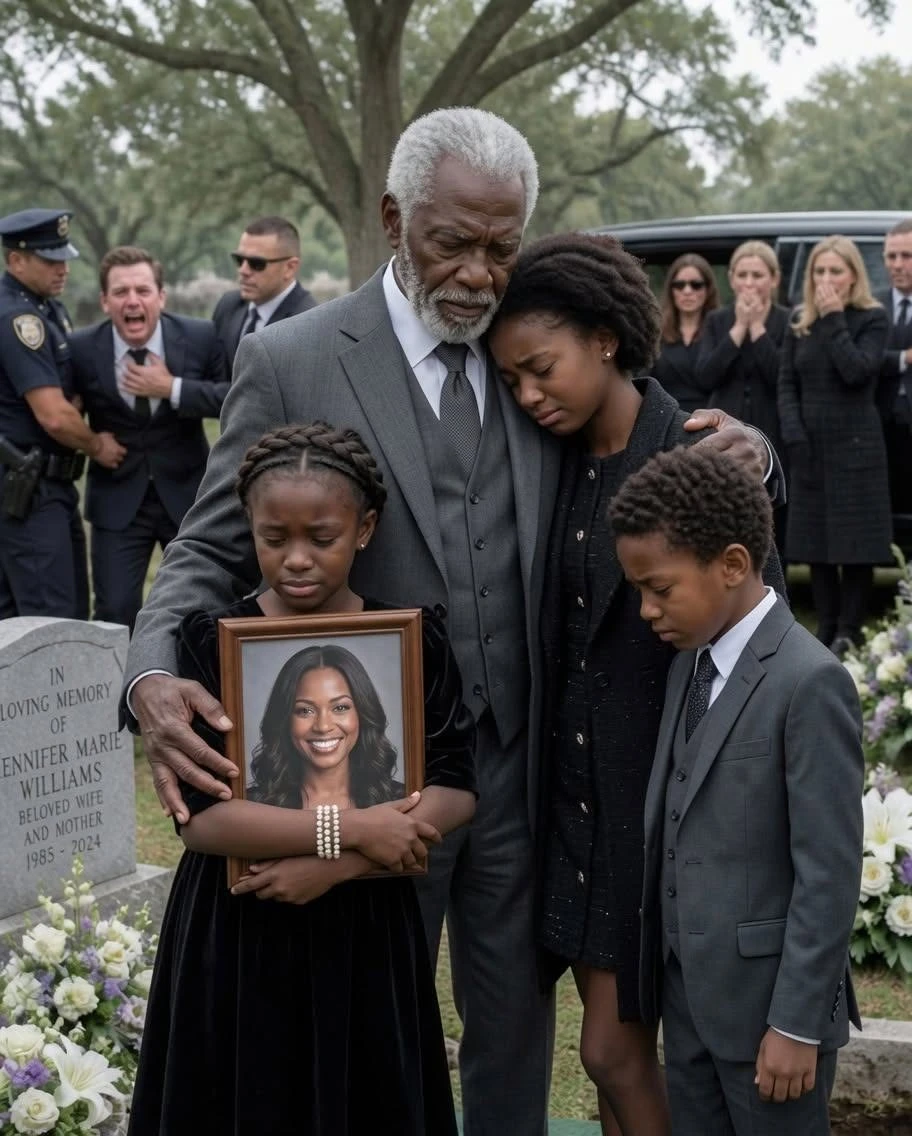
He stood beneath a black umbrella in a perfectly tailored gray suit, his polished shoes planted inches from the fresh soil that covered his wife. My daughter had been buried less than an hour earlier. She was only thirty-five years old.
And Arthur had already decided that their three daughters were obstacles between him and his new life.
Beside me, twelve-year-old Lucy held her mother’s framed photograph against her chest.
Nine-year-old Rachel stared at the grave without blinking.
Six-year-old April pressed herself into my coat, trembling so violently that I could feel it through both layers of fabric.
Arthur did not look like a grieving husband.
There was no redness around his eyes. No trembling in his hands. No exhausted collapse of a man who had lost the woman he loved.
His dark hair remained carefully styled. A silver watch gleamed beneath his cuff. Even the folded handkerchief in his breast pocket looked untouched.
Then his phone vibrated.
Arthur glanced down, read the message, and smiled.
It was only a flicker.
Most people might have missed it.
I did not.
I had spent forty years repairing clocks. I knew how to notice tiny movements—the twitch of a gear, the hesitation of a spring, the almost invisible shift that meant something inside a machine was broken.
And something inside Arthur had been broken for a very long time.
I stepped toward him.
“What did you just say?”
Arthur exhaled as though I were testing his patience.
“Charles, don’t turn this into a scene.”
“A scene?” My voice cracked. “You just threatened to send your daughters into foster care beside their mother’s grave.”
“They aren’t being threatened.”
Lucy flinched.
Arthur noticed, but his expression did not change.
“I’m being honest,” he continued. “Rose is gone. Someone has to make practical decisions.”
“And abandoning your children is practical?”
“My fiancée has no interest in raising three girls who barely respect me.”
The word struck harder than the rain.
May you like
They Raised a Glass to My Death on Day Ninety. I Came Downstairs Owning Their Future..105
Fiancée.
A murmur spread through the mourners.
My sister Evelyn gasped. Rose’s closest friend, Dana Mitchell, covered her mouth. Even Father Michael lowered his eyes in disgust.
I looked at Arthur carefully.
“Your wife was buried today.”
“The wedding won’t be immediate.”
“You are already engaged?”
Arthur’s mouth tightened.
“That isn’t anyone’s business.”
“It became our business when you announced it at Rose’s funeral.”
He glanced toward the girls for barely a second before waving one hand dismissively.
“You’re their grandfather. If they matter so much to you, take them.”
April made a sound against my coat—a tiny breath that broke into a sob.
For one wild moment, I imagined grabbing Arthur by the collar and dragging him to the ground beside Rose’s grave.
I wanted him to feel the wet soil against his expensive suit.
I wanted him to look at the coffin beneath him and understand what he had done.
Then April’s hand closed around mine.
The anger drained from my arms, replaced by something heavier.
Heartbreak.
I turned toward the girls.
Lucy was not crying.
That frightened me more than anything Arthur had said.
She did not beg her father to reconsider. She did not shout that she loved him. She did not ask what would happen to her and her sisters.
She simply watched him.
Her face was pale, but her expression was composed in a way no twelve-year-old’s face should ever be.
Then she looked at Rachel.
Rachel looked back.
Finally, both sisters glanced at April.
The three girls exchanged one silent look.
No words.
No tears.
Only a shared understanding.
My stomach tightened.
In that moment, I realized my granddaughters already knew something I did not.
I knelt in the wet grass before them.
“You’re coming home with me,” I said.
April threw both arms around my neck.
Rachel lowered her head.
Lucy gave a single nod.
Behind us, Arthur laughed quietly.
“Perfect. That solves my problem.”
He did not hug them goodbye.
He did not kneel beside April.
He did not tell Rachel that everything would be all right.
He did not touch Lucy’s shoulder.
Arthur Vale turned away from his wife’s grave and walked toward a white passenger van waiting beyond the cemetery gates.
A young woman sat inside wearing oversized black sunglasses.
She had long blond hair, a cream-colored coat, and one manicured hand resting against the glass.
The moment Arthur approached, she smiled.
He climbed into the van beside her.
As it pulled away, she leaned toward him and kissed his cheek.
He never looked back.
I stood in the rain with Rose’s daughters pressed around me, believing that I had just witnessed the worst thing Arthur could possibly do.
I was wrong.
As we began walking toward my truck, Lucy stumbled.
I reached out to steady her and noticed a purple cloth bag hidden beneath her black coat.
Her fingers tightened around it immediately.
“What’s in the bag?” I asked.
She looked toward the departing van.
Then she whispered, “The things Daddy thinks burned in the fire.”
PART ONE — THE BAG BENEATH HER COAT
My house stood on the quieter side of Savannah, on a narrow street shaded by live oaks and hanging Spanish moss.
Rose had grown up there.
Her height marks were still scratched into the kitchen doorway beneath layers of fading pencil. Her childhood bedroom still held the wooden bookshelf I had built when she was ten. A blue ceramic horse she had painted at summer camp remained on the windowsill.
I had lived alone since my wife, Margaret, died seven years earlier.
That night, for the first time since Rose left for college, the house filled with children again.
There were wet shoes by the door.
Small coats draped over chairs.
Three cups of untouched hot chocolate cooled on the kitchen table.
But the house did not feel alive.
It felt as if grief had entered with us and settled into every room.
April fell asleep on the sofa before eight, still wearing her black funeral dress. Rachel sat beside the window, watching rain slide down the glass. Lucy remained at the kitchen table with the purple bag resting on her lap.
I waited.
For nearly an hour, she said nothing.
Finally, I sat across from her.
“Your father said something burned.”
Lucy’s eyes lifted toward mine.
“The study.”
The fire that killed Rose had started in the study of the house she shared with Arthur.
That was what the investigators told us.
An overloaded outlet behind a bookcase had sparked sometime after midnight. The fire spread into the hallway. Arthur claimed he woke to the smoke alarm, ran outside with the girls, then tried to return for Rose.
According to him, the flames were already too intense.
Rose was found near the rear staircase.
The medical examiner ruled that she had died from smoke inhalation.
The fire had been declared accidental.
At least, that was what everyone believed.
“What was supposed to have burned?” I asked.
Lucy placed both hands over the purple bag.
“Mom’s notebook. Her recorder. The envelope.”
My heartbeat slowed.
“What recorder?”
“She used it for work.”
Rose had worked as an accountant for the Vale Foundation, the charitable organization Arthur’s family controlled. She handled grant records and donor reports, though Arthur often dismissed her job as “helping with paperwork.”
Lucy looked toward the living room, where April slept.
“Mom said if something happened to her, we had to bring the bag to you.”
The kitchen seemed to tilt.
“When did she tell you that?”
“Three weeks ago.”
Rachel turned from the window.
“She made us practice.”
“Practice what?”
“Getting out of the house,” Rachel said. “She showed us which window opened from the laundry room. She said if the alarm went off, we weren’t supposed to wait for Daddy.”
My hands became cold.
“Why?”
Lucy’s eyes filled for the first time.
“Because she was scared of him.”
The words seemed to strike every wall in the room.
I stared at my granddaughter, waiting for her to explain that she meant Arthur yelled too much or lost his temper or frightened them during arguments.
But Lucy reached into the bag and removed a small black notebook.
The cover was warped at one corner. A strip of silver tape ran across the spine.
She placed it on the table between us.
Then came a digital voice recorder.
A flash drive.
A brass key.
A sealed envelope bearing my full name.
CHARLES BENNETT.
The handwriting was Rose’s.
I touched the envelope but could not bring myself to open it.
“When did she give these to you?”
“She didn’t,” Lucy said. “She hid them.”
“Where?”
“In the old dollhouse in our room. There’s a loose board under the attic.”
Rose’s dollhouse.
I had built it for her when she was eight years old. Years later, she passed it to Lucy. It was large enough to stand against a wall, with tiny wooden furniture and a removable roof.
“Mom showed me the hiding place,” Lucy continued. “She said Daddy knew she kept records, but he didn’t know where.”
Rachel came to the table.
“The night of the fire, Mom woke us up.”
I looked at her.
“She woke you?”
Rachel nodded.
“She came into our room before the alarm started. She told Lucy to take the bag.”
“What did she say?”
Rachel’s chin trembled.
“She said, ‘Go to the laundry room. Take your sisters. Don’t stop for anything.’”
Lucy looked down.
“I asked if she was coming.”
The room fell silent.
“She said she had to get something first.”
“What?”
Lucy shook her head.
“I don’t know.”
Then April spoke from the living room.
“She went to find the red file.”
We all turned.
April had pushed herself upright on the sofa. Her hair clung to one cheek. She looked small and exhausted beneath Margaret’s old quilt.
“What red file?” I asked gently.
April rubbed her eyes.
“The one Daddy wanted.”
Lucy closed her eyes.
“April, go back to sleep.”
“No.” I kept my voice calm. “Let her talk.”
April slid off the sofa and walked toward us.
“Daddy was yelling before bedtime,” she said. “He said Mommy took his red file and he needed it before morning.”
“Did you see the file?”
“No.”
“Did you see your father start the fire?”
Lucy’s head snapped up.
“Grandpa.”
“I have to ask.”
April’s eyes widened.
“No. But I heard him.”
“Heard him doing what?”
She pressed both hands against her ears.
“Talking downstairs.”
“With your mother?”
April shook her head.
“With the lady from the van.”
The rain struck the windows harder.
“What lady?”
“The one who kissed him.”
Arthur’s fiancée.
I forced myself to breathe.
“What did they say?”
April stared at the table.
“The lady said Mommy wouldn’t sign something. Daddy said she wouldn’t matter after Friday.”
Lucy abruptly stood.
“That’s enough.”
“Lucy—”
“She’s six.”
“And your mother may not have died in an accident.”
Lucy’s face hardened.
“I know.”
Her certainty frightened me.
“You know what?”
She looked toward the recorder.
“Mom recorded them.”
I reached for the device.
Lucy put her hand over mine.
“Not here.”
“Why?”
“Mom said not to play everything in the house.”
“This house?”
“Any house.”
“Why?”
“Because Daddy knows people who can listen.”
Arthur’s family owned Vale Security Systems, a regional company that installed surveillance and access-control equipment in hotels, hospitals, schools, and private homes. His father, Harrison Vale, had founded the business before launching the family foundation.
I had always found Arthur’s obsession with cameras unsettling, but Rose insisted that it was simply his profession.
Now Lucy’s warning carried a different meaning.
“She said we should go somewhere with no smart devices,” Lucy explained. “No voice assistants. No security cameras. No wireless speakers.”
At twelve years old, my granddaughter was explaining counter-surveillance because her mother had believed her husband might kill her.
A sick pressure grew beneath my ribs.
“Did Rose tell anyone else?”
Lucy nodded.
“Ms. Dana.”
Dana Mitchell had been Rose’s closest friend since college. She worked as an investigative reporter for the Savannah Chronicle.
I immediately reached for my phone.
Lucy stopped me again.
“Mom said we should only call Ms. Dana after you opened the envelope.”
I looked at Rose’s name on the front.
My daughter had known me well.
She knew I would question myself. She knew grief might make me reckless. She knew I would need to hear her voice in my mind before I believed the impossible.
I broke the seal.
Inside were six handwritten pages.
The first line destroyed the last piece of certainty I had left.
Dad, if you are reading this, Arthur has either killed me or convinced everyone that my death was an accident.
My vision blurred.
I gripped the edge of the table.
Below the first sentence, Rose had written instructions.
Do not confront Arthur.
Do not bring the evidence directly to local police.
Contact Dana Mitchell.
Contact attorney Gabriel Shaw in Atlanta.
Use the brass key at Savannah Central Station, locker 214.
Keep the girls together.
And one final warning had been underlined three times.
Do not trust anyone from the Vale Foundation—including the police officers Arthur calls his friends.
I lowered the letter.
Rachel was crying silently.
Lucy remained still.
April climbed onto the chair beside me and whispered, “Mommy said you would know what to do.”
I wanted to tell her yes.
I wanted to become the man she believed I was.
But I was sixty-eight years old, recently retired, and had spent most of my life repairing clocks in a shop that barely made enough money to survive.
Arthur came from one of the wealthiest families in Georgia.
His company held contracts across three states.
His father donated patrol vehicles to the county sheriff’s department.
His mother sat on hospital boards.
His brother was a state senator.
I had no power that could compete with theirs.
Then I looked at my granddaughters.
They had escaped a burning house carrying evidence their mother had died to protect.
Power was no longer the question.
The only question was whether I would fail Rose a second time.
I folded the letter carefully.
“We’ll call Dana from the shop.”
PART TWO — THE VOICE IN THE DARK
Bennett Clock Repair occupied a narrow brick storefront near the river.
I had closed it after Rose’s death. A handwritten sign on the door said FAMILY EMERGENCY, and dust had begun gathering beneath the display window.
There were no wireless cameras inside.
No smart speakers.
No internet-connected devices.
Only clocks.
Hundreds of them.
Wall clocks, grandfather clocks, carriage clocks, mantel clocks, cuckoo clocks, marine chronometers, brass alarm clocks—all ticking at slightly different rhythms.
Rose used to say the shop sounded like rain made of seconds.
At eleven that night, it sounded like a room full of witnesses.
Dana arrived wearing jeans, boots, and a dark raincoat. Her curly black hair was pulled into a loose knot, and grief had hollowed the space beneath her eyes.
She hugged each girl before facing me.
“You opened the envelope?”
I nodded.
“Did Arthur follow you?”
“I don’t think so.”
“That isn’t good enough.”
She locked the front door, checked the back entrance, and switched off both our phones. Then she removed the batteries and placed the devices inside an old metal cashbox.
“Rose contacted me two months ago,” Dana said. “She believed Arthur and the Vale Foundation were laundering money.”
“Laundering how?”
“Fake charities. Inflated construction projects. Grants awarded to shell companies. Rose noticed that millions in donations supposedly sent to shelters and children’s hospitals had been redirected to private accounts.”
I stared at her.
“Why didn’t she go to the police?”
“She tried.”
Dana’s voice hardened.
“She gave partial records to Detective Samuel Rourke. Two days later, Arthur confronted her with details that only Rourke knew.”
Rourke had stood beside Arthur at the hospital the night Rose died.
He was the detective who told me the fire appeared accidental.
“He betrayed her,” I said.
“We believe so.”
“We?”
“Rose, me, and Gabriel Shaw.”
“The attorney from the letter.”
Dana nodded.
“He specializes in financial crimes and whistleblower protection. He has been helping us build a federal case.”
“Us?”
“I started investigating after Rose came to me. She had copied financial records, board minutes, payment schedules. But she needed direct proof that Arthur knew where the money went.”
Lucy placed the recorder on the workbench.
“She got it.”
Dana’s face changed.
For the first time, hope appeared through the grief.
“You found this?”
“Mom hid it for us.”
Dana examined the device but did not turn it on.
“Did anyone else see the bag?”
“Arthur might have noticed it at the cemetery,” I said.
“He didn’t,” Lucy replied. “I kept it under my coat.”
Dana looked at her carefully.
“You did exactly what your mother asked.”
Lucy’s composure cracked.
“She didn’t come with us.”
Dana reached across the bench and held her hand.
“No, sweetheart.”
“I should have gone back.”
“No.”
“I heard her scream.”
The clocks seemed to stop.
I stared at Lucy.
“You never told me that.”
Her face collapsed.
“After we got outside, Daddy was standing in the yard. Rachel and April were crying. Mom was still inside.”
“What was Arthur doing?”
“Watching.”
The word barely carried over the ticking.
“I told him she was in there,” Lucy continued. “He said the hallway was blocked. Then I heard Mom scream my name.”
Dana closed her eyes.
“What did Arthur do?”
“Nothing.”
“Did he try to go inside?”
“He waited until the neighbors came out. Then he ran toward the door and made them hold him back.”
Arthur’s heroic attempt to save Rose had been praised in the newspapers.
Witnesses said he struggled against two neighbors who stopped him from entering the burning house.
But Lucy had seen what happened before those witnesses arrived.
Arthur had waited until there was an audience before pretending to rescue his wife.
Dana placed fresh batteries into the recorder.
“There may be difficult things on this,” she warned.
Lucy straightened.
“We need to hear them.”
“You don’t.”
“They killed our mother.”
April covered her face.
Rachel pulled her close.
Dana looked at me.
I should have sent them into the back room.
I should have protected them from every word.
But Rose had entrusted the evidence to her daughters because she understood something I did not yet understand.
They were no longer innocent of what their father was.
Silence would not protect them.
It would only leave them alone with what they already knew.
I nodded.
Dana pressed PLAY.
Static filled the shop.
Then Arthur’s voice emerged.
“You copied files from the foundation server.”
Rose answered.
“I audited accounts assigned to me.”
“You stole confidential information.”
“I found proof that your family diverted $18.4 million from medical grants.”
My breath caught.
A second voice spoke.
A woman.
“You always were dramatic, Rose.”
April whispered, “That’s her.”
Arthur’s fiancée.
On the recording, Rose said, “You signed the transfer authorizations, Celeste.”
Dana looked at me.
“Celeste Monroe. Director of the Vale Foundation.”
I remembered her from charity galas. Blond hair. Pale dresses. A voice soft enough to sound harmless.
The woman in the van.
The recording continued.
Celeste laughed.
“I signed what Arthur put in front of me.”
“That doesn’t protect you.”
Arthur’s voice sharpened.
“You are going to return every copy.”
“No.”
“You will sign the marital confidentiality agreement and resign from the foundation.”
“No.”
“Think about the girls.”
“I am thinking about them.”
Something struck a table.
Then Arthur spoke more quietly.
“You have until Friday.”
“And then?”
A pause.
“You’ll give me what I need.”
The recording ended.
Dana immediately selected the next file.
This time, Rose’s voice came first.
“If you are hearing this, the recorder was found.”
She sounded exhausted.
“I discovered that Arthur has been using the foundation to move money into three companies registered under false directors. The largest is Mariner Development Holdings. Arthur believes I only found the financial crimes. He does not know I found the insurance documents.”
Dana stopped the recording.
“What insurance documents?”
Lucy reached into the purple bag and handed her the flash drive.
“Maybe they’re on there.”
Dana connected the drive to an old laptop she had brought.
It contained dozens of folders.
Photographs of checks.
Spreadsheets.
Scanned contracts.
Audio files.
Copies of emails.
One folder was labeled R.V. INSURANCE.
Inside were three life insurance policies on Rose.
The combined payout totaled $12 million.
Arthur was the primary beneficiary.
Celeste Monroe was listed as trustee of a newly created account that would receive the funds if Arthur died or became legally incapacitated.
The largest policy had been purchased only four months earlier.
Rose’s electronic signature appeared at the bottom.
“It’s forged,” I said immediately.
“How can you tell?”
“She never wrote her R like that.”
Dana enlarged the signature.
The shape was smooth and decorative.
Rose’s handwriting had always been sharp. Her capital R leaned forward, as if it were hurrying into the rest of the word.
Dana opened another file.
It was an email from Arthur to Celeste.
Subject: TIMING.
The message contained only one sentence.
Once the waiting period clears, we can finally reset everything.
The policy’s mandatory waiting period had ended six days before the fire.
The back door of the shop rattled.
All four of us froze.
Someone knocked three times.
Dana closed the laptop.
I reached beneath the counter for the old wooden bat I kept there.
A man’s voice came through the door.
“Charles? It’s Gabriel Shaw.”
Dana did not move.
“What was Rose’s verification phrase?” she called.
The man answered without hesitation.
“Broken clocks are right twice, but honest ones admit when they’ve stopped.”
Dana unlocked the door.
Gabriel Shaw entered carrying a leather briefcase.
He was in his early forties, with tired eyes and a dark overcoat wet from the rain.
“I came as soon as Dana contacted me.”
“You drove from Atlanta?” I asked.
“I was already in Savannah.”
“Why?”
His expression turned grim.
“Because Arthur filed for emergency custody relief this afternoon.”
I stared at him.
“He said he wanted foster care.”
“He wants the court to believe you kidnapped the girls.”
Lucy’s face went white.
Gabriel placed several printed pages on the workbench.
Arthur claimed that grief had made me unstable. He alleged that I had threatened him at the cemetery, removed the children without permission, and taken confidential property from his home.
The petition requested that the girls be placed temporarily with Arthur’s mother, Vivian Vale.
“He doesn’t want them,” Rachel said.
“He wants the bag,” Gabriel replied.
A vehicle slowed outside.
Headlights moved across the front window.
Then came a heavy knock.
“Savannah Police,” a voice called. “Open the door.”
Dana swore under her breath.
Gabriel looked toward the rear exit.
“Take the girls.”
“I’m not running.”
“You are not surrendering them to officers Arthur may control.”
The knocking grew louder.
“Mr. Bennett, we have reason to believe three minors are being unlawfully withheld.”
Lucy grabbed the purple bag.
Dana shut off the lamps in the front of the shop.
The only light came from the glowing faces of several clocks.
Gabriel opened the rear door.
“Where do we go?” I asked.
“Central Station.”
“The locker?”
He nodded.
“Rose placed her strongest evidence there.”
We slipped into the alley as the police began forcing the front lock.
PART THREE — LOCKER 214
Savannah Central Station was nearly empty after midnight.
A janitor pushed a yellow mop bucket near the ticket counters. Two college students slept against their backpacks. A security guard watched a basketball game on his phone.
Gabriel led us through the building separately.
Dana entered first.
Then the girls and I.
Gabriel followed five minutes later, checking behind him before joining us near the luggage lockers.
Locker 214 stood at the far end of the corridor.
The brass key fit.
Inside was a red file.
April stared at it.
“That’s the one.”
There was also a prepaid phone, a small external hard drive, and another envelope marked FOR THE WEDDING.
I opened the red file.
The first document was a contract between the Vale Foundation and Mariner Development Holdings for the construction of a children’s rehabilitation center.
The project had received $9.6 million.
The address listed for the facility belonged to an abandoned warehouse outside Macon.
The second document showed that Mariner had transferred $7.8 million to a private investment account.
The account holder was not Arthur.
It was Harrison Vale—Arthur’s father.
Gabriel turned the page.
Payment ledgers connected the money to Senator Lucas Vale, Arthur’s brother, and Detective Samuel Rourke.
“This is bigger than Arthur,” I said.
“It always was,” Gabriel replied.
The third document was a copy of Rose’s autopsy report.
I recognized it immediately.
But several sections had been highlighted.
Toxicology: carbon monoxide saturation consistent with smoke exposure.
Additional finding: trace sedative compounds.
The sedative concentration was below the level generally considered fatal, but high enough to cause disorientation and impaired movement.
“Rose was drugged,” Dana said.
Gabriel nodded.
“The final public report removed the sedative finding.”
“Who changed it?”
“Dr. Malcolm Trent, the county medical examiner.”
I knew the name.
Trent attended the Vales’ annual Christmas fundraiser.
A handwritten note from Rose was attached.
Trent received $250,000 through a consulting company two weeks before he amended a toxicology report in another foundation-related death.
“Another death?” I asked.
Dana opened the external drive.
The first folder contained information about a man named Evan Doyle, a financial controller who had worked for the Vale Foundation three years earlier.
He died when his car drove off a bridge.
The death was ruled accidental.
Before he died, Doyle had reportedly questioned payments to Mariner Development.
A second folder concerned Linda Perez, a grant auditor who disappeared after accusing the foundation of falsifying records.
Her car was found near the airport.
She was never located.
A third folder was labeled M.B.
Inside was a photograph of my wife.
Margaret Bennett.
I stopped breathing.
The station lights seemed to recede.
“What is this?”
Dana looked over my shoulder.
The folder contained copies of Margaret’s medical records from seven years earlier—the year she died.
Margaret had collapsed at home after complaining of dizziness and chest pain. She died in the hospital twelve hours later.
Doctors called it an undiagnosed cardiac condition.
But the file included emails between Harrison Vale and a private investigator.
One message read:
Bennett’s wife saw the transfer ledger. Rose may know she took copies. Resolve before Charles becomes involved.
I could no longer feel my hands.
“No,” I whispered.
Gabriel turned another page.
A payment of $75,000 had been made to a nurse named Patricia Glenn three days after Margaret died.
The payment came from Mariner Development Holdings.
Rachel touched my arm.
“Grandpa?”
I stared at my wife’s photograph.
Seven years earlier, Margaret had volunteered part-time with the Vale Foundation. She helped organize receipts and donor letters.
Weeks before her death, she had told me she thought something was wrong with the foundation’s records.
I dismissed it.
I told her large organizations often made bookkeeping mistakes.
I told her not to involve herself.
Then she died.
Rose had not been the first woman in our family to discover the Vales’ crimes.
And Arthur’s family might have murdered them both.
The prepaid phone vibrated inside the locker.
Every one of us jumped.
A message appeared on the screen.
YOU SHOULD HAVE LEFT THE LOCKER CLOSED.
Dana looked around the station.
“Someone knows we’re here.”
The second message arrived.
BRING THE DRIVE TO THE RIVER STREET PARKING GARAGE. COME ALONE, CHARLES, OR THE GIRLS WILL BE RETURNED TO THEIR FATHER IN PIECES.
Gabriel took the phone from me.
“That threat confirms they’re desperate.”
“They know where we are.”
“We need to leave.”
The station’s public address system chimed.
Then every overhead light went dark.
April screamed.
Emergency lamps flickered on, casting the corridor in red.
At the far entrance, two men in dark jackets appeared.
They were not police officers.
Dana grabbed Rachel’s hand.
Gabriel shoved the red file into his briefcase.
“This way.”
We ran toward the train platforms.
One of the men shouted.
The security guard rose from his chair, confused, but the second man flashed what looked like a badge.
“Police matter. Stay back.”
We crossed the platform as a late-night train began pulling in.
The sound of steel against steel filled the station.
Gabriel pushed the girls through an open carriage door.
Dana climbed after them.
I turned and saw one of the men less than twenty feet away.
He reached inside his coat.
Before he could pull out whatever was there, the train conductor stepped between us.
“Board or stand clear.”
I jumped inside.
The doors closed.
The man struck the glass with his palm as the train began moving.
Lucy clutched the purple bag against her chest.
Gabriel looked through the rear window.
“They’ll know our direction.”
“Where does this train go?” I asked.
“Charleston.”
“We can’t go to Charleston.”
“We aren’t.”
He checked his watch.
“We get off at the next stop. Federal agents are meeting us.”
Dana stared at him.
“You contacted them?”
“I sent Rose’s preliminary records to an assistant U.S. attorney two weeks ago.”
“Why didn’t they arrest Arthur?”
“Because financial crimes were not enough to prove murder. And someone inside the federal investigation leaked information back to the Vales.”
Even the federal case had been compromised.
“Then who can we trust?”
Gabriel looked toward the girls.
“At this moment? Very few people.”
The train sped through the darkness.
April leaned against me.
“Grandpa?”
“Yes?”
“Are bad people coming?”
I wrapped my arm around her.
“They’re going to try.”
“Will they win?”
I looked at Lucy.
At Rachel.
At Rose’s purple bag.
“No,” I said. “They already made the mistake that will stop them.”
“What mistake?”
“They left your mother’s daughters alive.”
PART FOUR — THE BRIDE IN WHITE
We spent the next three days in a protected apartment outside Beaufort under the supervision of Special Agent Naomi Price.
Price was not part of the original investigation. Gabriel had contacted her through a retired federal judge he trusted.
She was fifty-one, direct, and impossible to intimidate.
When she watched the recordings, her expression barely changed.
But after seeing Rose’s autopsy discrepancy and Margaret’s file, she closed the laptop and said, “This family has been burying witnesses for years.”
The evidence was powerful.
It was not complete.
The financial records proved fraud.
The insurance policies established motive.
The recordings demonstrated threats.
But Arthur’s lawyers could still argue that the fire was accidental, that Rose had misunderstood conversations, and that someone else had altered the records.
“We need the fire itself,” Agent Price explained. “Something showing planning, execution, or a direct admission.”
Lucy had listened silently from the sofa.
Then she said, “There’s another recording.”
Everyone turned.
“Where?”
“At home.”
I stared at her.
“You said everything was in the bag.”
“Everything Mom gave us.”
“What else is there?”
Lucy looked down.
“April’s rabbit.”
April held a stuffed white rabbit named Clover everywhere she went. The night of the fire, the toy had been left behind.
“Mom sewed a recorder inside it,” Lucy said. “She told me once, but I forgot until yesterday.”
“Where was the rabbit during the fire?”
“In April’s room.”
“Did the room burn?”
“Not much. The firefighters said the door stayed closed.”
Arthur’s house had been sealed pending repairs, but according to public reports, the children’s bedrooms remained structurally intact.
Agent Price immediately began making calls.
Before she finished, Gabriel’s phone rang.
He listened for less than a minute before his face darkened.
“What happened?” I asked.
“Arthur scheduled his wedding.”
“When?”
“Saturday.”
It was Thursday.
“He is getting married six days after burying Rose?”
“To Celeste Monroe,” Gabriel said. “Private ceremony at the Vale estate.”
Dana gave a bitter laugh.
“He can’t wait.”
Agent Price took the phone.
“Why rush it?”
“The life insurance payout,” Gabriel replied. “The policies contain a remarriage and trust consolidation clause. Once Arthur marries Celeste, she becomes co-trustee. They may be trying to move the funds beyond immediate seizure.”
“They haven’t received the payout.”
“They filed an expedited claim the morning after the funeral.”
I thought of the envelope in the locker marked FOR THE WEDDING.
Rose had anticipated this.
I opened it.
Inside was a single photograph and a handwritten card.
The photograph showed Arthur standing beside a black Mercedes outside a motel.
Celeste faced him.
Between them stood Detective Samuel Rourke.
The date stamp showed that the picture had been taken five days before the fire.
On the back, Rose had written:
If Arthur proceeds with the wedding, deliver this to the officiant and ask him to read Matthew 10:26.
The card contained the verse.
Nothing is concealed that will not be disclosed, or hidden that will not be made known.
There was also a small note.
The vows matter.
Dana read it twice.
“What does that mean?”
Gabriel frowned.
“Maybe she expected him to make a specific statement.”
“Or confess without realizing it,” Agent Price said.
We needed the recorder inside April’s rabbit.
But recovering it would not be easy.
Arthur had private security stationed at the house. Officially, they protected the damaged property from looters.
In reality, they were probably searching for whatever Rose had hidden.
Agent Price requested a federal warrant, but there was a delay. A judge wanted additional verification because the property was connected to an ongoing insurance investigation.
“We don’t have time,” Dana said.
Arthur’s wedding was less than forty-eight hours away.
Lucy stood.
“I can get it.”
“No,” I said.
“It’s my house.”
“No.”
“I know how to enter from the yard.”
“Absolutely not.”
She faced me with Rose’s same stubborn eyes.
“Mom died because adults kept telling her to wait until they had permission.”
The words cut deeper than she intended.
Or perhaps exactly as deeply as she intended.
Agent Price crouched in front of her.
“Lucy, your courage is not in question. But courage does not mean walking into danger alone.”
“I wouldn’t be alone.”
“Who would go with you?”
Lucy pointed at me.
I almost objected.
Then I saw the plan forming in Agent Price’s expression.
Arthur’s security team knew federal agents might attempt to enter. They would be alert for police vehicles and unfamiliar adults.
But they might allow a grieving grandfather to collect clothing and belongings for the children.
The following afternoon, I drove to the burned house with Lucy beside me.
A federal tracking device had been hidden under my collar. Agents waited several blocks away.
The Vale residence stood behind iron gates in an exclusive neighborhood south of the city. The fire had blackened the upper windows, but most of the exterior remained intact.
Two guards stopped us at the gate.
“I’m collecting clothes for my granddaughters,” I said.
“Mr. Vale has not authorized entry.”
“Then call him.”
One guard stepped away.
Lucy squeezed my hand.
Arthur answered by video.
His face appeared on the guard’s tablet.
“Charles.”
“Your daughters have nothing except funeral clothes.”
“That is your concern now.”
“April needs her stuffed rabbit.”
For the first time, Arthur’s expression shifted.
Only slightly.
But I saw it.
“Nothing is being removed from the property.”
“Why?”
“Insurance restrictions.”
“The rabbit is in her bedroom.”
“No.”
Lucy began crying.
It was not an act.
“She hasn’t slept,” I said. “She keeps asking for it.”
Arthur looked at Lucy’s face.
His mouth tightened.
Then he said, “The guard will retrieve it.”
Lucy immediately shook her head.
“He won’t know which one.”
“Describe it.”
“There are four rabbits.”
Arthur hesitated.
I watched his eyes.
He was calculating.
If he refused, it would seem suspicious.
If he allowed Lucy inside, he could observe what she searched for.
Finally, he said, “Five minutes. The guard stays with you.”
The gate opened.
Inside, the smell of smoke still hung in the air.
The lower hallway was stained with soot. Plastic sheeting covered several doorways. The study had been destroyed completely.
As we climbed the stairs, Lucy whispered, “Don’t look toward the attic.”
“Why?”
“I think they moved the dollhouse.”
The guard followed three steps behind us.
April’s room was mostly untouched.
Her toys remained scattered across the carpet, covered with a thin layer of gray dust. Several stuffed animals lay on the bed.
Lucy walked directly toward the white rabbit.
Then she paused.
“That isn’t Clover.”
The rabbit looked identical to the one April carried everywhere.
“What do you mean?” the guard asked.
“Clover has a blue stitch on her foot.”
The guard’s jaw tightened.
Lucy searched the bed, closet, and toy chest.
Nothing.
I looked around the room.
Someone had replaced the rabbit.
Why replace it unless they knew something had been hidden inside?
A floorboard creaked in the hallway.
I turned.
A woman stood near the stairs.
Celeste Monroe.
She wore a white silk robe beneath a camel-colored coat. Her blond hair was loose around her shoulders.
It was the first time I had seen her without the funeral sunglasses.
She smiled at Lucy.
“Looking for something?”
Lucy moved closer to me.
“Her sister’s toy,” I said.
Celeste entered the room.
“What a devoted grandfather.”
“You attended my daughter’s funeral in the van.”
“I wanted to give the family privacy.”
“You kissed her husband before the cemetery was out of sight.”
Her smile thinned.
“Grief affects everyone differently.”
“Apparently it affected you by making you choose a wedding dress.”
Her eyes became cold.
Then Lucy looked at Celeste’s coat.
A small white thread clung near the pocket.
Blue at one end.
“Grandpa,” Lucy whispered.
I saw it.
A blue stitch.
Celeste had torn open April’s rabbit.
She had found the recorder.
The guard stepped between us.
“Time to leave.”
I looked at Celeste.
“What was on it?”
Her smile returned.
“I have no idea what you mean.”
“You destroyed the rabbit.”
“Children’s toys were damaged in the fire.”
“The room barely burned.”
She moved close enough that I could smell her perfume.
“Charles, you should focus on giving those girls a peaceful life.”
“Is that a threat?”
“It is advice.”
Lucy suddenly dropped to the floor.
“My bracelet.”
The guard glanced down.
While he was distracted, she reached beneath the bed and pulled something from a narrow gap beside the baseboard.
A tiny black memory card.
She closed her hand around it before anyone noticed.
“I found it,” she said, holding up a cheap plastic bracelet with her other hand.
We left with no rabbit.
But the moment we reached the car, Lucy opened her fist.
“Mom told me the recorder made two copies.”
The memory card was a backup.
Arthur and Celeste had destroyed the device—but Rose had hidden its recording inside the wall.
PART FIVE — WHAT HAPPENED BEFORE THE FIRE
Agent Price copied the memory card onto three separate drives.
The audio file was almost four hours long.
For most of the recording, there was silence.
A child’s music box played faintly.
Doors opened and closed.
At 11:14 p.m., Arthur’s voice entered the room.
“Where is the backup?”
Celeste answered, “If I knew, we wouldn’t be tearing apart children’s toys.”
Arthur cursed.
A third man spoke.
Detective Rourke.
“The station received her email draft. She scheduled it to send if she didn’t log into an account by morning.”
Rose had created a digital dead man’s switch.
Celeste said, “Can you stop it?”
“I already did.”
“Are you sure?”
“The provider account was accessed through a warrant request.”
“A real warrant?” Arthur asked.
Rourke laughed.
“No.”
There was movement.
Then Arthur spoke.
“She must have copies somewhere else.”
Rourke replied, “Then make her tell you.”
At 11:38, Rose’s voice became audible from the hallway.
“The girls are asleep.”
Arthur said, “Come downstairs.”
“I’m tired.”
“We need to talk.”
“I have nothing to say.”
“You took company documents.”
“I copied evidence of crimes.”
Celeste’s voice entered.
“You should have accepted the agreement.”
Rose stopped.
“What is she doing here?”
Arthur did not answer.
For the next several minutes, the argument moved farther away.
Words became indistinct.
Then, at 12:03 a.m., the smoke alarm chirped once.
Not a full alarm.
A single test sound.
Rourke said, “The upstairs sensors are disabled.”
Arthur asked, “And the rear camera?”
“Looping yesterday’s feed.”
Celeste’s voice shook slightly.
“This was supposed to look accidental.”
“It will,” Rourke replied.
Rose shouted from downstairs.
“What did you put in my drink?”
Arthur answered.
“Something to help you stop fighting.”
April began moving in her bed. Fabric rustled near the hidden recorder.
Then Rose’s footsteps came rapidly up the stairs.
A door opened.
“Lucy,” Rose whispered urgently. “Wake up.”
The recording captured everything the girls had described.
Rose waking them.
Rose telling Lucy to take the bag.
Rose directing them to the laundry room.
Then Rachel’s frightened voice.
“Are you coming?”
“Yes. Go now.”
Arthur’s footsteps sounded in the hallway.
“Rose.”
“Stay away from them.”
“Give me the drive.”
“You’ll never find all the copies.”
A violent crash followed.
Lucy began crying on the recording.
Rose shouted, “Run!”
A door slammed.
For several minutes, only the girls’ hurried movements and the rising alarm could be heard.
Then came the sound that made every person in the apartment go still.
Arthur’s voice.
Close to the recorder.
“She hid something in here.”
Celeste answered, “The room is filling with smoke.”
“Search the beds.”
“What about the girls?”
“Rourke is bringing them outside.”
“And Rose?”
A pause.
Then Arthur said, “By the time the fire reaches the staircase, she won’t be able to stand.”
The recording continued.
Celeste opened drawers.
Arthur moved furniture.
Smoke alarms screamed.
Then Celeste said, “We have to go.”
Arthur replied, “Not until we find the drive.”
“What if Rose gets out?”
“She won’t.”
Footsteps receded.
A minute later, Rose entered the room.
Her breathing was ragged.
She coughed violently.
The audio captured her falling against the bed.
Then she crawled closer to the rabbit.
Her voice came faintly.
“Lucy… if you hear this…”
She coughed again.
“Do not hate yourself.”
My hand covered my mouth.
Rose continued.
“You did what I asked. You saved your sisters.”
Another alarm joined the first.
“My father will keep you safe.”
A door banged somewhere below.
Rose’s breathing became weaker.
Then she whispered, “Arthur believes this began with money. Tell Dad it began with Margaret.”
The file ended six minutes later.
No one spoke.
Rachel wept into Dana’s shoulder.
April curled against me.
Lucy sat perfectly still until the final second of audio disappeared from the screen.
Then she asked, “Can we arrest him now?”
Agent Price wiped her eyes.
“Yes.”
But Arthur was not arrested that night.
The assistant U.S. attorney insisted that they move carefully. Detective Rourke was still active law enforcement. Senator Lucas Vale had political influence. Harrison Vale controlled several financial institutions.
If the warrants were served too early, some conspirators might flee or destroy records.
Arthur’s wedding offered an opportunity.
Nearly every important member of the Vale network would attend.
Harrison.
Vivian.
Senator Lucas.
Dr. Trent.
Detective Rourke.
Major donors.
Executives from Mariner Development.
And, of course, Arthur and Celeste.
Agent Price proposed simultaneous arrests during the ceremony.
I hated the idea.
Every hour Arthur remained free felt like another insult to Rose.
But Gabriel pointed out that a public ceremony would reduce the risk of armed resistance and allow agents to secure multiple suspects at once.
Dana argued that public exposure also mattered.
“For years, the Vales controlled every version of the truth,” she said. “They turned murders into accidents and thieves into philanthropists. They should not disappear quietly into private courtrooms.”
Agent Price looked at me.
“What do you want?”
I thought of Rose’s envelope.
The vows matter.
“She wanted the wedding to proceed.”
Lucy looked at me.
“Why?”
“I think she knew Arthur would lie in front of everyone.”
Dana picked up the verse Rose had included.
Nothing is concealed that will not be disclosed.
The next morning, news outlets announced that Arthur Vale would marry Celeste Monroe at noon on the family estate.
The statement called Celeste “a source of healing after unimaginable tragedy.”
It described the ceremony as intimate.
The guest list contained three hundred names.
PART SIX — THE WEDDING OF THE WIDOWER
The Vale estate overlooked the Vernon River.
White columns framed the mansion. Ancient oaks shaded the lawn. Thousands of imported roses formed an arch beside the water.
The entire setting looked less like a wedding held six days after a funeral and more like a royal celebration.
Luxury vehicles lined the private road.
Security guards checked invitations at the gates.
A string quartet played beneath a silk canopy.
Arthur had spent more money decorating his remarriage than he had contributed toward Rose’s funeral.
We entered through separate routes.
Dana carried press credentials obtained through a society magazine invited to cover the “resilient love story.”
Gabriel attended as counsel for one of the foundation’s minor donors.
Agent Price and more than thirty federal officers waited beyond the estate in catering vehicles and unmarked vans.
The girls and I entered openly.
Arthur’s mother had sent formal invitations that morning.
Not from kindness.
From arrogance.
She wanted the guests to see that the grieving children had attended and supposedly blessed their father’s marriage.
Vivian Vale greeted us near the aisle wearing a silver dress and diamonds.
Her smile remained fixed as she kissed the air beside my cheek.
“Charles. How brave of you to come.”
“You invited us.”
“For the girls’ healing.”
Lucy stared at her.
“Our mother has been dead six days.”
Vivian’s smile faltered.
“This ceremony represents hope.”
“It represents adultery,” Rachel said.
A nearby guest coughed to hide a laugh.
Vivian’s face tightened.
“Young ladies should learn respect.”
“They learned from their father,” I replied.
Vivian leaned closer.
“You have no idea what you are doing.”
I looked directly into her eyes.
“No, Vivian. For the first time, I know exactly what your family has been doing.”
The blood drained from her face.
Before she could respond, Harrison Vale approached.
He was seventy-two, broad-shouldered, silver-haired, and accustomed to having rooms rearrange themselves around him.
“Charles,” he said warmly, extending one hand. “Our families have suffered enough. Let us behave with dignity.”
I did not take his hand.
“Did Margaret suffer with dignity?”
His fingers remained suspended between us.
Only for a second.
Then he lowered them.
“I’m sorry?”
“My wife.”
“I remember Margaret fondly.”
“She found your ledger.”
Harrison’s eyes hardened.
Behind us, the quartet continued playing.
Guests smiled.
Champagne glasses clinked.
The monster before me maintained the posture of a gracious host.
“You are grieving,” he said. “Grief can create dangerous fantasies.”
“So can guilt.”
He stepped closer.
“Be careful, Charles.”
“Rose left instructions for the wedding.”
For the first time, fear moved across Harrison’s face.
He looked at Lucy.
Then at the purple bag.
“Where did that come from?”
Lucy held it tighter.
Harrison raised one finger toward a security guard.
Before he could signal, the orchestra changed songs.
That was Agent Price’s cue.
The federal team was in position.
Harrison seemed to sense the shift.
He turned toward the mansion.
But the officiant stepped onto the platform and asked everyone to take their seats.
Running would draw attention.
Harrison sat in the front row beside Vivian.
The girls and I took seats across the aisle.
At precisely noon, Celeste appeared at the top of the stone staircase.
She wore a white gown with a cathedral-length veil.
The sight of it made April whisper, “She looks like Mommy did.”
The cruelty of the imitation was unmistakable.
Celeste had chosen a dress nearly identical to Rose’s wedding gown.
Same neckline.
Same lace sleeves.
Same pearl buttons.
Arthur waited beneath the rose arch wearing a black tuxedo.
When Celeste reached him, he took both her hands and smiled.
It was the happiest I had ever seen him.
The officiant began.
“Friends and family, we gather today to celebrate a love that has endured sorrow and emerged stronger—”
Lucy stood.
Every face turned.
Vivian hissed, “Sit down.”
Lucy did not move.
The officiant hesitated.
Arthur’s smile vanished.
“Lucy,” he said, “this is neither the time nor place.”
She looked at him across the aisle.
“You said Mom would want you to be happy.”
“She would.”
“How do you know?”
Arthur’s expression hardened.
“Sit down.”
Lucy reached into the purple bag.
Harrison rose.
“Security.”
Before the guards moved, Agent Price’s voice sounded through their earpieces.
“Federal operation. Stand down.”
Several guards froze.
Others looked toward the gates, where dark-jacketed agents were entering the estate.
Gasps moved through the guests.
Arthur looked around.
“What is this?”
The officiant stepped away from the altar.
Lucy held up Rose’s photograph.
“Mom left something for your wedding.”
Celeste began backing away.
Dana moved to the side of the platform with a portable speaker connected to the copied recording.
Arthur lunged toward her.
Gabriel stepped between them.
“Do not touch her.”
“This is private property.”
“Not anymore.”
Harrison shouted toward the guests, “There has been a misunderstanding. Please remain calm.”
Agent Price approached the altar.
“Arthur Vale, Celeste Monroe, Harrison Vale, Samuel Rourke, and Lucas Vale are under federal investigation for conspiracy, fraud, obstruction of justice, and multiple homicides.”
Chaos erupted.
Senator Lucas stood from the second row and tried to move toward the mansion.
Two agents blocked him.
Detective Rourke reached beneath his jacket.
Five weapons were drawn instantly.
“Hands where we can see them.”
Rourke slowly raised his hands.
Celeste turned toward Arthur.
“You said this was handled.”
“It was.”
“You destroyed the recorder.”
“I did.”
Lucy looked at him.
“No. You destroyed the rabbit.”
Dana pressed PLAY.
Rose’s voice filled the wedding lawn.
“You copied files from the foundation server.”
Arthur’s recorded reply followed.
“You will sign the marital confidentiality agreement and resign from the foundation.”
Guests stared at him.
Celeste shook her head.
“That proves nothing.”
Dana advanced the file.
Rourke’s voice sounded next.
“The upstairs sensors are disabled.”
Then Arthur:
“By the time the fire reaches the staircase, she won’t be able to stand.”
Celeste staggered.
The officiant removed his glasses.
Vivian covered her mouth.
Arthur’s face changed from panic to something colder.
He looked at Lucy.
“You little thief.”
I stepped between them.
“She saved her sisters.”
“She stole private recordings.”
“She obeyed her mother.”
Arthur laughed once.
It was a broken, disbelieving sound.
“You think Rose was innocent?”
The question silenced me.
He looked toward the speaker.
“She manipulated all of you.”
“Arthur,” Harrison warned.
“No. They want the truth? Give them the truth.”
He pointed at Rose’s photograph.
“She was not some helpless wife who stumbled into financial records. She had been investigating my family for years.”
Dana said, “Because you murdered Margaret Bennett.”
Arthur looked at me.
“My father did not kill Margaret.”
Harrison’s voice became sharp.
“Stop talking.”
Arthur ignored him.
“Margaret was alive when she left the foundation office. Rose knew that.”
My pulse pounded.
“What are you saying?”
He smiled.
“Ask your perfect daughter.”
Then a new voice spoke behind us.
“Charles already knows his daughter wasn’t perfect.”
Everyone turned.
A woman stood at the top of the aisle.
She wore a dark blue suit and carried an old leather handbag.
Her hair was streaked with gray.
Her face was thinner than in the photographs, but Dana recognized her immediately.
“Linda Perez,” she whispered.
The missing auditor.
The woman who had vanished years earlier.
Agents moved toward her.
Linda raised both hands.
“I came voluntarily.”
Agent Price stared.
“You have been missing for six years.”
“I was hiding.”
“From the Vales?”
Linda looked at Rose’s picture.
“From Rose.”
PART SEVEN — THE WOMAN WHO SHOULD HAVE BEEN DEAD
The wedding guests remained trapped between the river and a widening federal perimeter.
No one spoke as Linda Perez walked toward the altar.
Arthur looked almost relieved.
Harrison looked terrified.
Agent Price stepped in front of Linda.
“You need to come with us.”
“Not until Charles hears what happened to Margaret.”
My knees felt weak.
“What do you know about my wife?”
Linda opened her handbag and removed a small cassette tape.
“Margaret recorded our meeting.”
“A meeting about what?”
“The Vale Foundation.”
Linda’s voice trembled.
“Margaret found the original transfer ledger. She came to me because I was the senior auditor. We discovered that Harrison Vale had been stealing charitable funds for more than a decade.”
Harrison shouted, “This woman is mentally unstable.”
Linda ignored him.
“We planned to take the records to federal authorities. But Rose overheard us.”
I looked at Linda.
“Rose was twenty-eight.”
“She was working part-time at the foundation while studying forensic accounting.”
That was true.
Rose had returned to school during the final year of Margaret’s life.
“She begged Margaret not to report it yet,” Linda continued. “Rose had begun dating Arthur. She believed she could gather stronger evidence from inside the family.”
My grief turned into confusion.
“What does that have to do with Margaret’s death?”
Linda’s eyes filled.
“Margaret refused to wait.”
She held out the tape.
“Listen.”
Dana found an adapter among the media equipment and inserted the cassette.
Static crackled across the wedding lawn.
Margaret’s voice emerged.
My wife.
Alive.
Firm.
Unmistakable.
“Rose, I am taking this to the authorities tomorrow.”
Then Rose answered.
“Mom, please. If you move now, Harrison will know Linda helped you.”
“He cannot be allowed to steal from sick children.”
“I know.”
“Then why are you defending them?”
“I’m not defending them. I need another week.”
“You have already had a month.”
“Arthur is going to propose.”
Margaret’s voice hardened.
“And that matters more than the truth?”
“No.”
“It sounds as though it does.”
Rose began crying.
“I can get access to Harrison’s private accounts after I’m part of the family.”
“At what cost?”
“Mom—”
“At what cost, Rose?”
The tape clicked off.
I stared at the speaker.
Rose had known about the fraud before marrying Arthur.
She had entered the Vale family deliberately.
Linda spoke softly.
“The next day, Margaret became ill.”
“You said Harrison did not kill her.”
“I said Margaret was alive when she left the office. That is true.”
“Who poisoned her?”
Linda looked at Arthur.
Then at Rose’s photograph.
“I believed Rose did.”
The world disappeared beneath me.
Lucy shouted, “That’s a lie.”
Linda flinched.
“I saw Rose pour something into Margaret’s tea.”
Arthur smiled.
“There it is.”
Lucy ran toward Linda, but I caught her.
“No! Mom loved Grandma!”
“I know,” I whispered, though I no longer knew anything.
Linda continued.
“After Margaret collapsed, Rose begged me not to tell anyone what I saw. She said she had only given her a mild sedative so she could delay the federal meeting.”
A sound of horror moved through the guests.
“Margaret had an undiagnosed heart condition,” Linda said. “The drug caused a fatal reaction.”
I could barely remain standing.
“Rose killed her mother?”
“Not intentionally.”
Arthur laughed.
“How comforting.”
Harrison tried to leave.
Agents stopped him.
Linda pointed toward the old tape.
“Rose confessed to Harrison after Margaret died.”
“Why?”
“He had obtained the security footage showing her preparing the drink. He used it to control her.”
I understood then.
Rose had married Arthur not only to investigate the family.
She married him because Harrison possessed proof that she had caused Margaret’s death.
Every year of that marriage had been built inside a cage.
Arthur saw understanding on my face.
“She stayed because we owned her,” he said. “Your daughter was never brave enough to tell you the truth.”
Lucy screamed, “She was brave!”
Arthur turned toward her.
“She lied to you every day.”
I struck him.
My fist connected with his mouth before the agents could stop me.
Arthur fell against the rose arch, scattering white petals across the grass.
Agent Price grabbed my arm.
“Charles!”
Arthur wiped blood from his lip and laughed.
“There he is. The violent old man.”
Lucy stood between us.
“No,” she said.
Her voice was quiet.
Everyone looked at her.
“Mom told us.”
I stared at her.
“What?”
“She told us about Grandma Margaret.”
“When?”
“The night before the fire.”
Lucy reached into the purple bag and removed the black notebook.
“She wrote it down because she wanted Grandpa to know.”
My hands shook as she opened to the final pages.
Rose’s handwriting filled both sides.
Dad, there is one truth I have feared more than death.
I caused Mom’s death.
I put a sedative in her tea because I believed delaying her report would give me time to protect Linda and secure the evidence. I did not know about her heart condition. Harrison found the security recording and used it to force me into silence.
I married Arthur because I thought being inside the family would allow me to expose them and redeem what I had done.
Instead, I gave them years of power over me.
I lowered the notebook.
There were no words large enough for the grief inside me.
My daughter had made a terrible choice.
She had caused Margaret’s death.
Then she had spent seven years trying to destroy the people who used that death to imprison her.
Rose had not been innocent.
But neither was she the monster Arthur wanted us to see.
She was human.
Afraid.
Guilty.
Desperate to repair what could never be repaired.
Lucy pointed at Arthur.
“You said Mom never told the truth. But she did.”
Arthur climbed slowly to his feet.
“You think a confession makes her good?”
“No,” Lucy said. “It makes her honest.”
“And what does that make you?” Rachel asked him.
Arthur’s face twisted.
Celeste began crying.
“Harrison said Rose killed Margaret,” she said. “He said the fire was justice.”
Arthur turned toward her.
“Be quiet.”
“You told me she deserved it.”
“Celeste.”
“You said we were protecting the family.”
Agent Price stepped closer.
“What exactly did Arthur tell you?”
Celeste stared at the federal agents surrounding the altar.
Her wedding veil moved in the river breeze.
Suddenly, the beautiful ceremony looked absurd—white flowers beneath a sky darkening with storm clouds, champagne tables beside armed officers, a bride realizing that the man she had helped kill for would sacrifice her without hesitation.
“He planned everything,” she whispered.
Arthur lunged toward her.
Agents forced him to the ground.
Celeste screamed.
“He drugged Rose! Rourke disabled the alarms! Harrison ordered Dr. Trent to change the toxicology report!”
Harrison shouted, “She is lying!”
Celeste pointed at him.
“You said no one would investigate because Charles would accept the accident.”
The statement struck me harder than anything else.
They had counted on my trust.
On my grief.
On the fact that decent people do not immediately imagine murder.
Celeste looked toward Vivian.
“And she knew.”
Every head turned toward Arthur’s mother.
Vivian’s diamonds glittered at her throat.
Her face had become completely blank.
Celeste continued.
“Vivian took the girls to a movie that afternoon so Arthur could search Rose’s room. She knew the fire would happen that night.”
Vivian stepped backward.
“I did no such thing.”
April spoke.
“Yes, you did.”
Vivian looked at her.
April’s small voice shook, but she did not stop.
“You kept asking where Mommy hid her purple bag.”
The final thread snapped.
Agents arrested Harrison, Vivian, Arthur, Celeste, Rourke, Senator Lucas Vale, and Dr. Trent before the first drop of rain reached the lawn.
But as Arthur was led away in handcuffs, he turned toward Rose’s photograph and smiled.
“You still don’t understand,” he said.
Agent Price pushed him forward.
Arthur twisted his head toward me.
“The fire wasn’t supposed to kill Rose.”
I stared at him.
“What?”
“It was supposed to kill the girls.”
PART EIGHT — THE FINAL ENVELOPE
Arthur’s claim changed the investigation.
At first, Agent Price believed he was attempting to cause additional pain.
Then investigators reviewed the fire pattern.
The blaze had started in the study, but a second ignition point was found near the laundry room—the escape route Rose had taught the girls to use.
Someone had poured an accelerant beneath the window.
If Rose had not woken the children before the alarms, they would have entered a corridor filled with flames.
Why would Arthur want his own daughters dead?
The answer appeared inside the final undisclosed section of Rose’s notebook.
She had written it in code.
Lucy knew how to decode it.
Rose used the same number-substitution game she taught the girls during road trips.
The decoded passage contained only four lines.
Arthur is not the girls’ biological father.
He discovered the truth in the insurance files.
Their father is alive.
His name is Gabriel Shaw.
I read the passage three times.
Then I looked at Gabriel.
He had gone completely pale.
“No,” he whispered.
Dana stared at him.
“You knew Rose before Arthur?”
Gabriel lowered himself into a chair.
“We were together in college.”
“For how long?”
“Four years.”
“Were you engaged?”
“Yes.”
Lucy watched him with enormous eyes.
Gabriel looked toward me.
“Rose ended our relationship suddenly. She said she had fallen in love with Arthur.”
“What year?”
“Twelve years ago.”
The year Lucy was born.
Gabriel covered his face.
“She told me Lucy was Arthur’s.”
The notebook explained the rest.
Rose had discovered she was pregnant days after Harrison showed her the footage involving Margaret.
Harrison threatened to expose her unless she ended her relationship with Gabriel and married Arthur.
Arthur agreed to claim Lucy as his biological child because the Vale family wanted Rose under constant control.
Years later, Rachel and April were conceived during brief encounters between Rose and Gabriel while he secretly helped her investigate the foundation.
Gabriel stood abruptly.
“She never told me.”
“She thought it would put you in danger,” Dana said.
“She let me spend twelve years believing—”
His voice broke.
Lucy walked toward him.
“Are you our dad?”
Gabriel looked at her.
He seemed unable to answer.
April studied his face.
“You have Rachel’s nose.”
Rachel touched her nose.
Against every instinct, a small laugh escaped me.
It was the first sound of joy any of us had made since Rose died.
Gabriel knelt before the girls.
“I don’t know what I’m allowed to call myself yet.”
Lucy began crying.
“Mom said our father was good.”
He closed his eyes.
When he opened them, tears ran down his face.
“I loved her.”
“I know.”
“How?”
“She wrote it.”
Lucy handed him the notebook.
Rose’s final message to Gabriel filled the last page.
Gabriel, I denied you the truth because I believed secrecy kept you safe.
I understand now that silence only gave Arthur power.
Lucy has your courage.
Rachel has your patience.
April has your terrible habit of singing when she is nervous.
I am sorry for every year I stole from you.
Should I fail, please do not take them from Dad. Raise them together.
They will need both of you.
Gabriel pressed the notebook against his forehead.
The legal process took months.
DNA tests confirmed that he was the biological father of all three girls.
Arthur had known for nearly a year.
He discovered the truth while forging Rose’s insurance applications. The blood-type information submitted for the policies made Lucy’s parentage medically impossible if Arthur were her father.
Once he investigated further, he learned about Rachel and April.
The $12 million insurance policy did not cover only Rose.
It contained child-loss riders worth an additional $3 million if the girls died in the same accidental event.
Arthur planned to kill Rose and all three children, collect the payouts, destroy Rose’s evidence, and marry Celeste.
The girls survived because Rose realized the plan hours before it was carried out.
The red file Arthur demanded contained the insurance documents and paternity records.
Rose had gone back for it after sending the girls out.
That decision cost her life.
But it also exposed the full conspiracy.
Arthur was convicted on three counts of attempted murder, one count of murder, conspiracy, insurance fraud, financial crimes, and obstruction of justice.
He received life in prison without parole.
Celeste testified against the Vale family and received forty-two years.
Harrison Vale was sentenced to life for ordering multiple killings, including Evan Doyle’s death and the attempted murder of Linda Perez.
Detective Rourke received sixty years.
Vivian was convicted as a conspirator and sentenced to thirty-eight years.
Senator Lucas Vale resigned before being convicted of fraud, bribery, and obstruction.
Dr. Trent lost his medical license and died in prison awaiting appeal.
The Vale Foundation collapsed.
Its remaining assets—more than $63 million—were seized and redirected through a court-supervised trust to the children’s hospitals and shelters the family had defrauded.
Dana’s investigation won a national journalism award.
Her first article began with Arthur’s words at the cemetery.
They’ll be placed in foster care.
The line that was meant to discard three children became the first line in the story that destroyed his entire family.
Gabriel moved to Savannah but did not try to replace me.
He bought the small house next door.
At first, the girls called him Mr. Gabriel.
Then Gabriel.
One morning, nearly a year after Rose’s death, April ran into his yard shouting, “Dad, Lucy took my bicycle!”
Gabriel froze halfway through watering the garden.
April froze too.
Neither of them knew what to do.
Then Gabriel dropped the hose and hugged her.
Lucy pretended she had not been watching from our porch.
Rachel cried openly.
I looked toward the upstairs window of my house, where Rose’s old ceramic horse still stood.
For the first time, I understood why her final instruction had not asked Gabriel to take the girls.
Raise them together.
Rose knew love did not need to erase one father to make room for another.
She had chosen Gabriel to give them life.
She had chosen me to help them survive it.
Two years after the fire, we established the Margaret and Rose Bennett Justice Fund.
The name was Lucy’s idea.
“Grandma Margaret deserves to be remembered,” she said. “And Mom shouldn’t only be remembered for her worst mistake.”
The fund provided legal support for whistleblowers inside charities and family-controlled corporations.
Linda Perez became its first adviser.
On the anniversary of Rose’s death, the girls, Gabriel, and I returned to the cemetery.
The day was warm and clear.
April placed a white rabbit beside the headstone.
Rachel left three lilies.
Lucy brought the purple bag.
She had repaired its torn strap herself.
We stood quietly before Rose’s name.
ROSE BENNETT VALE
BELOVED MOTHER, DAUGHTER, AND SEEKER OF TRUTH
Lucy opened the notebook to the final page.
“There’s something we never read,” she said.
“What?”
“It was written beneath the lining.”
She had discovered another folded piece of paper hidden inside the back cover.
The message was addressed to the girls.
My dearest Lucy, Rachel, and April,
You may one day learn things about me that make you angry.
You may learn that I lied, that I was afraid, and that my choices hurt people I loved.
Do not let anyone teach you that love requires pretending someone was perfect.
Tell the whole truth about me.
Tell them I made a terrible mistake.
Tell them I spent the rest of my life trying to repair it.
Tell them courage came late to me—but it came.
And when you are asked what defeated Arthur, do not say it was a notebook, a recording, or an envelope.
Tell them it was three sisters who trusted one another when every adult around them had failed.
Lucy stopped reading.
April leaned against Gabriel.
Rachel took my hand.
The cemetery was quiet except for the wind moving through the live oaks.
For months, people had described Rose’s death as a tragedy.
They were right.
But tragedy was not the end of her story.
Arthur believed he had silenced a frightened woman.
Instead, Rose had placed the truth into the hands of her daughters.
She knew Lucy would carry it.
She knew Rachel would remember every detail.
She knew April would speak when everyone else was afraid.
And she knew that I would finally listen.
As we walked away from the grave, Lucy remained behind for one final moment.
She rested her palm against the headstone.
Then she whispered the words Arthur should have understood before he set the fire.
- A Boy Kept Saying He Was My Son’s Brother — Then I Saw His Face Hoặc drama hơn:
- After Four Years Working Overseas, I Came Home Without Warning and Found My Wife Sleeping Beside the Garage, Weighing Barely a Hundred Pounds—My Mother Told Me,
- I Became A Surrogate For My Brother — But When He Saw His Newborn Daughter, He Said, “I Can’t Take This Baby,” And The Reason Made My Knees Buckle.
- Five years after the divorce, I returned to the country with my fiancée and found my ex-wife cleaning the floor at the airport. I was about to approach her to say hello when my fiancée went pale and whispered, “What is she doing here?” I said nothing, but hours later I opened an old family folder and discovered that our encounter had not been a simple coincidence.
- My husband forgot to end the video call, and 30 employees watched his assistant sitting on his lap, wearing the $110,000 necklace he had refused to buy me.
