He Used My Son’s “Dirty” Shirt to Prove I Was an Unfit Mother. Then My Eight-Year-Old Lifted It—and Turned the Entire Courtroom Against Him.
The first thing the judge saw was the bruise shaped like a belt buckle.
It sat beneath Nolan’s ribs in a dark, swollen rectangle, the skin at its center broken into two precise letters:
G.C.
Grant Cole.
My ex-husband’s initials.
The same initials engraved into the silver buckle Grant was wearing beneath his ten-thousand-dollar watch.
A second bruise curved across Nolan’s narrow back. Then a third. Older yellow marks disappeared beneath the waistband of his trousers, layered beneath fresh purple welts.
The dark stains on his shirt had never been dirt.
They were antiseptic, dried blood, and ointment leaking through the cotton.
For one terrible second, no one in the courtroom breathed.
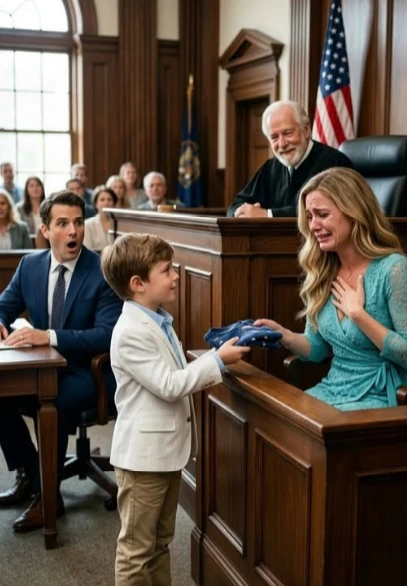
Judge Miriam Holloway leaned so far over her bench that one hand struck the gavel and sent it rolling across the polished wood.
“Oh, my God,” someone whispered behind me.
Grant’s smirk vanished.
His attorney, William Carroway, still held the enlarged photograph of Nolan’s “filthy” shirt. His arm slowly lowered until the picture hung uselessly beside his leg.
Nolan stood before the bench with his shirt raised to his chest.
His body trembled.
His voice did not.
“My dad did this,” he said.
Grant shot to his feet.
“That is a lie.”
Two deputies immediately moved toward him.
Judge Holloway’s face hardened.
“Mr. Cole, sit down.”
“He’s confused,” Grant said. “His mother has coached him.”
“I said sit down.”
“Your Honor, this is exactly what I warned you about. She has poisoned him against me.”
Nolan turned.
He looked directly at his father.
“I didn’t tell Mom.”
The courtroom became quiet again.
Grant’s lips parted.
Nolan lowered his shirt carefully, wincing as the cloth touched his skin.
“He said if I told her, he would make us sleep in the car again.”
My stomach dropped.
Again.
Grant had arranged that too.
The eviction.
The night Nolan and I spent in my twelve-year-old Honda behind a twenty-four-hour grocery store because every motel within thirty miles had suddenly “lost” our reservation.
I had believed it was another piece of bad luck in a life that had become a landslide.
Nolan had known better.
Judge Holloway turned toward me.
“Ms. Cole, were you aware of these injuries?”
“No, Your Honor.”
My voice cracked.
Nolan’s shoulders folded at the sound.
I wanted to run to him, wrap him in my coat, and apologize until the words lost all meaning.
But I could see the fear in his face.
May you like
PART 2: THE SECRET BEHIND JOHNNY, PAUL, AND LILY 041
Not fear of me.
Fear that I would blame myself and make his courage another burden he had to carry.
Judge Holloway looked toward the court clerk.
“Clear the courtroom. Contact the child advocacy center and emergency medical services. No one leaves this floor.”
Carroway found his voice.
“Your Honor, I object to this extraordinary overreaction.”
The judge slowly turned toward him.
“You just presented a photograph of an injured child as evidence of maternal neglect.”
“We had no knowledge of any alleged injury.”
Nolan spoke before the judge could respond.
“Yes, you did.”
Carroway’s face went still.
Nolan reached inside the pocket beneath the embroidered moon on his shirt.
He removed a tiny black device no larger than a matchbox.
A red light blinked on its side.
Grant stopped breathing.
I recognized it.
It was the digital recorder Nolan used for school spelling practice.
He placed it on the clerk’s desk.
“My dad said grown-ups believe lawyers instead of kids,” Nolan said. “So I brought his voice.”
Grant surged toward him.
The deputies seized him before he made it three steps.
“Give me that!” he shouted.
Nolan flinched but did not retreat.
Judge Holloway stood.
“Remove Mr. Cole from the courtroom.”
“You cannot do this!” Grant twisted against the deputies. “That recording was made illegally. He is eight years old. He doesn’t understand what he’s saying.”
Nolan looked at the judge.
“I understand.”
The deputies pulled Grant toward the side door.
His expensive shoes scraped across the floor.
His watch flashed beneath the fluorescent lights.
The last thing I saw before the door closed was his face.
Not angry.
Terrified.
Because Nolan had not simply shown the court what Grant had done.
He had recorded why.
The judge ordered everyone except court personnel, the parties, and emergency responders removed from the courtroom.
Nolan was taken into a private consultation room with a child advocate and a paramedic. I was allowed to follow only after a deputy photographed his injuries exactly as they appeared beneath the shirt.
Every flash felt like an accusation.
Not from Nolan.
From myself.
How had I missed them?
He had complained of stomach pain after returning from Grant’s house three days earlier. He had changed his clothes with the bathroom door locked. When I asked whether he had fallen, he said he was tired and crawled beneath his blanket.
I had believed him because the refrigerator was nearly empty, the electricity bill was overdue, and I had spent the night before filling out job applications on a phone with a cracked screen.
Grant had not only taken my money.
He had exhausted me until survival occupied every corner of my attention.
Then he had hidden his violence inside my exhaustion.
Nolan sat on an examination table while the paramedic lifted his shirt again.
I saw the full extent of the injuries.
The buckle imprint.
Thin parallel welts across his back.
Finger-shaped bruises on his upper arms.
A burn near his left side, small and circular.
The paramedic touched the skin around it gently.
“What caused this?”
Nolan looked toward the child advocate.
She nodded.
“You can tell us.”
Nolan’s good hand curled into a fist.
“My dad’s cigar.”
The room blurred.
I gripped the edge of a chair.
“He said boys who cry need to learn how to hold still.”
The paramedic closed his eyes for half a second.
The child advocate moved closer to Nolan.
“What happened before he hurt you?”
Nolan looked at me.
“Mom, I’m sorry.”
“No.”
I crossed the room and knelt in front of him, careful not to touch him until he nodded.
“You did nothing wrong.”
“I let them take the picture.”
“What picture?”
“The one in court.”
He pointed toward the door, where Carroway’s enlarged photograph remained on an evidence cart.
“Dad gave me the shirt at his house. He rubbed black stuff on it and said I had to wear it when we went near the school.”
My throat tightened.
“He stained it himself?”
Nolan nodded.
“There was a man with a camera waiting across the street.”
The surveillance photograph had not captured accidental neglect.
It had been staged.
Grant had purchased the shirt—or taken it from my laundry—smeared it with grease, and arranged for a private investigator to photograph Nolan wearing it.
“Why didn’t you take it off when you came home?”
“I needed you to wash it.”
“I don’t understand.”
“The black stuff had a smell. I thought maybe the police could find out what it was.”
My eight-year-old had preserved evidence because he believed the adults around him might need help seeing the truth.
I lowered my head.
“Nolan…”
“And I needed the same shirt for court,” he continued. “Dad told Mr. Carroway they were going to show the picture today.”
Everyone in the room became still.
“How did you hear that?” the advocate asked.
“I was in Dad’s office.”
“Were they speaking in front of you?”
“They thought I was asleep on the couch.”
Nolan looked toward the recorder.
“So I turned it on.”
The advocate exchanged a glance with the paramedic.
“Did your father know you had the recorder?”
“No.”
“Did anyone tell you to record him?”
“No.”
His gaze returned to me.
“Mom didn’t know anything.”
Judge Holloway entered with the court clerk and a woman from the district attorney’s office.
The judge had removed her robe. Without it, she looked less distant, but no less formidable.
“Mr. Carroway has requested that the recording be suppressed and sealed,” she said.
The prosecutor beside her spoke.
“He claims attorney-client privilege.”
Nolan frowned.
“What does that mean?”
“It means lawyers and clients are normally allowed to speak privately,” the child advocate explained.
“But they were planning to lie.”
Judge Holloway looked at him.
“That may change things.”
The prosecutor held out an evidence bag.
“Nolan, with your permission, we would like to copy the recording without altering the original.”
He looked at me.
I nodded.
“Yes,” he said.
The recorder was sealed and taken away.
Judge Holloway crouched so she was closer to Nolan’s height.
“You did something very brave today.”
Nolan looked down.
“I was scared.”
“Brave people usually are.”
His eyes filled.
“Are you going to send me to my dad?”
“No.”
The judge answered without hesitation.
“I am suspending all visitation immediately. You will remain with your mother while we investigate.”
Nolan’s entire body sagged.
I caught him carefully.
He pressed his face into my shoulder, avoiding his bruised ribs.
For the first time that morning, he cried.
Not loudly.
Not dramatically.
He made the quiet, exhausted sounds of a child who had spent too long trying to act like an adult.
I held him and looked over his head at the judge.
“Thank you.”
Her expression remained grave.
“This is not over, Ms. Cole.”
I thought she meant the custody case.
She did not.
She looked toward the sealed recorder being carried down the hall.
“I suspect we have only seen the smallest part of what your former husband has done.”
The first audio file began at 6:13 p.m. three nights before the hearing.
Grant’s voice was unmistakable.
“Hold still.”
Nolan whimpered.
“I don’t want that on my shirt.”
“It is grease, not acid.”
“Mom bought it for my birthday.”
A slap cracked through the recording.
I stopped breathing.
Grant spoke again.
“Your mother bought nothing. I bought every meal she ever fed you, every bed you ever slept in, and every breath she takes pretending she can survive without me.”
A second voice entered.
Carroway.
“Grant, leave the boy alone. We have the photograph.”
The lawyer’s tone did not contain shock.
It contained annoyance.
Grant laughed.
“He needs to understand why he is wearing it.”
Carroway lowered his voice.
“The investigator got the angle we needed. Dirty shirt, old shoes, slumped posture. It looks exactly like neglect.”
The prosecutor paused the file.
We were gathered in Judge Holloway’s chambers: the judge, the prosecutor, a court reporter, my temporary legal aid attorney, and two investigators from the Tennessee Bureau of Investigation.
Carroway had been placed in a separate room.
Grant remained detained by court security while police obtained emergency warrants.
Nolan was at the hospital with a child advocate.
I had refused to leave until I heard the recording.
The prosecutor resumed playback.
Nolan’s recorded voice trembled.
“Why are you trying to take me from Mom?”
Grant answered.
“Because your mother needs to learn that leaving me has consequences.”
“You already took her money.”
“She took my son.”
“I’m not yours.”
A heavy impact sounded.
Then Nolan cried out.
My attorney reached toward the recorder.
“We can stop.”
“No.”
I needed to hear what my son had survived alone.
Grant’s breathing became loud.
“You will never say that again.”
Carroway spoke.
“Grant, that is enough.”
“Do not tell me what is enough.”
“We have a hearing in seventy-two hours. Marks on him could compromise the petition.”
Grant laughed.
“Not if they stay under the shirt.”
Judge Holloway’s hand tightened around her pen.
The recording continued.
Carroway said, “The mother’s counsel may request an interview.”
“She cannot afford counsel.”
“She qualified for legal aid.”
“I already dealt with that.”
A pause.
“How?”
“The same way I dealt with her job.”
Carroway cursed softly.
“You should not discuss that in front of the child.”
“He won’t repeat it.”
Grant’s voice moved closer to the recorder.
“Will you, Nolan?”
Silence.
A blow.
“No,” Nolan whispered.
“That’s my boy.”
I stared at the desk until the wood grain became a meaningless pattern.
Grant had arranged my termination.
I had suspected it.
But suspicion was something a desperate woman could be accused of inventing.
His voice made it fact.
The prosecutor continued the file.
Carroway asked, “What did you tell the hospital?”
“That she stole patient records.”
I had worked as an accounts supervisor at a private surgical center. I had been dismissed after anonymous evidence supposedly showed that I accessed celebrity patient files.
I had never seen those files.
My supervisor refused to explain how my login credentials appeared in the system.
Grant’s voice continued.
“The administrator owed me after the malpractice settlement. He placed the access logs where they needed to be.”
Carroway said, “That creates unnecessary exposure.”
“It creates unemployment.”
“And the landlords?”
“Three were easy. One needed cash. The last one had a zoning violation.”
He said it casually.
As though he were describing restaurant reservations.
Carroway exhaled.
“You have already achieved substantial financial pressure. The court does not need to know every detail.”
“The court won’t.”
Grant paused.
“Once I have custody, she will sign anything to see Nolan.”
“What do you want her to sign?”
“The revised property settlement. The nondisclosure agreement. A statement withdrawing her accusations about hidden assets.”
The prosecutor paused the audio again.
“What hidden assets?” one investigator asked me.
“I don’t know.”
“Did you accuse him of concealing money during the divorce?”
“Yes. His company reported almost no profit, but he bought the watch, a lake house, and a plane share through businesses he claimed belonged to clients.”
“What company?”
“Cole Strategic Holdings.”
The second investigator opened a laptop.
“The company’s public filings show it is nearly insolvent.”
I laughed once.
It sounded bitter and unfamiliar.
“Grant has been nearly insolvent on paper since the day I filed for divorce.”
Judge Holloway looked toward the investigator.
“Find the money.”
The audio resumed.
Nolan’s voice was quieter.
“Mom says stealing is wrong.”
Grant replied, “Poor people call it stealing. Rich people call it structuring.”
Carroway gave a short laugh.
The sound ended his career.
Grant continued.
“The judge sees a woman with no job, no permanent address, and a neglected child. She sees me in a suit. She does not need to understand anything else.”
Judge Holloway stopped the recording herself.
Her face had become white with anger.
“He used this court as a weapon.”
The prosecutor shook her head.
“He used everyone.”
“There is more,” the investigator said.
He checked the recorder’s file list.
“Fourteen audio files.”
The next recording began inside a car.
Grant was speaking on the phone.
A woman’s voice answered through the speakers.
“Did she receive the eviction notice?”
“Yes.”
“Will she go to her sister?”
“She has no sister.”
“What about her mother?”
“Dead.”
“And friends?”
“I handled the useful ones.”
I recognized the woman’s voice.
Grant’s mother, Patricia Cole.
She had testified during our divorce that Grant was “generous to a fault” and that I was mentally unstable.
Patricia continued.
“What if she asks the court for emergency support?”
“Carroway will delay it.”
“Your father thinks this is becoming excessive.”
“My father still believes she should be treated like a person.”
A pause.
Patricia’s voice hardened.
“She humiliated this family.”
“She left me.”
“She exposed the affair.”
“She photographed it.”
“And now she will learn what photographs can do.”
The prosecutor glanced toward the staged image of Nolan.
The strategy had been Patricia’s.
Not merely to take my son.
To use a photograph as revenge for the photograph that ended my marriage.
Two years earlier, I found Grant in a hotel with his assistant. When he denied it, I showed him the picture I had taken through the open suite door.
He stared at the image for a long time.
Then he looked at me and said, “You have no idea what you just started.”
I had thought he meant the divorce.
He meant the destruction of my life.
At 11:40 that morning, police searched Grant’s home.
They found the monogrammed belt in his bedroom.
The buckle matched the injury on Nolan’s body in size, shape, and lettering.
In the garage, investigators found the container of industrial grease used to stain the shirt.
Beside it sat a camera bag belonging to the private investigator who took the photograph.
The camera’s memory card contained sixty-three images.
Nolan standing near the school.
Nolan being ordered to slump.
Grant gripping the back of his neck.
Carroway examining the images on a laptop.
And one photograph taken accidentally through the window of Grant’s study.
On the desk lay a printed document titled:
PROJECT ORPHAN.
That was the name Grant had given his campaign against me.
Not divorce strategy.
Not custody preparation.
Project Orphan.
Investigators found the complete file encrypted on Grant’s computer.
It contained a timeline of every action taken against me over two years.
The anonymous complaint that cost me my job.
Payments to former landlords.
Fake online reviews accusing me of theft.
Emails sent to employers warning them that I was unstable.
A fabricated report claiming I left Nolan alone overnight.
Photographs of my car.
My bank records.
My medical records.
A list of every person who had helped me, with notes beside their names.
PRESSURE.
DISCREDIT.
REMOVE.
My attorney, a soft-spoken woman named Elena Park, studied the file in silence.
“He did not merely retaliate,” she said. “He created a private system designed to isolate you.”
“Can we prove he created it?”
“The records came from his computer.”
“He will say someone planted them.”
“The metadata spans twenty-six months. Payments connect to his accounts.”
“He claims those accounts aren’t his.”
Elena looked toward the forensic investigator.
“They will be.”
The Rolex became the first thread.
Grant had claimed in court filings that it was borrowed from a friend.
The serial number showed it had been purchased through a company called Volunteer Education Services.
The same company owned the lake house.
It paid the lease on his Mercedes.
It funded the private investigator.
And its sole listed beneficiary was an educational trust created for Nolan.
Grant had hidden millions of dollars inside his son’s name while refusing to pay child support.
By midnight, investigators had identified eleven related companies.
By the following afternoon, they had located more than twelve million dollars in concealed marital assets.
One transfer appeared repeatedly.
A monthly payment of eighteen thousand dollars to a consulting company owned by Carroway’s wife.
Another paid the surgical center administrator who manufactured the evidence that cost me my job.
A third paid a county employee who delayed my housing assistance applications.
Grant had not simply used his wealth to starve us.
He had hired a network.
And the network had documented its invoices.
Nolan remained in the hospital overnight.
I sat beside him while snow began falling outside the window.
He had been given pain medication, but he fought sleep.
“What if Dad comes?”
“He won’t.”
“What if the judge changes her mind?”
“She won’t.”
“What if his lawyers tell everyone I lied?”
“They may try.”
His eyes widened.
I reached for his hand.
“That does not mean anyone will believe them.”
“They believed him before.”
The truth of that silenced me.
Grant had been believed by employers, landlords, administrators, and court officials because he spoke calmly, wore expensive clothes, and understood which documents made cruelty appear procedural.
Nolan had watched the world reward his father’s confidence.
No promise from me could erase that.
So I told him the truth.
“Some people believed him because they did not look closely enough.”
“Did you?”
“At first.”
He turned his face away.
The movement wounded me, but I did not defend myself.
“I knew your dad could be cruel,” I said. “I didn’t know he was hurting you.”
“I tried not to let you know.”
“Why?”
“He said you would fight him.”
“I would have.”
“He said you’d lose.”
Nolan looked back at me.
“He said you always lose.”
I moved my chair closer.
“Your father thinks winning means making everyone else afraid.”
“He has money.”
“Yes.”
“He has lawyers.”
“Yes.”
“And we don’t.”
“We have the truth.”
Nolan frowned.
“That doesn’t always win.”
“No.”
I would not insult him with a fairy tale after what he had endured.
“But today, you gave the truth evidence. That made it harder to bury.”
He looked toward the dark window.
“Are you mad I didn’t tell you?”
“No.”
“Sad?”
“Yes.”
“Because I lied?”
“Because you thought you had to protect me.”
His face crumpled.
“I didn’t want us to be homeless again.”
I climbed carefully onto the edge of the bed and held him.
“You are the child,” I whispered. “You never have to save me.”
“But I did.”
The words were simple.
Undeniable.
He had saved me from losing him.
He had saved the court from believing a manufactured lie.
He had possibly saved other families from the network Grant had built.
I closed my eyes.
“Yes,” I said. “You did.”
Nolan’s small body relaxed against me.
“But that was never supposed to be your job.”
Grant’s criminal attorneys moved quickly.
They claimed the injuries occurred while Nolan was under my care.
They argued the recorder had been manipulated.
They accused me of parental alienation, evidence fabrication, emotional instability, and coaching a minor witness.
Then the medical examination destroyed their first argument.
Several bruises were dated to the precise weekend Nolan had been in Grant’s exclusive care.
The cigar burn contained residue matching a brand found in Grant’s study.
The buckle imprint matched his belt.
The grease on the shirt matched the container in his garage.
The audio files contained continuous metadata and background sounds placing Grant inside his home.
The staged photograph’s original files included location and time data contradicting Carroway’s courtroom description.
Grant had claimed the image showed Nolan leaving school under my supervision.
It was taken on a Sunday.
The school was closed.
Nolan had been with Grant.
Carroway withdrew from the custody case.
He was arrested three days later for conspiracy, evidence tampering, obstruction, and suborning false testimony.
As deputies led him from his office, reporters asked whether he regretted displaying the photograph.
He answered, “I relied on information provided by my client.”
The recorder captured his own voice directing the photographer to crop Grant from the image.
His defense lasted six minutes.
Patricia Cole was arrested after investigators found messages instructing landlords to reject my applications.
The surgical center administrator resigned before being charged with computer fraud and conspiracy.
My former employer issued a public statement declaring that “newly discovered evidence raised concerns” about my termination.
They offered me my job back.
I declined.
Not because I could afford pride.
I still had forty-three dollars in my bank account and an overdue electric bill.
But the same executives who had dismissed me without a real investigation now wanted me to return because keeping me fired had become embarrassing.
I accepted a settlement instead.
The amount paid our debts, secured an apartment, and created enough breathing room for me to think beyond the next meal.
Grant’s concealed accounts were frozen.
Judge Holloway ordered temporary support from the trust he had hidden in Nolan’s name.
For the first time in two years, I entered a grocery store without calculating which meal I would skip.
Nolan placed a box of cereal in the cart.
Then another.
He looked at me cautiously.
“Can we get both?”
“Yes.”
He smiled.
I turned away and pretended to examine soup labels until I could breathe again.
The final custody hearing took place four months later.
The same courtroom felt different.
Perhaps because Grant was not wearing his charcoal suit.
He appeared by video from the county detention center in an orange uniform, his face pale beneath the fluorescent lights.
His Rolex was gone.
So was the confidence it had represented.
Nolan did not attend.
Judge Holloway had ruled that he had already carried more of the case than any child should.
Instead, the child advocate read a short statement he had written.
“My name is Nolan Cole. I love my mom. She washed my shirt three times because she thought the stains were dirt. She didn’t know they were from my injuries because I hid them.
“My dad said being rich meant he could decide what was true.
“I want to live with my mom because she listens when I say I am scared. I do not want to see my dad until people who know about hurting children say it is safe.
“I also want everyone to stop calling the shirt dirty. It was my birthday shirt.”
Judge Holloway removed her glasses.
She placed them on the bench and looked toward Grant’s image.
“Mr. Cole, this court previously considered evidence portraying your former wife as impoverished, unstable, and incapable of providing appropriate care.”
Grant’s attorney stood.
“Your Honor, the criminal allegations remain unresolved.”
“I am aware.”
The judge continued.
“We now know that much of the financial instability cited against Ms. Cole was deliberately created by you.”
Grant leaned toward the camera.
“That has not been proven beyond a reasonable doubt.”
“This is not your criminal trial. The standard here is different.”
“She turned my son against me.”
Judge Holloway’s expression hardened.
“Your son recorded you beating him.”
“He was coached.”
“Your former wife did not know the recording existed.”
“She could have—”
“Mr. Cole.”
Her voice cut through his.
“You stained your child’s clothing, arranged surveillance photographs, and presented the resulting image as evidence that his mother neglected him. You concealed marital property, interfered with her employment, compromised her housing, and then cited the deprivation you engineered as grounds to take her child.”
Grant stared at the screen.
“You created the danger and asked this court to punish her for surviving it.”
No one moved.
Judge Holloway picked up the custody order.
“Ms. Cole is awarded sole legal and physical custody. Mr. Cole’s parental contact is suspended indefinitely, subject to future review only after completion of a certified intervention program, a full psychological evaluation, resolution of the pending criminal matters, and a finding that contact would not endanger the child.”
Grant’s face twisted.
“You cannot erase me as his father.”
“No,” Judge Holloway said. “Only your actions can do that.”
She signed the order.
The sound of the pen scratching across paper was quieter than a gavel.
It felt louder.
Grant struck the table in the detention room.
“You think she won?”
The judge looked directly into the camera.
“This is not a prize awarded to one parent over another. It is a child being removed from danger.”
He pointed toward me through the screen.
“She has nothing without my money.”
For two years, that sentence had ruled my life.
It had followed me through eviction notices, rejected applications, empty cupboards, and nights when I told Nolan I had already eaten.
Now I understood its weakness.
Grant believed money was the only thing he had taken from me because money was the only thing he knew how to value.
I stood.
“I have Nolan.”
The deputies in the detention room moved toward him.
I picked up my copy of the order.
“And you no longer have either of us.”
Grant eventually pleaded guilty to aggravated child abuse, conspiracy, fraud, evidence tampering, stalking, and multiple financial crimes.
The plea spared Nolan from testifying at a criminal trial.
Grant received nineteen years.
Carroway received six.
Patricia received probation and home confinement after cooperating, a sentence I considered insulting until the civil judgments stripped away the wealth she had spent her life protecting.
The hidden assets were divided, restitution was ordered, and Nolan’s stolen trust was placed under independent management.
Grant’s lake house was sold.
His plane share was sold.
The Mercedes was sold.
The Rolex was seized as evidence and later auctioned.
The watch he flashed in court to remind me how powerless I was paid for nearly a year of trauma therapy for children affected by domestic violence.
Nolan thought that was funny.
“Dad finally helped somebody,” he said.
Then he looked guilty for laughing.
I told him he was allowed.
Healing did not always arrive solemnly.
Sometimes it wore dinosaur pajamas and laughed at terrible irony.
The navy-blue shirt remained in evidence for almost a year.
When it was finally released, an officer delivered it in a sealed paper bag.
I placed it on the kitchen table.
The dark grease stains remained.
So did the cut along the side where paramedics had examined Nolan’s injuries.
“Can we throw it away?” I asked.
Nolan touched the embroidered moon.
“No.”
I waited.
He carried the shirt to his room and returned with a pair of scissors.
Together, we cut away the stained fabric.
He kept the small pocket with the moon.
The rest went into the trash.
A week later, he stitched the pocket onto a clean gray backpack.
The sewing was crooked.
He refused to let me fix it.
“That’s where the recorder was,” he said. “It’s the part that told the truth.”
I did not tell him that he had been the one who told it.
He already knew.
A year after the hearing, I began working for a nonprofit legal clinic that helped parents respond to financial abuse during custody disputes.
I understood the forms.
The missed payments.
The sudden terminations.
The landlords who changed their minds without explanation.
The way a person with money could create poverty around someone else and then point to that poverty as proof of moral failure.
Women arrived carrying boxes of bank statements and apologies.
Men did too.
Abuse was not loyal to one gender, but it was always loyal to power.
My first question was never, “Why didn’t you leave?”
It was, “What did they make impossible after you did?”
Nolan grew taller.
The bruises faded.
The scar from the cigar burn did not.
For months, he covered it when changing for gym class. Then one day he stopped.
A boy asked what happened.
Nolan said, “Someone hurt me, and then I told.”
That was all.
He did not owe anyone the rest.
On the second anniversary of the custody decision, Judge Holloway invited Nolan to visit the courthouse after hours.
He stood in front of the same bench where he had lifted his shirt.
The room was empty now.
No cameras.
No lawyers.
No father smirking across the aisle.
The judge handed him a small wooden box.
Inside was the gavel she had nearly knocked over when she saw his injuries.
“I replaced it,” she explained.
Nolan held the handle carefully.
“Why are you giving it to me?”
“To remind you that telling the truth can change what happens next.”
He examined the worn wood.
“Did I win the case?”
Judge Holloway smiled sadly.
“You should never have been responsible for winning it.”
He looked toward me.
“But I helped.”
“Yes,” she said. “You helped everyone see.”
On the drive home, Nolan kept the box on his lap.
“Mom?”
“Yes?”
“Was I really dirty?”
I pulled the car to the side of the road.
For a moment, I could not speak.
Then I turned toward him.
“No.”
“The shirt was.”
“The shirt was stained.”
“Same thing.”
“No, sweetheart.”
I reached across the console and took his hand.
“Dirt is something that gets on you. It is not what you are.”
He thought about that.
“Dad tried to make people think the stains were your fault.”
“Yes.”
“But he put them there.”
“Yes.”
Nolan looked through the window at the passing winter fields.
“That’s what he did with everything.”
I stared at my son.
At eight years old, he had understood Grant’s entire method.
Create the damage.
Photograph the damage.
Blame the person struggling to clean it.
“Yes,” I said. “That is exactly what he did.”
Nolan squeezed my hand.
“But we know now.”
We did.
And knowledge did not restore every lost job, meal, home, or night of sleep.
It did something more useful.
It taught us where the stains came from.
People later told the story as though my son had transformed inside that courtroom.
They said he became brave when he stood before the judge.
They were wrong.
Nolan had been brave each time he returned from his father’s house and tried to protect me from another disaster.
He had been brave when he hid the recorder beneath the embroidered moon.
He had been brave while Grant stained his birthday shirt and Carroway planned to display it as proof of neglect.
Standing up was not the beginning of his courage.
It was the first time the adults in the room were forced to witness it.
Grant entered family court believing poverty would make me look guilty.
He believed a tailored suit looked like stability.
He believed an expensive watch looked like responsibility.
He believed a photograph could become truth if the person holding it charged enough per hour.
Most of all, he believed our son was too frightened to speak.
That was his final mistake.
Because beneath the faded shirt Grant used to humiliate us was the evidence of every lie he had built.
Bruises shaped like his initials.
A recording of his own voice.
And an eight-year-old boy who had finally understood something his father never would:
Being powerful is not the same as being believed forever.
Before that hearing, Grant had taken my savings, my home, my career, and nearly my child.
By sunset, his accounts were frozen.
By the end of the week, his lawyer was under investigation.
By the end of the year, the watch was gone, the mansion belonged to someone else, and the courtroom photograph that was supposed to destroy me had become evidence of his conspiracy.
But none of those losses frightened him as much as the moment Nolan stood.
Because Grant could hide money.
He could purchase testimony.
He could manufacture poverty and hire men to photograph the result.
What he could not survive was the one thing he had spent years trying to eliminate:
A child who was no longer afraid of telling the truth.
See more on the next page
