Gene approached a built-in bookcase.
She removed three books.
Behind them was a narrow brass keyhole.
Brandon slowly pulled the key from his pocket.
The key from Holly’s red box.
“You said it was for Box 317.”
“It is.”
“And this?”
“Your father loved redundancies.”
Brandon inserted the key.
It turned.
A hidden panel clicked open.
Behind the bookcase was a shallow wall compartment.
Inside sat a wooden box.
Brandon removed it.
On top was an envelope.
His name.
Below that, another.
FOR THE CHILD WHO OPENED THE DOOR.
Brandon sat in his father’s chair.
His hands shook.
“I thought I found everything.”
Gene whispered, “So did I.”
He opened his envelope.
Inside was a letter.
He read silently at first.
Then aloud.
“Brandon,
“If you are reading this, your mother has probably proven me right, which is not something I take pleasure in writing.”
Gene closed her eyes.
Brandon continued.
“I spent too much of my life believing I could keep peace by leaving hard truths for another day. If you inherit anything useful from me, let it be the courage to stop doing that.”
Brandon swallowed.
“There are two kinds of inheritance. Money is the smaller one.”
He looked at me.
Then kept reading.
“The larger inheritance is what a family teaches its children to tolerate.”
Gene began crying silently.
“I watched your mother make Rachel earn a place she should have been given freely. I confronted her privately because I feared embarrassing her publicly. That was cowardice disguised as loyalty.”
Brandon’s voice cracked.
“I will not make the same mistake with the next child.”
He paused.
The next lines were underlined.
“If Gene ever refuses to call your child family, do not waste years persuading her. Believe what she has shown you.”
Brandon covered his mouth.
I touched his shoulder.
He continued after a moment.
“The trust has been structured so that any adopted descendant receives equal standing immediately. If this exposes wrongdoing, then the wrongdoing deserved exposure.”
Gene sat down heavily.
“And one more thing,” Brandon read.
“If the child is old enough to understand why the key matters, the final envelope belongs to them. Do not open it first.”
Brandon lowered the letter.
We looked at the second envelope.
FOR THE CHILD WHO OPENED THE DOOR.
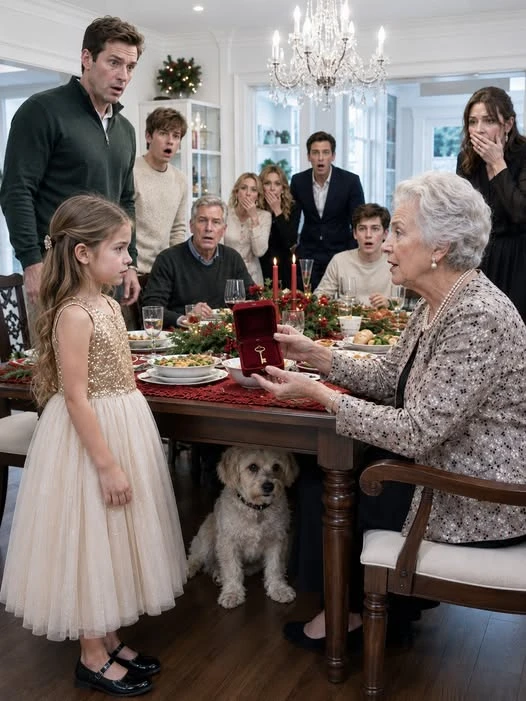
Holly.
We brought it home.
We didn’t open it.
For three days Holly ignored the envelope sitting on our bookshelf.
Then one evening she climbed onto the sofa beside Brandon.
“Is that Grandpa Robert’s?”
“Yes.”
“For me?”
“Yes.”
“Can you read it?”
“Only if you want.”
She thought about it.
“Okay.”
He opened it carefully.
Inside was a single sheet.
Robert had written it before Holly existed.
Before he knew whether the child would be a boy or girl.
Before he knew the child’s name.
Brandon read.
“To the child holding this letter,
“I don’t know who you are.”
Holly smiled.
“He doesn’t?”
“No.”
“Keep going.”
“I don’t know when you joined this family, where you came from, what you look like, or what name you answer to.”
Brandon paused.
“But if someone gave you this letter, then there is one thing I know.”
His voice shook.
“You were chosen.”
Holly stopped smiling.
Brandon continued.
“Some people will tell you blood is what makes a family. Blood can make relatives. It cannot make kindness. It cannot make loyalty. It cannot make someone stay.”
I wiped my eyes.
“The person who gave you this key may have been afraid to stand against someone they loved. If they stood anyway, forgive them for taking so long.”
Brandon couldn’t continue.
I took the letter.
“Your place in a family should never depend on your willingness to tolerate humiliation.”
Holly stared at me.
“If someone calls you a guest where you have been given a home, remember this: sometimes the bravest thing a person can do is stop asking to be invited.”
I looked at Brandon.
The final paragraph read:
“The key does not belong to the house, the bank, or anything money can buy.
The key belongs to the first person in this family brave enough to close one door so a better one can open.
Keep it.”
Holly looked at the little brass key in Brandon’s palm.
Then she took it.
“Can I put it on my backpack?”
Brandon laughed through tears.
“Absolutely.”
Gene moved out of Hawthorne Lane in February.
Not because Holly demanded it.
Not because Brandon screamed for revenge.
Because the trust terms were clear.
Gene’s breach of fiduciary duty terminated her automatic occupancy right.
The independent trustee could have allowed her to remain.
Brandon was consulted.
So were Evan and other adult beneficiaries.
Brandon said no.
When Gene asked why, he told her, “Because Holly should never have to enter a house where she needs armor.”
Gene moved into a condominium fifteen minutes away.
For the first time in decades, Hawthorne Lane sat empty.
The family trust eventually decided to sell it.
Brandon refused the opportunity to buy.
“You don’t want your childhood home?” I asked.
He looked at the enormous house through the windshield.
“No.”
“Why?”
“Too many people confused that place with family.”
The house sold in May.
The money returned to the trust.
The audit expanded.
Melissa eventually admitted forging nine authorizations.
She negotiated a plea agreement requiring restitution, probation, community service, and financial monitoring.
She and Daniel sold their vacation property.
Their daughters left private school.
The world did not end.
That fact seemed to surprise everyone.
Evan voluntarily returned money traceable to improper distributions even though he had never known their source.
Brandon did the same.
Gene sold jewelry.
A car.
Several investments.
By autumn, nearly seventy percent of the missing money had been restored.
But money was the easy part.
Family was harder.
Gene sent birthday cards to Holly.
The first one arrived in March.
The envelope said:
HOLLY MERCER.
Not “Brandon’s girl.”
Not “guest.”
Holly opened it.
Inside was fifty dollars and a note.
I am sorry.
Holly brought it to me.
“Do I have to forgive her?”
“No.”
“Will Dad be sad if I don’t?”
“No.”
“Will Grandma?”
“Probably.”
She considered that.
Then asked the question that proved she understood more than any adult had given her credit for.
“Is being sorry the same as being safe?”
I stared at her.
“No.”
She nodded.
“Okay.”
She placed the card in a drawer.
She did not call Gene.
Months passed.
Gene attended therapy.
I knew because she told Brandon in one of the emails he allowed himself to read.
She stopped saying she had “made mistakes” and began naming them.
I excluded Holly.
I protected Melissa.
I lied about the trust.
I prioritized appearances over people.
I punished a child because her legal recognition threatened a secret.
Brandon did not immediately reconcile.
Neither did I.
Forgiveness wasn’t a password that reopened every locked door.
Sometimes it only meant you stopped carrying the door on your back.
The next Christmas approached.
Holly was eight.
She asked if we were going to Grandma Gene’s.
“No,” Brandon said.
“Is she coming here?”
“No.”
Holly nodded.
Then two days before Christmas she came into our bedroom carrying the brass key.
“Can Grandma come for one hour?”
Brandon sat up.
“Why?”
“I want to see if she’s different.”
“You don’t have to test people.”
“I know.”
“Then why?”
Holly shrugged.
“Because I want to.”
He looked at me.
I said, “One hour.”
Gene arrived at four o’clock Christmas Eve.
She carried no giant shopping bags.
No elaborate presents.
No performance.
She brought a pie.
And a small gift for Holly.
Holly eyed it suspiciously.
Gene noticed.
“You don’t have to open it.”
“I will.”
Inside was a wooden picture frame.
The photograph showed our family at Holly’s adoption celebration.
Me.
Brandon.
Holly.
On the bottom of the frame, engraved in small letters, were four words.
OUR GRANDDAUGHTER, HOLLY MERCER.
Holly stared.
Gene looked nervous.
“I should have said it sooner.”
Nobody rescued her from the silence.
That mattered.
In the old days, someone would have joked.
Changed subjects.
Smoothed the discomfort.
Now Gene sat inside it.
Holly finally asked, “Do you think I’m your granddaughter because Dad adopted me?”
Gene swallowed.
“Yes.”
Holly frowned.
“Only because of papers?”
Gene looked at Brandon.
He didn’t help her.
She looked back at Holly.
“No.”
“Why then?”
Gene’s eyes filled.
“Because I should have understood before the papers that you were already his daughter.”
Holly considered that.
“And?”
Gene almost smiled.
“And if you’re his daughter, you’re my granddaughter.”
Holly nodded.
Then said, “Okay.”
Gene blinked.
“Okay?”
“I’m still mad.”
“You should be.”
“I don’t trust you yet.”
“I understand.”
“You can’t call me guest anymore.”
“I won’t.”
“Or Brandon’s girl.”
“I won’t.”
Holly looked at her father.
Then back at Gene.
“One hour.”
Gene nodded.
“One hour.”
It lasted fifty-three minutes.
That was enough.
After Gene left, Brandon stood at the window watching her car disappear.
“You okay?” I asked.
“I think so.”
Holly came up beside him.
“Dad?”
“Yeah?”
She held up the brass key.
“Grandpa Robert said it closes doors, right?”
“Sometimes.”
“What if you want to open one again?”
Brandon smiled.
“Then you check what’s on the other side first.”
Holly slipped the key into her pocket.
That should have been the end.
For a while, I thought it was.
I thought Robert’s hidden letter was the final secret.
I thought Melissa’s fraud was the shocking truth buried beneath years of Christmas gifts and family photographs.
I thought Gene’s fear of Holly came entirely from the trust.
I was wrong one last time.
The final revelation arrived the following April.
It came in an ordinary white envelope from First Mercer Bank.
Brandon opened it at the kitchen counter.
I was making coffee.
Holly was upstairs getting ready for school.
He read the first page twice.
Then sat down.
“Claire.”
Something in his voice made me turn.
“What?”
He handed me the letter.
It concerned the final inventory of Box 317.
During the bank’s transfer of materials to archival storage, a false bottom had been discovered inside the original metal document case.
Beneath it was one additional sealed envelope.
The handwriting belonged to Robert.
The envelope said:
FOR GENEVIEVE, WHEN SHE FINALLY TELLS THE TRUTH.
Genevieve.
Gene’s full name.
Brandon called her.
She came over that afternoon.
The envelope remained unopened on our dining table.
Gene stared at it for nearly a minute.
“I thought he destroyed that too.”
Brandon’s face hardened.
“You keep saying that.”
Gene sat.
“What truth?”
She didn’t answer.
I felt the old dread returning.
Brandon slid the envelope toward her.
“Open it.”
Her hands trembled.
Inside was a photograph.
Gene looked at it.
Then covered her mouth.
Brandon took the photograph.
It showed Gene at perhaps twenty years old.
Beside her stood Robert.
Between them was a little boy.
Maybe three.
Dark hair.
Serious eyes.
On the back Robert had written a date and a name.
JAMES.
Brandon frowned.
“Uncle James?”
Gene nodded.
“But why is this hidden?”
She began crying.
“Because James wasn’t Robert’s biological son.”
Brandon stared.
“What?”
“Robert adopted him.”
I felt the air leave the room.
Brandon didn’t speak.
Gene continued.
“I had James before I met your father.”
“What happened to his father?”
“He left.”
“And Dad adopted James?”
“When he was four.”
Brandon looked stunned.
“But everyone always said—”
“I know what everyone said.”
Gene wiped her face.
“We let them assume.”
“Why?”
“Robert’s parents.”
Her voice shrank.
“They didn’t approve. They thought I was damaged goods. They thought James wasn’t really family.”
Brandon stared at her.
Gene laughed once bitterly.
“Your grandmother called him Robert’s charity case.”
I thought of Holly.
The candle.
The place card.
Guest.
Gene closed her eyes.
“Robert fought them for years.”
Brandon whispered, “And you became them.”
She began sobbing.
Not elegant tears.
Not controlled grief.
She bent over in the chair, shoulders shaking.
“I became them.”
Nobody comforted her.
Not because we wanted her to suffer.
Because some grief belonged to the person who had created it.
After a minute she unfolded Robert’s final letter.
Her voice failed, so Brandon read it.
“Gene,
“If you are reading this, then either you finally told the children about James or someone found what you tried to bury.”
Gene covered her face.
“You once asked me to destroy every record proving James was adopted.”
Brandon stopped.
He looked at her.
Gene whispered, “I was ashamed.”
“Of him?”
“No.”
“Then what?”
“Of what people said about me.”
Brandon looked disgusted.
He continued reading.
“I refused because James’s story is not your shame to erase.”
Gene closed her eyes.
“You know better than anyone what it is to watch a child treated as less because someone worships blood.”
Robert’s words seemed to fill the room.
“That is why I cannot understand the person you have become.”
Gene began shaking.
“I have watched you repeat my mother’s cruelty toward Rachel. I fear one day you will do it again.”
Brandon’s eyes filled.
“If that happens, the child you reject will carry the key.”
He stopped.
I put my hand over my mouth.
Robert had not merely predicted Gene’s behavior.
He had designed the key as a mirror.
Brandon continued.
“Not because that child needs my money.”
His voice broke.
“Because you need to see yourself.”
Gene whispered, “Robert.”
The final lines were the cruelest because they were written with love.
“Gene, if you ever look at an adopted child and call them less than family, remember that the oldest son whose graduation made you cry, whose wedding you planned, whose children you boast about, and whose photograph sits beside our bed was once exactly the kind of child you claim does not belong.”
Brandon lowered the letter.
Nobody spoke.
Then Holly entered the room.
We hadn’t heard her come downstairs.
She stood near the doorway wearing her school backpack.
The brass key dangled from its zipper.
Gene looked at it.
Then at Holly.
Holly looked at the photograph.
“Who’s that?”
Gene wiped her face.
“Your Uncle James.”
“He was little.”
“Yes.”
“Why are you crying?”
Gene seemed unable to answer.
Brandon said softly, “Grandma remembered something important.”
Holly walked closer.
“What?”
Gene looked directly at her.
For once, there was no performance.
No excuse.
No mention of generations or tradition.
She said, “I forgot that someone once did to my son exactly what I did to you.”
Holly frowned.
“Why’d you forget?”
Gene shook her head.
“I don’t think I really forgot.”
“Then what?”
Gene’s answer was barely audible.
“I think I decided remembering was inconvenient.”
Holly considered that.
Then looked at the photograph again.
“That’s worse.”
Gene nodded.
“Yes.”
Brandon almost smiled.
“Yes, it is.”
Holly adjusted her backpack.
“I have school.”
I checked the clock.
“We really have to go.”
She started toward the door.
Then stopped beside Gene.
“Grandma?”
Gene looked up.
“Yeah?”
Holly touched the brass key hanging from her backpack.
“Grandpa Robert gave me this because you were mean, right?”
Gene swallowed.
“In a way.”
Holly shook her head.
“No.”
We waited.
She looked at Robert’s letter.
“He gave it to me because he knew you might be mean.”
Gene’s face crumpled.
Holly continued.
“But I’m the one who used it.”
“Yes.”
“So Grandpa didn’t kick you out.”
Gene whispered, “No.”
“The bank didn’t?”
“No.”
“Dad didn’t?”
Brandon looked at her.
Holly shook her head.
“You did.”
Nobody said anything.
That seven-year-old girl had understood the entire story better than the adults who had spent years hiding pieces of it.
Gene had removed herself from our lives long before Holly ever placed the red box on the table.
The insults had done it.
The lies had done it.
The favoritism had done it.
The stolen money had done it.
The choice to protect appearances instead of children had done it.
The key had only opened the door wide enough for everyone to finally see.
Gene reached for her purse.
Before leaving, she stopped beside Holly.
“I don’t expect you to forgive me.”
Holly looked up.
“I already did.”
Gene froze.
So did I.
“When?”
“I don’t know.”
Holly shrugged.
“But forgiving isn’t the same as letting you do it again.”
Gene closed her eyes.
A tear slipped down her cheek.
“No.”
Holly gave her the smallest smile.
“It isn’t.”
Years later, when people asked Holly about the brass key she still kept in a small wooden box on her dresser, she never told them it had once opened a bank vault.
She never mentioned the Mercer trust.
She didn’t talk about the money.
Or the house.
Or the audit.
She told them it was a gift from a grandfather she had never met.
When she turned eighteen, the restored trust funded her first year of college.
She chose social work.
Gene laughed when she heard.
“Of course she did.”
By then, their relationship had become something neither of them forced.
Gene was never allowed to return to the position she once held in the family.
She didn’t control holidays.
She didn’t distribute gifts like royal decrees.
She didn’t decide who belonged.
She attended when invited.
She left when asked.
Sometimes consequences don’t disappear just because someone improves.
That was another lesson Holly taught us.
Melissa repaid the final dollar she owed shortly before Holly’s seventeenth birthday.
She and Brandon eventually spoke again.
Carefully.
Without pretending the past had vanished.
Evan became the loudest advocate for independent oversight of every family account.
And Uncle James?
That was the final beautiful piece.
When Brandon called him and told him everything, there was silence on the other end.
Then James said, “Dad kept the picture?”
“Yes.”
Another silence.
“Mom told me he’d thrown all that away.”
“He didn’t.”
James began crying.
He flew in two weeks later.
Holly met him at the airport.
James was sixty-three then, gray-haired, broad-shouldered, and nervous.
Holly held a cardboard sign that said UNCLE JAMES even though he obviously knew who we were.
When he saw the brass key hanging from her backpack, he stopped walking.
“You’re the kid?”
Holly grinned.
“What kid?”
“The one who finally scared Gene Mercer.”
Holly laughed.
“No.”
She pointed at Brandon.
“Dad scared her.”
Brandon shook his head.
“Absolutely not.”
James looked at me.
“You?”
“Definitely Holly.”
Holly rolled her eyes.
Then James knelt awkwardly in front of her.
“You know your Grandpa Robert would’ve loved you.”
Holly smiled.
“I know.”
“How?”
“He wrote me a letter.”
James’s eyes filled.
“Yeah?”
“Yeah.”
“What did he say?”
Holly thought.
Then she gave the answer I will remember until the day I die.
“He said being chosen counts.”
James covered his mouth.
Holly hugged him.
And in an airport terminal full of strangers, surrounded by rolling suitcases and flight announcements and people hurrying toward wherever they believed they belonged, our strange, damaged, rebuilt family stood together.
Not because everyone shared blood.
Not because every wound had healed.
Not because forgiveness had erased consequences.
We stood together because the people who mattered had finally learned the difference between being related and being family.
And it had taken a seven-year-old girl in a gold dress to teach us.
Sometimes I still think about that Christmas candle.
I kept it.
Holly doesn’t know.
It’s packed in a box in the back of my closet, still wrapped in the cheap tissue paper Gene used.
The vanilla scent is almost gone now.
The tag remains.
To Brandon’s Girl.
I once thought those words represented the cruelest moment of my daughter’s childhood.
Now I see them differently.
They were Gene’s final attempt to keep Holly outside a door that had already opened.
Because Holly was Brandon’s girl.
She was also mine.
She was Robert’s granddaughter by every principle he had cared enough to protect.
She became James’s favorite grandniece.
She became Gene’s granddaughter only when Gene finally learned the word had to mean more than possession.
Most importantly, she was Holly.
And that was enough.
On the morning she left for college, I found her standing beside her packed car.
The brass key hung from a chain around her neck.
“You still carry it?” I asked.
She looked down.
“Sometimes.”
“What does it open now?”
She smiled.
“Nothing.”
Then she reconsidered.
“Actually, that’s not true.”
“What?”
She touched the key.
“It reminds me I can leave any room where someone makes me beg to belong.”
I felt tears sting my eyes.
Brandon came outside carrying another suitcase.
“Who’s begging to belong?”
“Nobody,” Holly said.
“Good.”
He loaded the suitcase.
Then Holly hugged him.
Not a polite hug.
Not the careful kind.
She wrapped both arms around the man who had spent years choosing her before a judge ever made it official.
“You’ll still be my dad when I’m at college, right?”
Brandon groaned.
“Kid, we covered this when you were seven.”
“I want to check.”
He kissed the top of her head.
“Always.”
She smiled against his shirt.
Behind them, morning sunlight flashed across the little brass key.
And for the first time, I understood Robert Mercer’s final trick.
The key had never been designed to remove Gene from a house.
It had never really been about money.
It had never even been about exposing Melissa.
Robert had created something much harder to inherit.
A choice.
A way for the next generation to refuse the oldest lie in the Mercer family—the lie that love could be rationed, belonging could be ranked, and cruelty had to be tolerated simply because it came from someone who shared your name.
Gene thought the key would take her home.
Melissa thought it would expose stolen money.
Brandon thought it would enforce a trust.
I thought it would protect my daughter.
But Robert had understood the truth years before any of us.
The child holding the key would not inherit the power to throw someone out.
She would inherit the power to decide whom she let in.
And that changed everything.
See more on the next page
